All In on AI, but Only $29 a Month? What Happened at Accenture



A company that urges its clients to invest in AI has capped what it will pay for its own employees’ Claude use at $29 a month. That’s the Accenture story 404 Media reported on October 15. Some employees were reportedly already spending up to about $1,000 a month. So after telling everyone to use AI aggressively, is the company now telling them to cut back?
Accenture is the world’s largest consulting and IT services firm, with about 814,000 people. That figure is as of the end of fiscal 2026, per the company, and Accenture has built a bench of about 110,000 AI and data specialists as it grows AI adoption and business transformation into a core line of business.
That a firm like this would draw a line on AI spending is interesting in itself. But read the coverage a little more closely and the $29 cap doesn’t mean employees can’t use Claude beyond it. Usage above that amount is now charged to project and team budgets instead of the central budget. In my view, that’s close to the rational choice for a consulting firm’s business model. Encouraging AI use and asking where its cost should land, and how much, can go hand in hand.
Key Takeaways
1. The reported $29 a month is the level of central budget support. Usage above it goes to project and team budgets; it doesn’t mean individual employees automatically get the bill.
2. If a project uses AI to cut staffing or other costs, profitability can improve even as AI spending rises. What matters is the project’s total cost and results, not one line item.
3. Investing in a company-wide culture of AI use and paying to deliver a specific project are different costs that may belong to different owners. Loading both onto a single project is hard to justify.
The $29 Cap: What Exactly Is Being Limited?
According to The Next Web’s account, starting October 1, Accenture set centrally funded Claude usage at $29 per person per month. Anything above that is charged to a WBS (Work Breakdown Structure) code, the budget code for a project or team.
In effect, part of a cost the whole company used to carry has been assigned to the teams that actually use the tool. Accenture also told 404 Media it provides the tools people need for their work and continues to invest in AI skills and training. It’s hard to read this as the company abandoning AI or capping every employee’s usage at $29 a month.
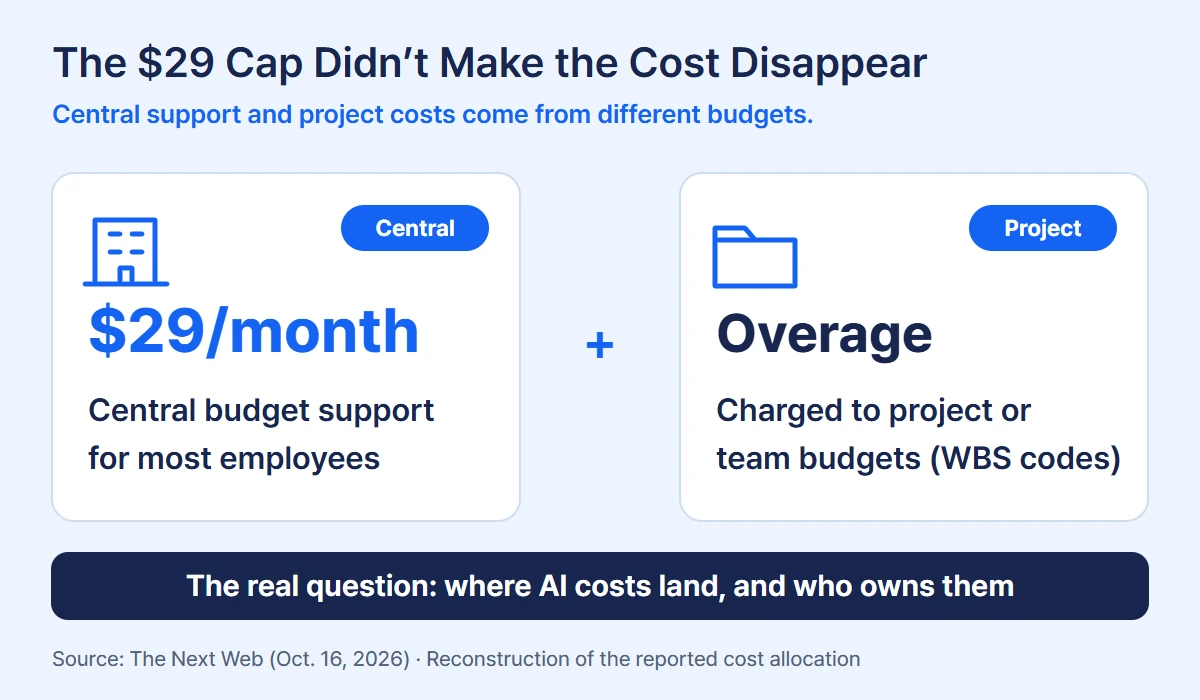
Once project leads see AI spending as their own team’s cost, they start rethinking how much to use. That doesn’t have to be read as a device for discouraging AI. For an organization that takes on client work, delivers results within a set timeframe, and measures the profit it makes on that work, weighing the cost of its tools is only natural.
This is where general debates about adopting AI inside a company need to be separated from the realities of a consulting firm. The fact that a company values AI doesn’t mean every project can keep increasing its AI spending without asking what it gets in return.
Higher AI Spending Can Still Mean a More Profitable Project
Consulting and IT services firms manage many project costs together, from the people and hours they put in to outside research. Even if AI spending goes up, the project can come out ahead if staffing or research costs fall by more. If a team delivers the same work with fewer resources while holding quality, that’s the kind of AI use that deserves credit.
On the other hand, if all a team can show is that it used a lot of AI, with no improvement in total cost or results, the company is right to ask why the money was spent. What matters is not the size of the AI bill but what the project got for it. Look at how much other costs came down, whether the deliverables got better, and whether time spent reworking output went up.
Higher AI spending isn’t waste just because it’s higher. But “the company says AI matters, so we used it” doesn’t make it a good expense, either.
Of course, how saved time turns into profit depends on the contract. In its fiscal 2025 annual report, Accenture describes several contract types, including time-and-materials arrangements and fixed-price contracts.
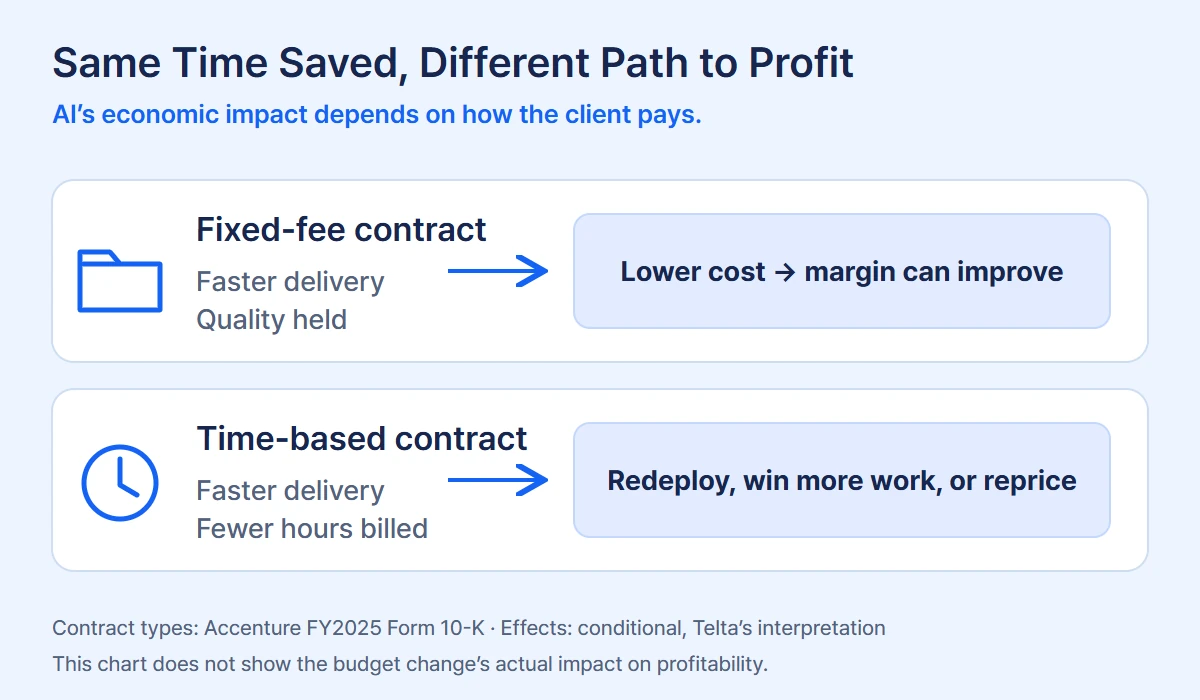
On a fixed-price engagement, cutting work hours while maintaining quality can help margins. On a contract billed by the hour, saving time doesn’t raise profit by the same amount. The outcome depends on whether the freed-up hours can go to other work and on the terms agreed with the client.
That’s why it’s hard to view charging AI costs to projects as a bad thing in itself. It lets project leads weigh contract terms and the resources they need together. And if a modest amount of AI spending seriously dents a project’s profitability, the first thing to revisit is where that money went and what it was expected to achieve.
Projects Can’t Carry the Burden of Company-Wide Investment
So who should pay for experiments whose payoff is still uncertain? Putting AI to work means testing different approaches and reviewing the results. What one team learns may carry over to the next project. Not every attempt can be justified by the profit and loss of the first project alone.
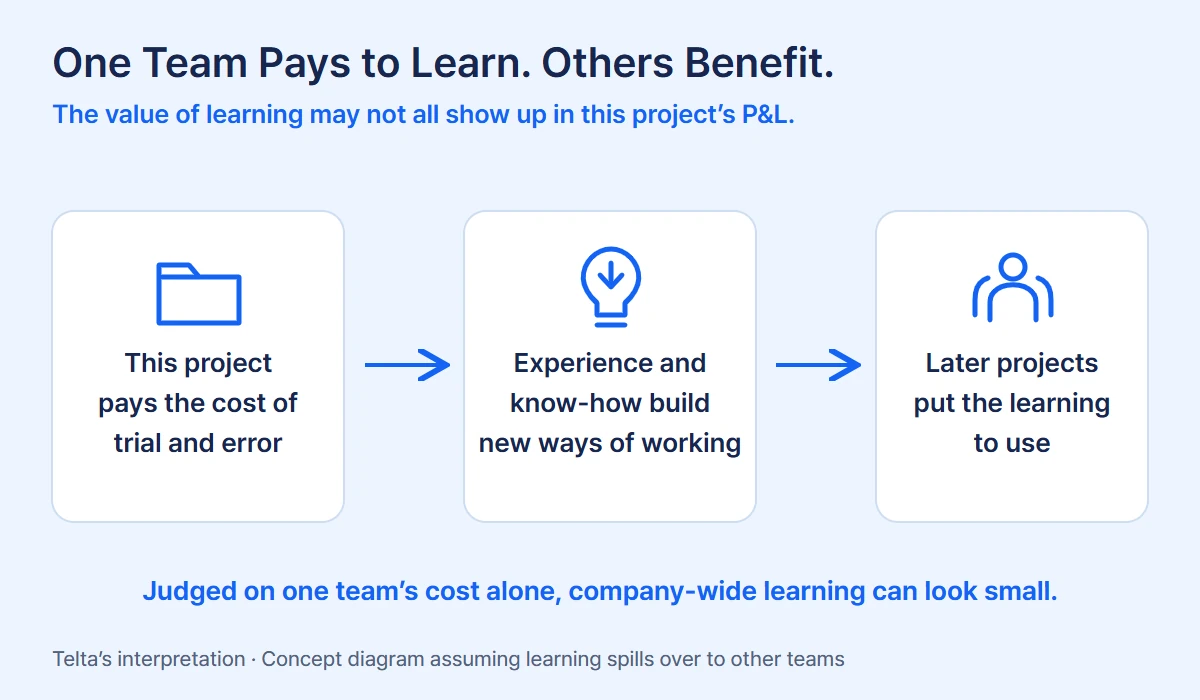
Still, a project team with a fixed timeline and budget can’t be made responsible for the whole company’s long-term learning. If a team that has to finish this client’s work spends money for the sake of future projects, and can only justify it as a long-term investment for the company, the scope of responsibility doesn’t line up.
This is where I think the object of investment needs to be seen a little differently. Rather than stopping at getting individual employees up to speed on AI, it means investing in a work culture where people actively try AI and the methods that work stay inside the company. If what people learn becomes proven ways of working and shared standards for judgment, not just individual skills, the organization can keep using that experience even when people move to other projects or leave.
The cost of tools a client project needs and the cost of experiments to find methods many teams can use serve different purposes. If the latter is a company-level investment, it makes sense for headquarters or a dedicated initiative to fund it. Individual projects manage the profitability of their own work, and the company invests in the capabilities that will outlast any single project.
That said, how Accenture is running this kind of investment alongside the change would need to be confirmed separately. Reports that overage costs now go to projects aren’t enough to conclude that the company has shut down company-wide experimentation, or that it is supporting it well.
If AI Matters, You Should Be Able to Explain Spending That Paid Off
Whether this change actually cut waste, or also blocked useful applications, isn’t yet clear. Even so, there are good reasons to agree with a company that manages profitability project by project charging overage costs to the teams that incur them. A strategy of using AI to do the work better and a demand to spend on that work responsibly don’t conflict.
What to expect from employees isn’t to use AI as much or as little as possible, either. They should be able to explain what they improved with it, and the company should give credit to uses that lowered total cost or improved results, even if AI spending went up. That’s how you avoid confusing more usage with real performance.
At the same time, if the company wants a culture of active AI use, it has to decide for itself which experiments that are hard to recoup on a single project count as company-wide investment. Asking project teams to invest for the long term while judging them only on short-term profit and loss won’t win much buy-in on the ground.
What deserves attention isn’t the $29 figure but whether the purpose of each cost matches who is accountable for it. Money spent on a project is explained by that project’s results, and the company invests in the ways of working it wants to keep. I read the Accenture case less as a retreat by a company that championed AI and more as the moment it began treating AI within the real revenues and costs of its business.
Related Reading
- AI Training Not Paying Off? Assess Your Team’s AI Competency First
- Why Completion Rates Can’t Measure the Impact of Corporate AI Training
References
- Accenture Fact Sheet · Headcount and business overview as of FY2026 year-end (Aug. 31, 2026)
- Accenture Q4 FY2026 earnings call · Oct. 1, 2026 · AI and data specialists, p. 7
- 404 Media · Publicly available portion of the original report · Oct. 15, 2026
- The Next Web · Central support, overage allocation, and the company’s response · Oct. 16, 2026
- Reddit r/accenture · Comments and counterpoints on the report
- Accenture FY2025 Form 10-K · Contract types · Notes to Consolidated Financial Statements, Revenue Recognition
※ We reviewed the publicly available opening of the 404 Media report and the accessible text of The Next Web article. We could not verify whether the commenters in the online community are Accenture employees. Contract types are based on the FY2025 filing, and the views on cost allocation, project profitability, and work culture are the author’s own interpretation. Nothing here indicates that the actual effects of the change have been confirmed.
Related Articles