.svg)
Why Completion Rates Can’t Measure the Impact of Corporate AI Training


In January 2026, AI and AX (AI transformation) were the keywords that came up most often in the New Year’s addresses of Korea’s leading companies. Sure enough, every HRD team among the clients Telta works with now offers AI training for employees. They bring in outside instructors, upload courses to the LMS, and run prompt-writing workshops. Then, in the quarterly report, a slide like this usually goes up.
- Completion rate: 92%
- Average satisfaction: 4.6 / 5.0
It looks fine, but the slide can’t answer the most important question: “Has our organization’s AI capability actually improved?”
This isn’t just one company’s problem. According to Gartner’s AI Infrastructure & Operations ROI survey, published in April 2026, only 28% of enterprise AI infrastructure projects fully achieved their expected ROI. One in five could be considered an outright failure, and 57% of leaders who had experienced one cited unrealistic expectations as the main cause.
As AI investment grows quickly, so does the pressure to explain its impact with data. Yet the metrics HRD teams hold are still satisfaction and completion rates. The reason is simple: until now, we have been measuring participation in training, not its impact.
Completion and Satisfaction Rates Can’t Tell You Whether AI Training Works
The Kirkpatrick Four-Level Model, the longest-standing training evaluation model in HR, looks at training effectiveness on four levels.
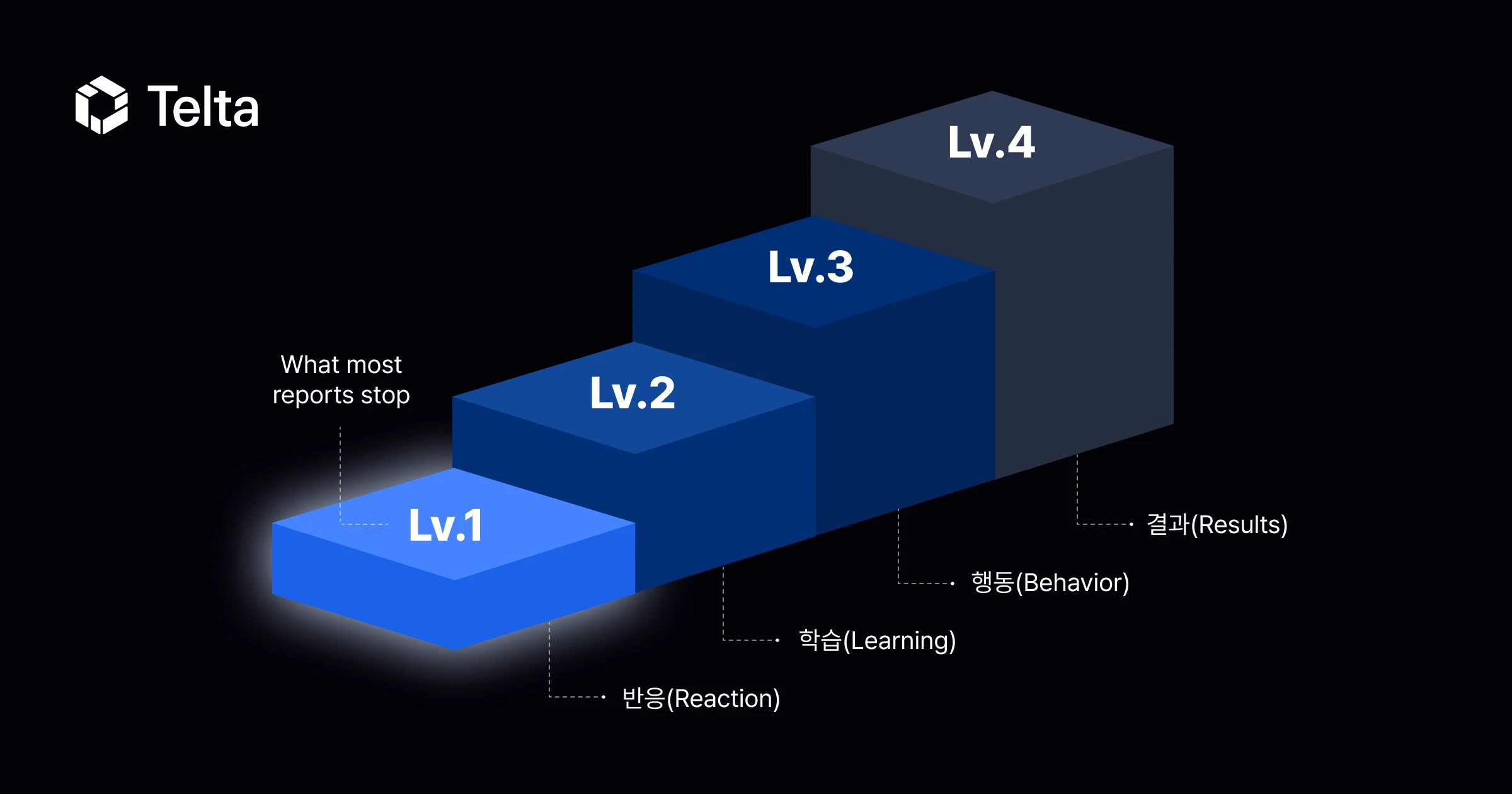
- Level 1. Reaction: Were learners satisfied with the training?
- Level 2. Learning: What did learners learn?
- Level 3. Behavior: Did learners change how they work on the job?
- Level 4. Results: Did organizational performance change?
The problem is that many organizations stop at Level 1. The further you move past Level 1 toward behavior change and business results, the harder impact becomes to measure.
The completion rate we track is the share of learners who finished a course to a set standard, and satisfaction is the average of learners’ ratings. Both show only the level of participation. Neither says a single thing about how learners have changed.
Same Course, Same Certificate, Very Different Levels of AI Use
British economist Charles Goodhart observed that “what gets measured becomes the target.” Once completion rate becomes a KPI, training gets designed to maximize completion. Content gets shorter, and quizzes get easier to pass. Training that is judged by completion rate and training designed to build employees’ capabilities have different goals from the start, and naturally they don’t produce the same results.
AI competency in particular is not about memorizing facts. It is a composite capability: judging which work to apply AI to, choosing and using the right tools, verifying the output, and fitting that output into the business context.
It’s common for two people to complete the same introductory ChatGPT course, after which one produces a weekly report draft in 30 minutes while the other still spends hours writing it by hand. Both show a 100% completion rate, yet their levels of use are completely different.
In other words, completion rate can’t tell these two learners apart. Nothing in that metric reveals how differently the two of them are actually applying AI on the job.
What to Look At to Understand AI Training Impact
HRD leaders responsible for AI training wrestle with the same questions: “Is our training actually raising employees’ ability to use AI?” and “What should we design differently next quarter, and how?” Answering them requires data that shows how learners are changing.
Gartner’s Successful AI = 4x More Investment in Foundations analysis, published in April 2026, found that the biggest difference between organizations that get results from AI and those that don’t is investment in foundations such as data quality, governance, AI talent, and change management. Successful organizations invest up to four times more in these areas relative to revenue. In short, foundations like data, people, and culture determine the outcome of AI transformation.
The key point is that you ultimately need data about people. Which job family has the widest AI competency gap? Which training actually raised competencies? Where should limited training resources go first next quarter? Only with data that answers these questions can HRD’s work shift from running content to designing how people change.
Corporate AI Training: Time to Measure the Change in Competencies
You can keep tracking satisfaction and completion rates. They still mean something as indicators of how well training is run. But your KPIs need to look at something else: metrics that show what has changed in employees, and how, compared with before the training.
Start a cycle: measure employees’ starting point with a pre-assessment, run the training, then compare the degree of change with a post-assessment.
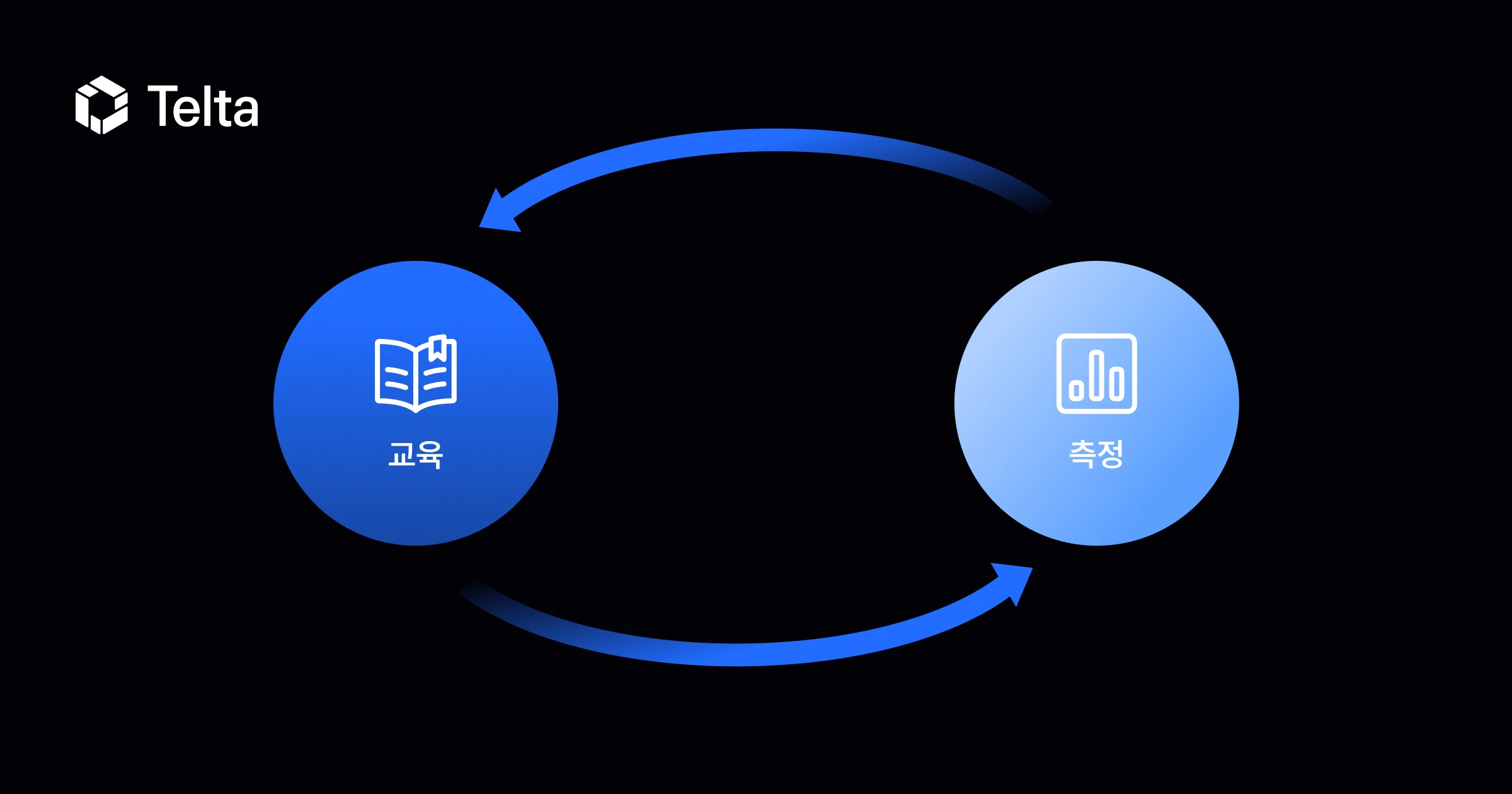
Once assessment runs as a cycle, things you couldn’t see before come into view: which roles changed the most, which content actually shifted competencies, and who should be the priority for next quarter’s training. HRD can then design the next round of training with data instead of instinct.
Get this far, and the next question follows naturally: What exactly should you measure about employees’ AI competencies, and how? We’ll answer that in the next article.
👉 Part 2: Read Workplace AI Literacy: What Exactly Should You Assess?
Related Reading
- AI Training Not Paying Off? Assess Your Team’s AI Competency First
- To Improve Job Training Outcomes, Assess Competencies Before Training Starts
Related Articles
.webp)
.png)