.svg)
As 22% of Jobs Shift, Job Descriptions Need a New Standard


As AI spreads quickly through the workplace, a trend toward “job fragmentation” (in Korean) is emerging. Rather than whole occupations disappearing, work is being reorganized within each job family. AI takes over simple, repetitive tasks, and the center of gravity of human work is shifting toward judgment and review.
Leadership teams are treating these efficiency gains as the new baseline and expecting a higher level of problem-solving from their people. To find talent with the right skills for this reshaped work and these higher expectations, job descriptions (JDs) now need a new standard.
Jobs Are Being Broken Down and Rebuilt, and the Rules of Work Are Changing
AI isn’t wiping out occupations. It’s driving a “job reallocation” within each job family: automating simple, repetitive tasks and raising the level of what people do. According to the World Economic Forum’s Future of Jobs Report 2025, about 22% of jobs worldwide are expected to undergo structural change (churn) by 2030, with 170 million new jobs created and 92 million displaced.

The basic research and routine tasks that once took up so much of practitioners’ time now belong to AI. The center of gravity has moved from first-pass “production” to review: checking AI output, weighing ethical and structural factors, and making the final “judgment.”
Software developers can hand simple coding to Copilot and focus on code review and security checks. Bank call center agents pass simple inquiries to chatbots and take on complex cases such as helping victims of voice phishing scams. All of this means that the way work gets done, and the competencies it requires, have fundamentally changed.
Why Traditional Job Descriptions Can’t Find the Talent You Need in the AI Era
Past Experience No Longer Guarantees Capability
The problem is that most job descriptions haven’t kept up with these changes. The JDs we’re used to can’t evaluate the competencies people need in the AI era. With technology and work changing daily, five years of past experience no longer guarantees consistent capability.
Marketing today looks nothing like marketing two years ago. What matters more than how long someone has done the work is what problems they’ve solved, and with what tools and methods. To evaluate those capabilities, the global HR market is moving beyond job-centered models toward skills-based HR, which places people based on the skills and competencies they actually have.
Your organization’s job descriptions now need to be redesigned around skills that can be demonstrated.
📌 Example: How Data, AI, and Engineering JDs Are Changing
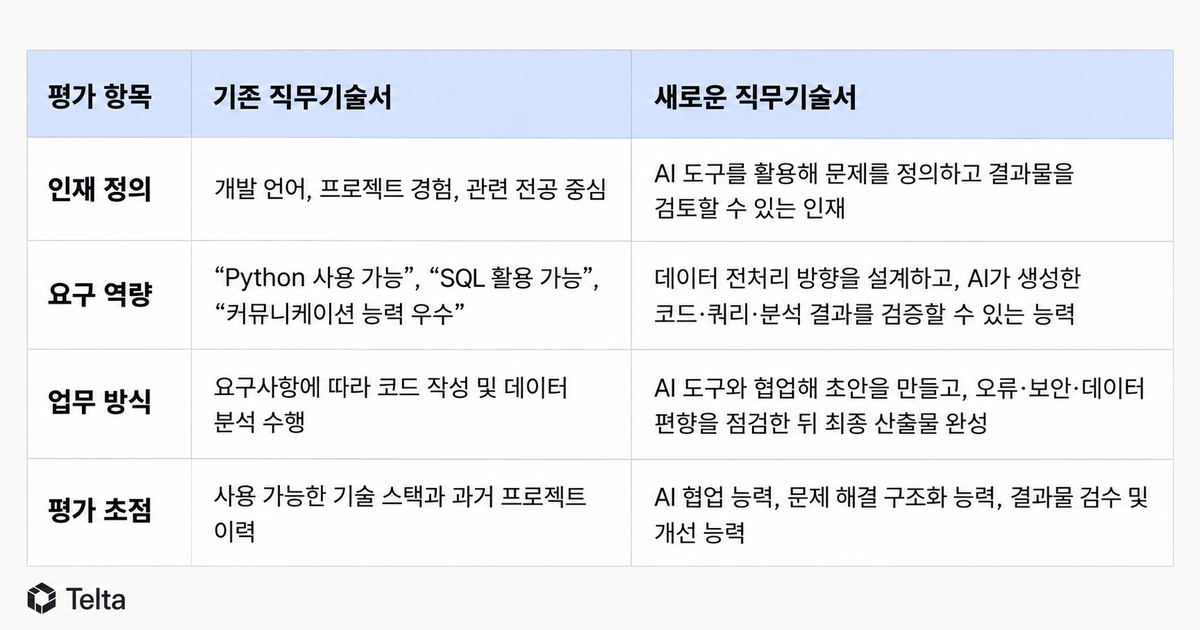
The New Standard for 2027 Job Descriptions: Skills-Based Design
How well you find talent ready for the AI era depends on how your organization structures and measures skills. Here are two core design principles for moving away from JDs that simply list tasks and toward a skills framework tied to your organization’s strategic goals.
1. Define Hard-to-Measure Soft Skills as Behavioral Indicators
Degrees, past experience, and tech stacks alone can’t capture the real capabilities that AI can’t easily replace. As AI use matures, distinctly human competencies that machines can’t substitute, such as adaptability, collaboration, and critical thinking, become even more central. A skills-based JD doesn’t leave these soft skills buried in abstract language; it structures them into concrete behavioral indicators and assessment items.
Example: Structuring Human Competencies as Behavioral Indicators
1. Critical Thinking
- Evaluate how well the person identifies and corrects logical gaps or data bias in AI-generated output
- Reflect the ability to verify sources and reliability and to propose alternative hypotheses
2. Adaptability
- Measure how quickly the person learns and applies new AI tools and work processes
- Evaluate problem-solving that responds flexibly to unexpected situations and shifting requirements
3. Collaboration
- Treat AI as a work partner and direct it with clear, well-structured prompts
- Share effective AI practices across the organization and raise the whole team’s collaborative productivity
2. Break Broad Job Titles Down Into Skills That Drive Results
Broad titles like “international sales” or “marketer” can’t define the competencies a role actually requires. In a skills-based HR system, you precisely define, at a granular level, the AI and data skills needed to reach the organization’s strategic goals, then use that to assess the gap against current capabilities (the skill gap).
Example: Skills-Based Talent Management and JD Redesign
Step 1. Link organizational goals to core skills
Systematically identify the core skills each role needs to hit a business goal such as “grow revenue 20%” (for international sales, for example: real-time market data analysis, pricing simulation, and automated risk detection).
Step 2. Assess company-wide skills and identify gaps
Use an assessment tool to measure employees’ current skill levels, compare them with the skills identified in Step 1, and pinpoint which competencies the organization lacks and which matter most.
Step 3. Redesign JDs and execute talent strategy based on skill gaps
Redesign targeted job descriptions to close the identified gaps. These become clear targeting criteria for hiring and also serve as organization-wide skill guidelines for designing internal training and development roadmaps.
Telta’s Competency Assessment: The Starting Point for JDs Built Around Your Organization
In the AI era, a job description should be more than a list of tasks. It should anchor a skills framework that reflects the gap between the skills the organization needs and the capabilities its people have today. But when you actually sit down to design a skills-based JD, it’s hard to pin down objectively which skills your organization is missing.
That’s where Telta’s competency assessment provides a solid data foundation. It analyzes skill levels and competency gaps across the company and by team, and clearly identifies the core competencies each role needs to strengthen or redefine.
Without months of HR consulting, you can use assessment data to quickly build and standardize skills-based job descriptions that are ready for the AI era. Start designing your job descriptions with Telta today.
Related Articles
.webp)
.png)


