.svg)
AI Training Not Paying Off? Assess Your Team’s AI Competency First


How much are companies investing in AI training?
According to a DataCamp report based on a survey of business leaders, 82% of respondents said their organization provides AI training. Yet 59% still see an AI skills gap inside their organization.
In other words, AI training can spark interest for a while, but it rarely changes how people actually work or lifts the capability of the organization as a whole. The root cause is one-size-fits-all training delivered without a clear picture of where the organization’s competencies stand today.
Why AI Training Doesn’t Translate Into Real Competency
Right after an AI training session, interest and engagement often go up. But it doesn’t last. There are three specific reasons why.
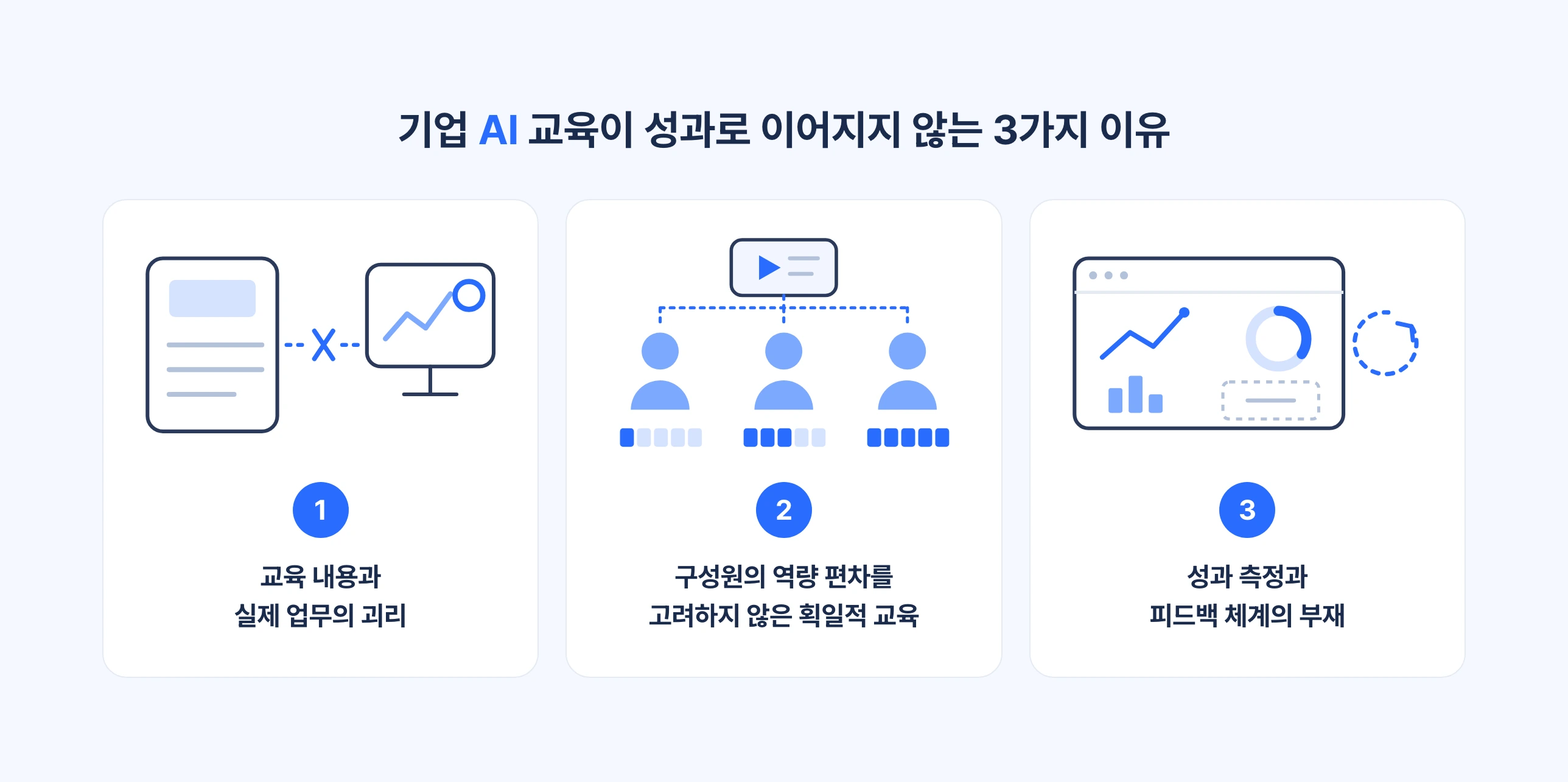
1. A Gap Between Training Content and Real Work
When AI training is disconnected from day-to-day work, employees can’t apply what they learned to their own jobs. A sales team gets a surface-level walkthrough of general-purpose tools but nothing on how to use them for proposals or customer research. Or a data analytics team sits through basic concepts it already knows. When what people learn doesn’t mesh with the work they do, training loses its impact.
2. One-Size-Fits-All Training That Ignores Skill Gaps
Even within one organization, people’s understanding of AI and their ability to use it vary enormously, and that ability doesn’t track tenure or seniority. In fact, it’s common for entry-level hires who have used AI since college to be fluent with it, while seasoned professionals put it off because they don’t know where to start. A single team can include someone who uses AI deeply in their work, someone who has an account but barely touches it, and someone who understands the concepts but struggles to apply them. Teach everyone the same content in that situation, and beginners struggle to keep up while advanced users sit through material they already know. Either way, the training falls flat.
3. No System for Measuring Results and Giving Feedback
Sustaining and building on the impact of AI training requires a system that objectively measures change after training and feeds the results back. But many companies focus so heavily on delivering training that they never systematically track changes in AI usage, productivity, or employee satisfaction.
Before Designing Training, Find Out Where AI Competency Stands
If you don’t know your starting point, you end up designing training on gut feel. To answer with data who needs to learn what, and what changed after training, you first need to know your employees’ current level of AI competency. Telta’s AI Literacy Assessment uses a skills framework spanning understanding, risk awareness, and practical application to report where individuals and the organization stand today.
Telta’s Skills-Based Assessment Makes AI Usage Across Your Organization Measurable
Telta’s AI Literacy Assessment doesn’t check whether people know about AI. It checks whether they can actually get work done with it. Instead of multiple-choice questions with a right answer, participants complete scenario tasks they could plausibly face on the job, working directly with a built-in LLM. Telta analyzes the LLM conversation logs to see how each person structures prompts and the logic they use to work through the problem. It then reports where individuals and the organization stand, organized by a skills framework covering AI understanding, risk awareness, and practical application.
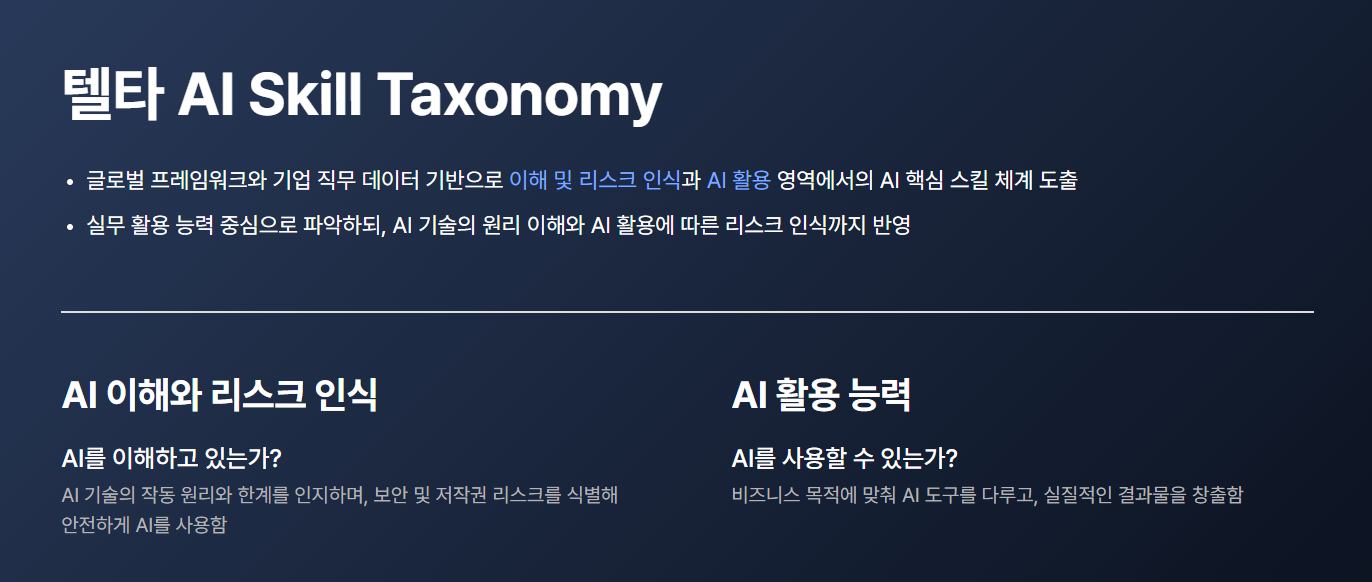
Understanding and Risk Awareness for Using AI Safely
AI understanding and risk awareness is the ability to grasp how AI technology works and where its limits are, and to judge the risks it can create at work. Using AI safely requires recognizing security and copyright issues and not taking AI output at face value.
That’s why experience with AI or proficiency with a tool isn’t enough on its own. Only when you know whether employees can judge AI’s limits for themselves and review its output on their own can you set organization-wide standards for safe use and decide where training should focus first.
Applying AI to Deliver Real Business Results
AI application is the ability to work with AI tools to fit a business goal and produce real deliverables. Telta measures practical performance through a process that runs from task planning to LLM prompting to output verification.
The point isn’t just writing one good prompt. People can only put AI to proper use at work when they have real problem-solving ability: structuring a business problem logically, then verifying and refining AI-generated drafts until the final deliverable meets the bar.
Corporate AI Training Delivers Results When It Starts With Assessment
The goal of corporate AI training shouldn’t simply be to introduce a new technology. It should be to change how the whole organization works and to create lasting results. Getting there starts with knowing exactly where your organization stands today.
Telta’s AI Literacy Assessment gives you an objective view of your organization’s AI competency and helps you build an effective, data-driven training strategy. If you want your AI training to translate into real results, start by systematically assessing your organization’s AI competency with Telta.
Related Reading
- Why Completion Rates Can’t Measure the Impact of Corporate AI Training
- Workplace AI Literacy: What Exactly Should You Assess?
Related Articles
.webp)
.png)