.svg)
To Improve Job Training Outcomes, Assess Competencies Before Training Starts


Many HRD leaders get stuck when executives ask after a training program, “So what got better, and by how much?” Deloitte’s 2025 Global Human Capital Trends report (in Korean) notes that while leaders worldwide recognize the importance of reshaping their workforce’s capabilities, they are not yet ready to define and assess the skills that future roles will require. In the same way, organizations know training is necessary but are not prepared to measure and prove what it achieves.
The impact of job training depends not on the content of the training but on whether you can compare before and after against the same standard. Satisfaction surveys alone can’t explain changes in competency. Only by first setting a baseline with a pre-training competency assessment can you show the change after training with data.
💡 Key Takeaways
- Satisfaction surveys alone can’t prove that job training works.
- To explain how much changed, set a baseline with a pre-training competency assessment and reassess against the same standard after training.
- Consistent comparison is only possible when you measure with the same questions and the same standard.
- Telta’s competency assessment is a tool for building that baseline quickly.
Job Training Impact Is Hard to Prove When You Only Measure Satisfaction
Asking “Were you satisfied with the training?” after a program tells you how people reacted to it. It doesn’t tell you how much their competencies changed. If a two-week onboarding program for new hires leaves you with nothing but a satisfaction score, all the report can say is that “participants rated it positively.” What actually changed stays invisible.
To explain impact, you need change, not reaction. You need to see how employees’ understanding of the role, confidence in doing the work, and approach to solving problems have changed since before the training. Without that standard, people may agree training is necessary, but the link between training investment and results stays weak.
A Pre-Training Competency Assessment Sets the Baseline for Growth
To explain the effect of training, you first have to capture the pre-training state in numbers. Only by comparing before and after with the same questions and the same scoring criteria can you say not just “it improved” but “this improved, by this much.” What happens without a pre-training baseline? Even if scores rise after training, you can’t tell whether the change came from the training or from people’s existing level of competency.
That said, before-and-after score comparisons can’t explain everything about training impact. Right after training, check reaction and learning indicators such as understanding and learning completeness. Then, one to three months later, look separately at whether on-the-job behavior has changed and whether it has contributed to actual results. Separating these two points in time keeps the post-training glow from getting mixed up with real on-the-job impact.
Before-and-After Competency Data Becomes the Basis for Designing Your Next Program
If every program uses different evaluation criteria, you can’t compare results. Keeping the same questions and rating scales lets you compare outcomes across programs, and that data becomes the evidence you need to win over executives and secure budget for the next round of training.
![[AI-generated] A vague satisfaction survey (left) vs. a specific competency assessment (right)](https://cdn.prod.website-files.com/68538820b59396bcb3ef3b75/6a4c611d8dff4302c05a1430_Edit_this_Korean_infographic_Add_two_subtitle_tex-1783048943017.webp)
For example, a report that says “95% satisfaction with leadership training” won’t do much to justify the next training budget. But with numbers for each competency, such as “team goal management up 15 points, feedback skills up 20 points,” you can explain training impact with data. Evidence of score gains measured against the same standard before and after carries far more weight internally than high satisfaction with no proof of on-the-job application.
Related Reading
- Why Completion Rates Can’t Measure the Impact of Corporate AI Training
- Insurance Case: From Marketing and CRM Job Analysis to Training Design
Start Measuring Job Training Impact with Telta’s Competency Assessment Package
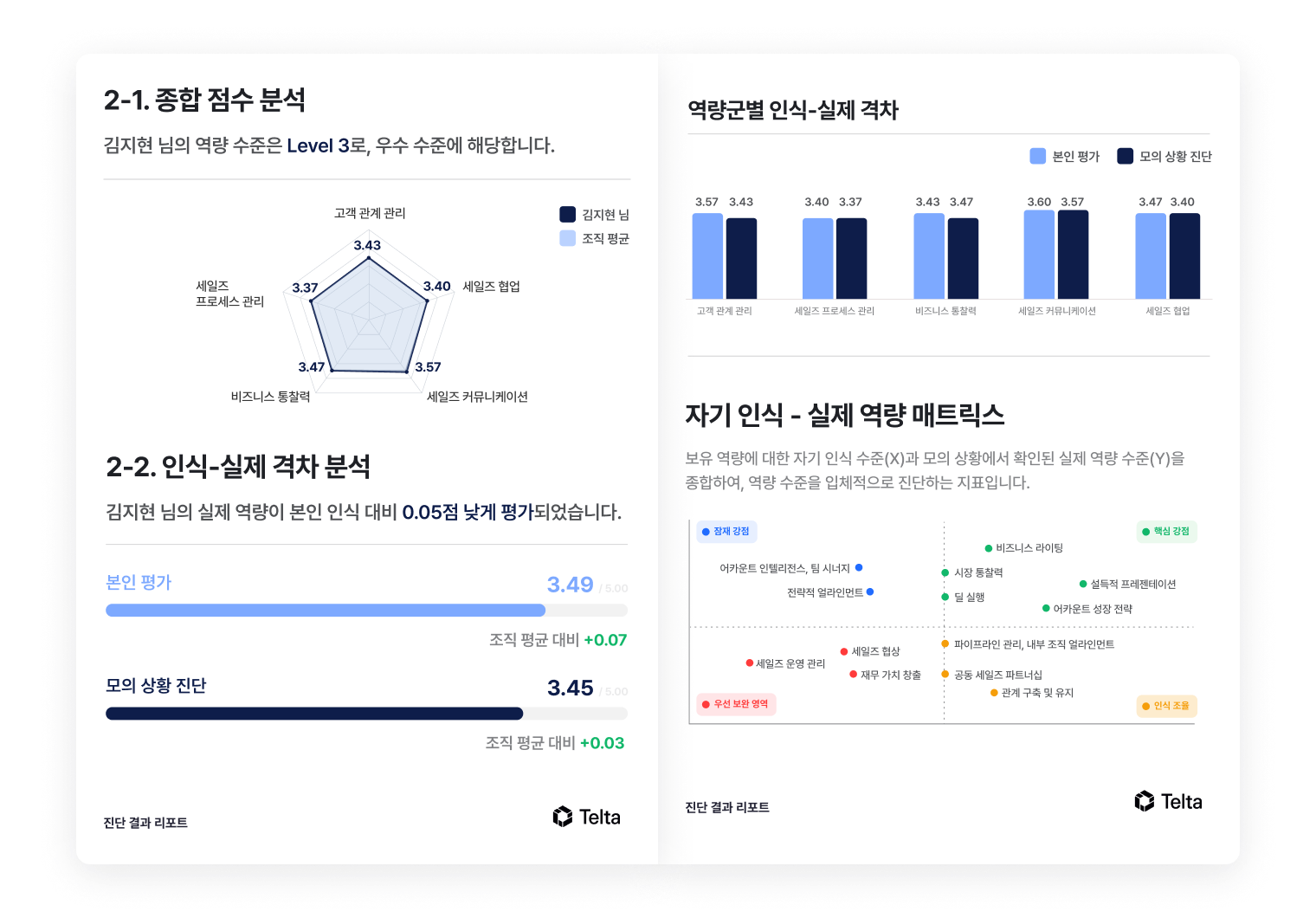
Even when you want to measure training impact, it’s hard to know where to start: which questions to write and what standard to evaluate against. The Telta competency assessment package lets you compare before and after against the same standard, based on benchmark competencies designed for each role.
A pre-training assessment measures current competency levels to set the baseline, and a reassessment against the same standard right after training shows the gain for each competency. Add a follow-up assessment one to three months later to check on-the-job application and behavior change, and you can systematically prove training impact from short-term reaction to long-term results.
Because the same standard applies to recurring programs, you can manage leadership training, new-hire onboarding, and AI literacy training as comparable data in the same way.
Training results become persuasive only when they show “what changed, and by how much,” not just “whether training happened.” With Telta’s competency assessment, build a system that supports not only executive reporting but also your next training strategy and budget requests.
Related Articles
.webp)
.png)