.svg)
Better Questions, Not Better Notes: How AI Can Help Interviewers


Interview Intelligence Series, Part 2 of 2
Even a perfect transcript can’t recover information you didn’t ask for when it mattered. The more important job for interview AI may not be organizing the answers you already have, but helping you gather the evidence that’s still missing.
If a candidate says, “I led almost the entire project,” and no one asks what they actually contributed, the transcript will faithfully preserve a claim no one verified.
The Bottom Line
1. Interview quality depends less on how much you record than on how much evidence you gather for your decision.
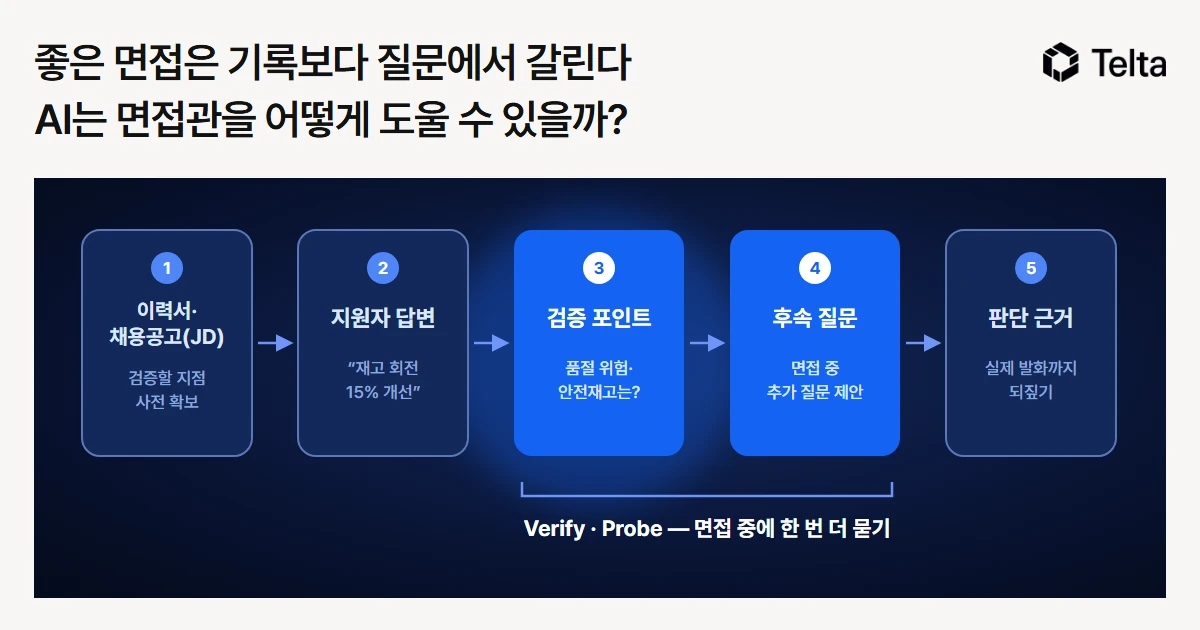
2. Looking at the resume, the job description (JD), and the answer just given together produces probing questions that fit the role better.
3. Today’s AI Assistant is less an automated interviewer that replaces you than a “second set of eyes” that catches verification points you might miss.
Real-Time Notes and Real-Time Verification Are Different Problems
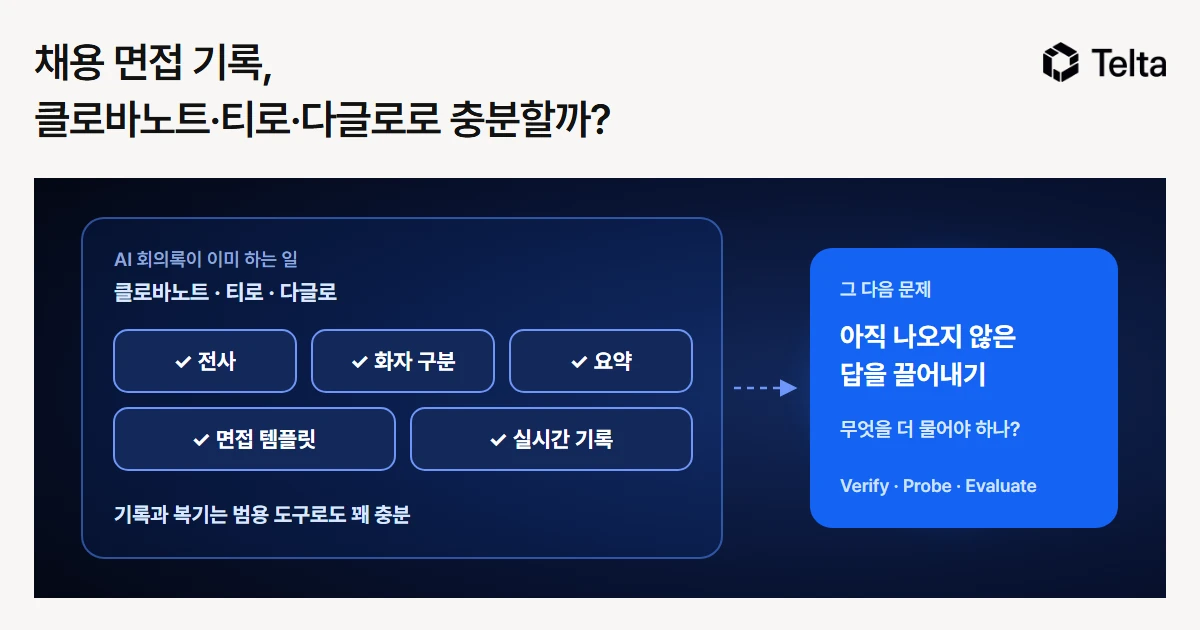
As we saw in Part 1, some general-purpose AI note-takers already provide live transcripts and summaries during interviews. Note quality is about capturing “what was said.” Interview quality also has to cover “what else should have been asked.”
You Need Verified Evidence, Not Just Plausible Answers
Interviews with experienced hires are full of statements that sound convincing but call for one more question.
No summarization model, however good, can ask these questions for you after the interview is over. In the end, interview quality comes down to how much solid evidence you gathered in the room.
Job Description
Before the Interview: Attach Questions to Every Line of the Resume and JD
For our test, we used the resume of a merchandiser (MD) candidate working at a household goods brand and a detailed job description for a brand MD role. The resume listed a “15% improvement in inventory days,” and the JD named “managing the trade-off between inventory turnover and lost sales from stockouts” as a core responsibility.
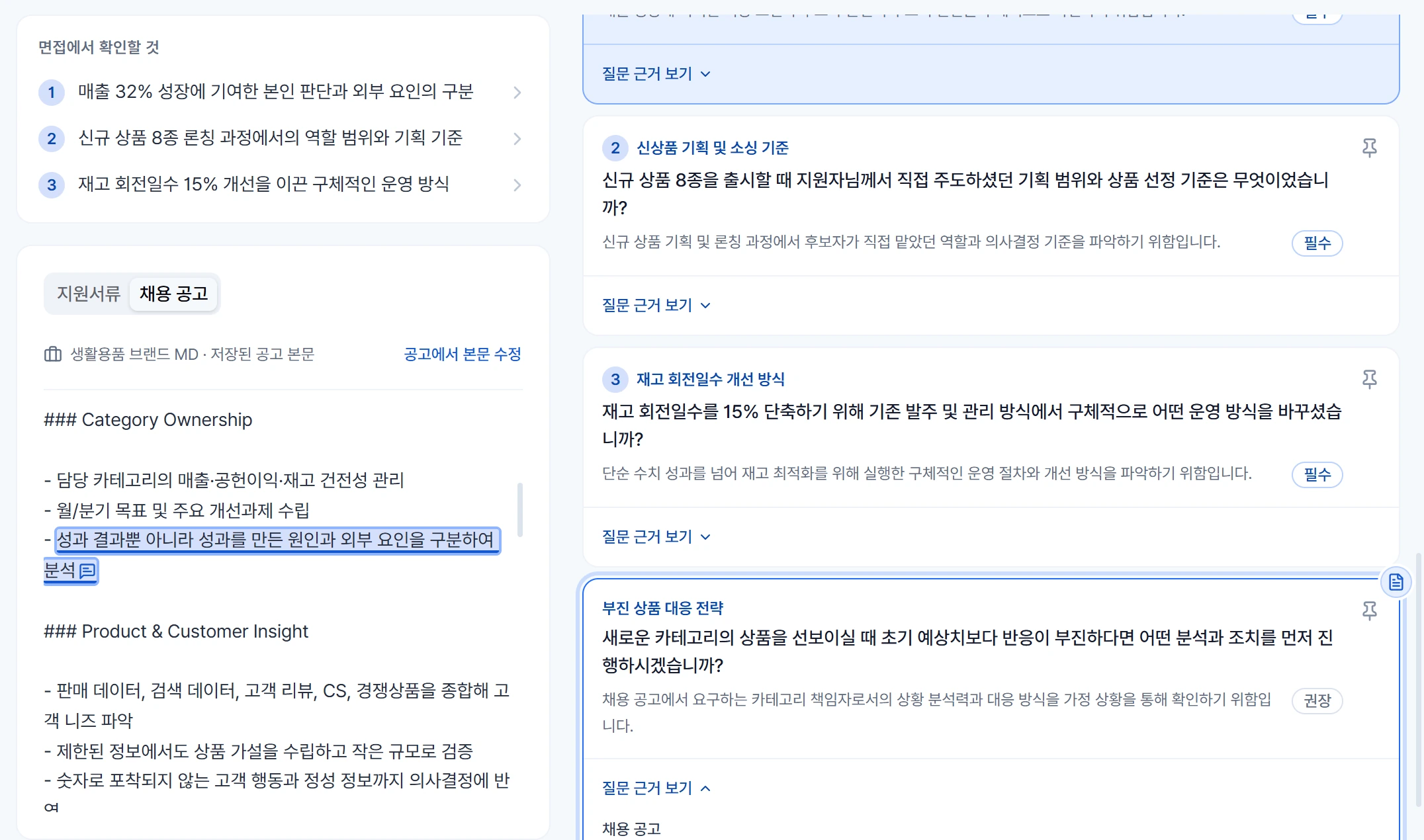
Based on these materials, Telta Interview Pro listed what to “Verify in the Interview”: how much of the 32% revenue growth came from the candidate’s own decisions versus external factors, the scope of their role and their planning criteria in launching eight new products, and the operational changes behind the improvement in inventory days. In the updated interface, each suggested question links to the resume line it was based on. Click “View in Source,” and that line is highlighted in the resume on the left.
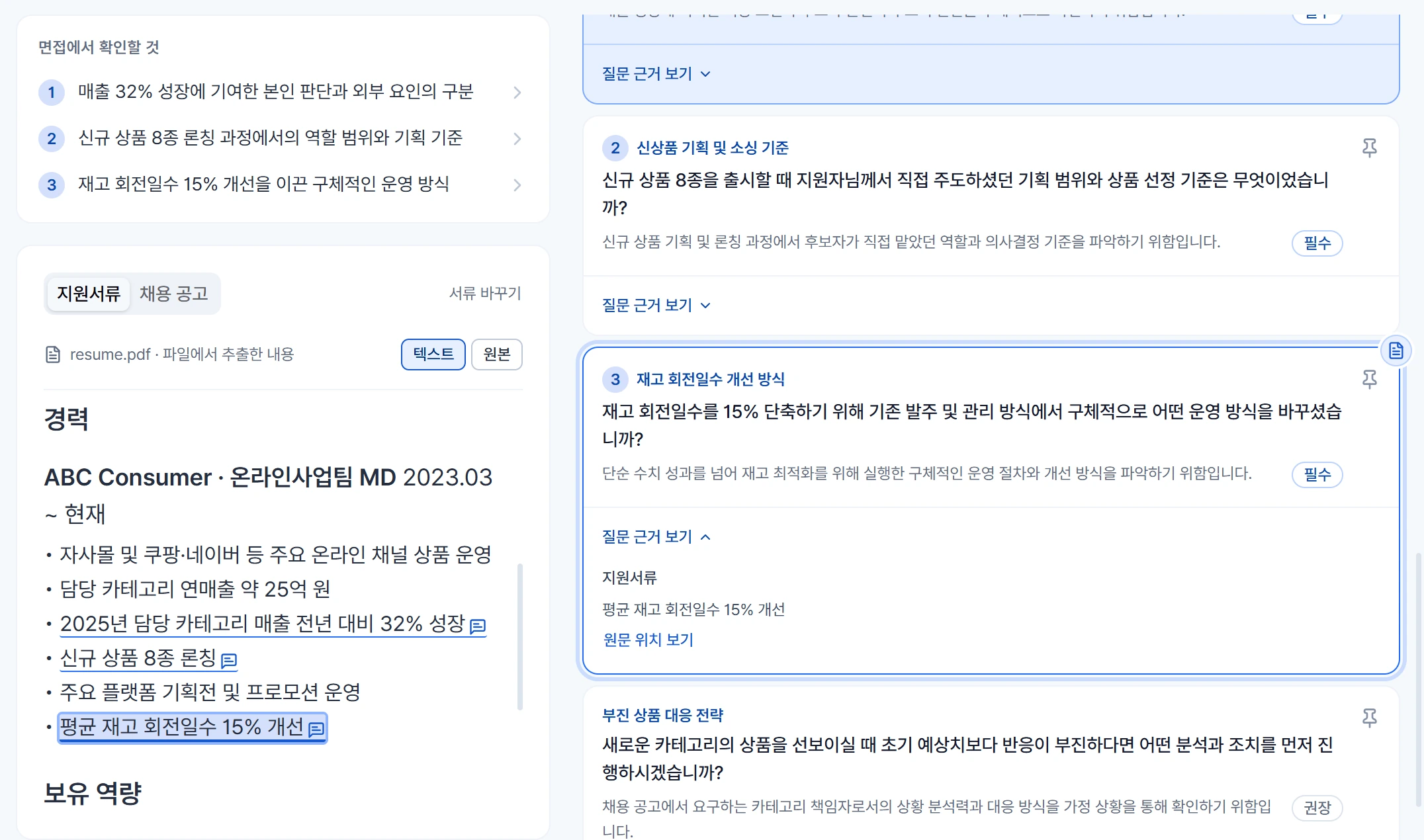
Some questions were drawn from the job posting itself. Based on the listed responsibility to “analyze the causes behind results separately from external factors,” Interview Pro added a question asking what the candidate would analyze and act on first if a new product underperformed expectations.
During the Interview: Dig One Level Deeper into Answers That Sound Good
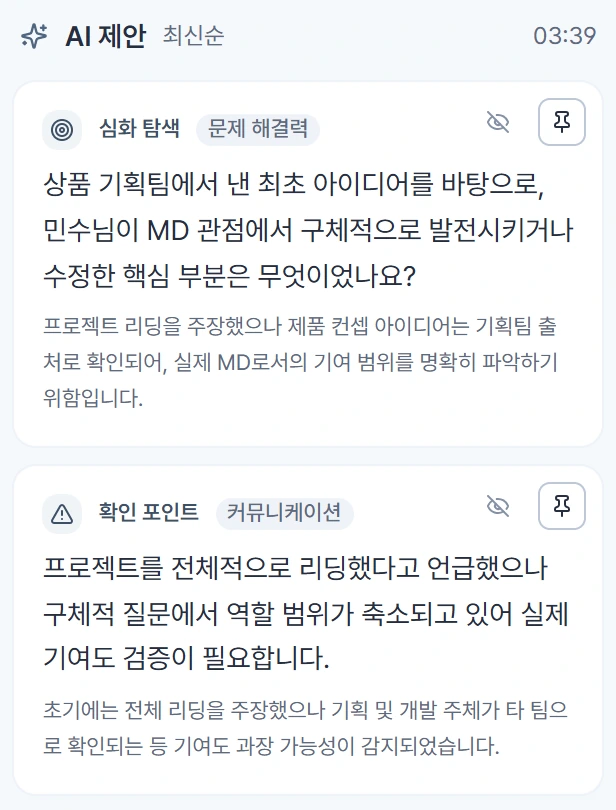
In the updated interview screen, the original resume stays open on the left while AI suggestions stack up on the right in time order. The candidate said they had “led almost the entire” new product launch, then explained that the original idea came from the product planning team. At that point, Interview Pro flagged that their contribution needed verifying and suggested a question probing what they had actually developed or changed from an MD’s perspective.
It Raised Questions Before the Interviewer Did, and Some the Interviewer Never Asked
When the candidate described the new product’s fast early sales, the AI Assistant suggested asking how they handled supply and inventory. That was about eight minutes before the interviewer in the script asked about stockouts. Suggestions in the same direction came up again when we reran the test before and after a product update and with a different job posting.
It also flagged areas the interviewer never got to. After inventory had been covered thoroughly, the AI Assistant suggested moving on to how the candidate had led manufacturer selection and cost negotiations for the new product. That’s a core brand MD responsibility listed in the job posting, but the interviewer in this script never asked about it.
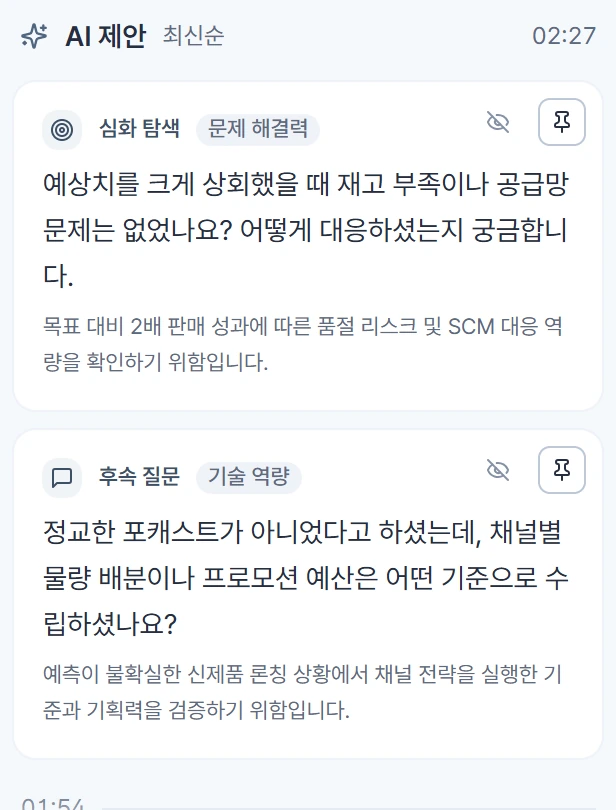
① Inventory response · 2:27
The “Deep Dive” card at the top. Suggested about eight minutes before the interviewer asked about stockouts (10:51).
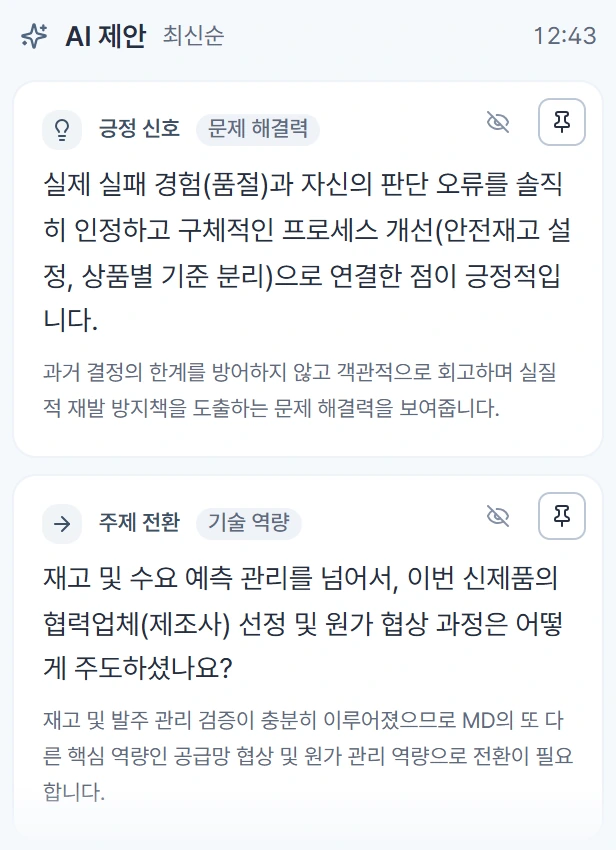
② Manufacturer and cost negotiation · 12:43
The “Change Topic” card at the bottom. Flagged a core brand MD responsibility the interviewer never asked about.
The AI Assistant Is a “Second Set of Eyes,” Not an Automated Interviewer
Not every catch landed. The AI didn’t flag the gap in real time between the KRW 2.5 billion on the resume and the KRW 3 billion the candidate mentioned early in the interview; it was cleared up only after the interviewer asked directly. In the new interface, the KRW 2.5 billion figure is right there in the resume on the left, so it’s easier for interviewers to cross-check themselves, but the AI didn’t point it out first. At its current level, the AI Assistant is less a replacement for the interviewer than a second set of eyes that catches verification points you might miss in the moment.
Generating Lots of Questions Isn’t the Same as Generating Good Ones
Anyone can ask a generative AI tool for “20 interview questions for an MD” and get plenty. The harder part of a real interview is listening to the answer a candidate just gave and deciding what needs verifying right now.
- Does it actually reflect the answer just given?
Does it dig into what was vague in the last answer instead of repeating prepared questions? - Does it connect to the resume and JD?
Does it ask with both the numbers and scope in the application and the role’s core responsibilities in view? - Does it verify attribution, baselines, and trade-offs?
Does it check individual versus team contribution, how targets were set, external factors, and what success cost? - Does it distinguish missing evidence from low competency?
Does it avoid concluding that a candidate is weak in an area no one asked about?
After the Interview, the Evidence Matters More Than the Score
The Interview Pro report summarizes core competencies, job competencies, and Position Fit, and shows the candidate statements behind each judgment. In this report, scored against a brand MD competency set, scores were assigned on role-specific criteria such as product planning and lineup, cost, pricing, and margin design, and demand forecasting, ordering, and inventory management. Strengths came with evidence tied to the job posting, such as “directly made decisions to discontinue underperforming products and adjust order cycles, a core duty in the posting.” The report also suggested a question for the next interview round: confirm a case in which the candidate negotiated costs directly with a manufacturer or managed quality.
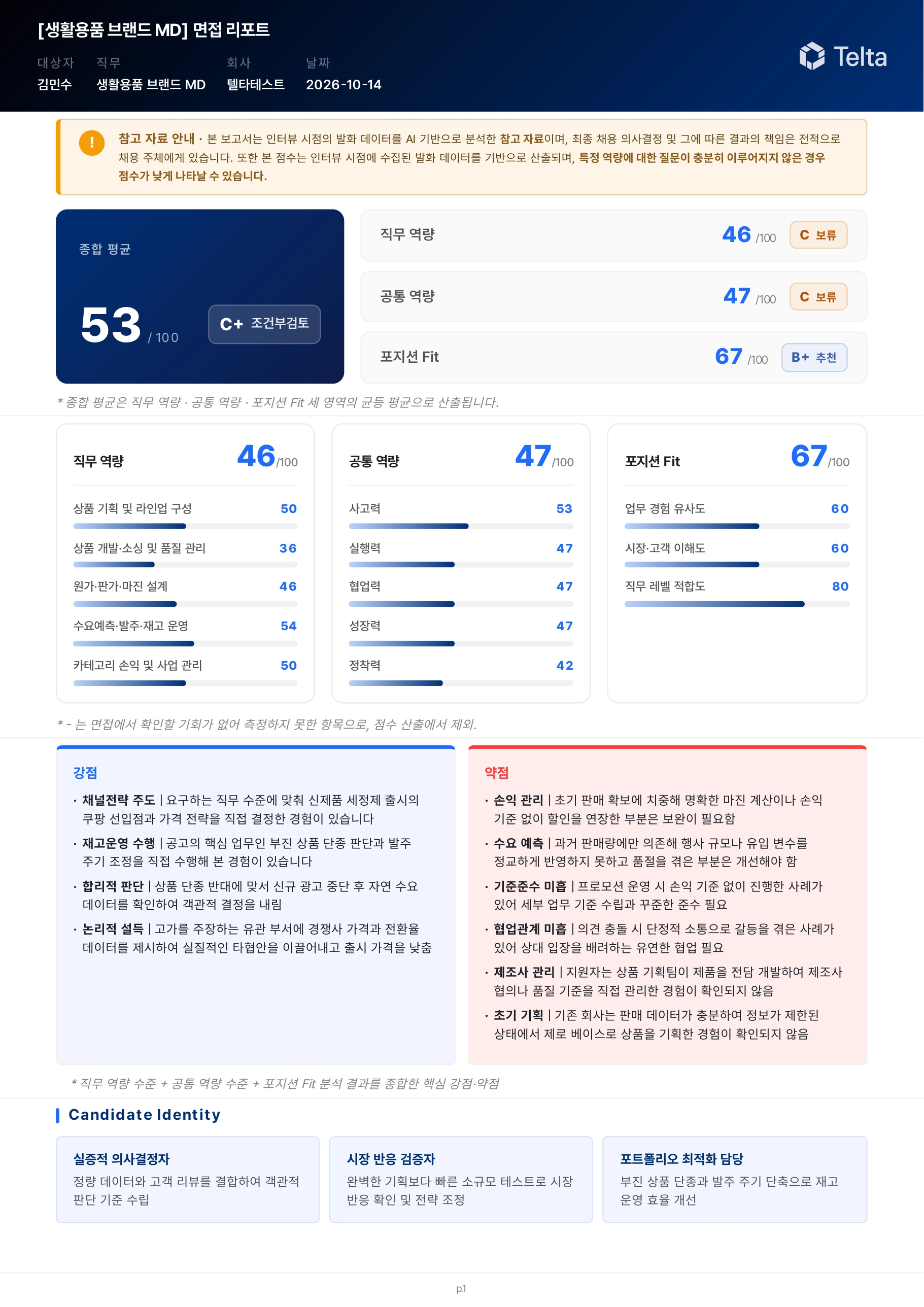
Scores, strengths, and areas to develop at the top of the report.
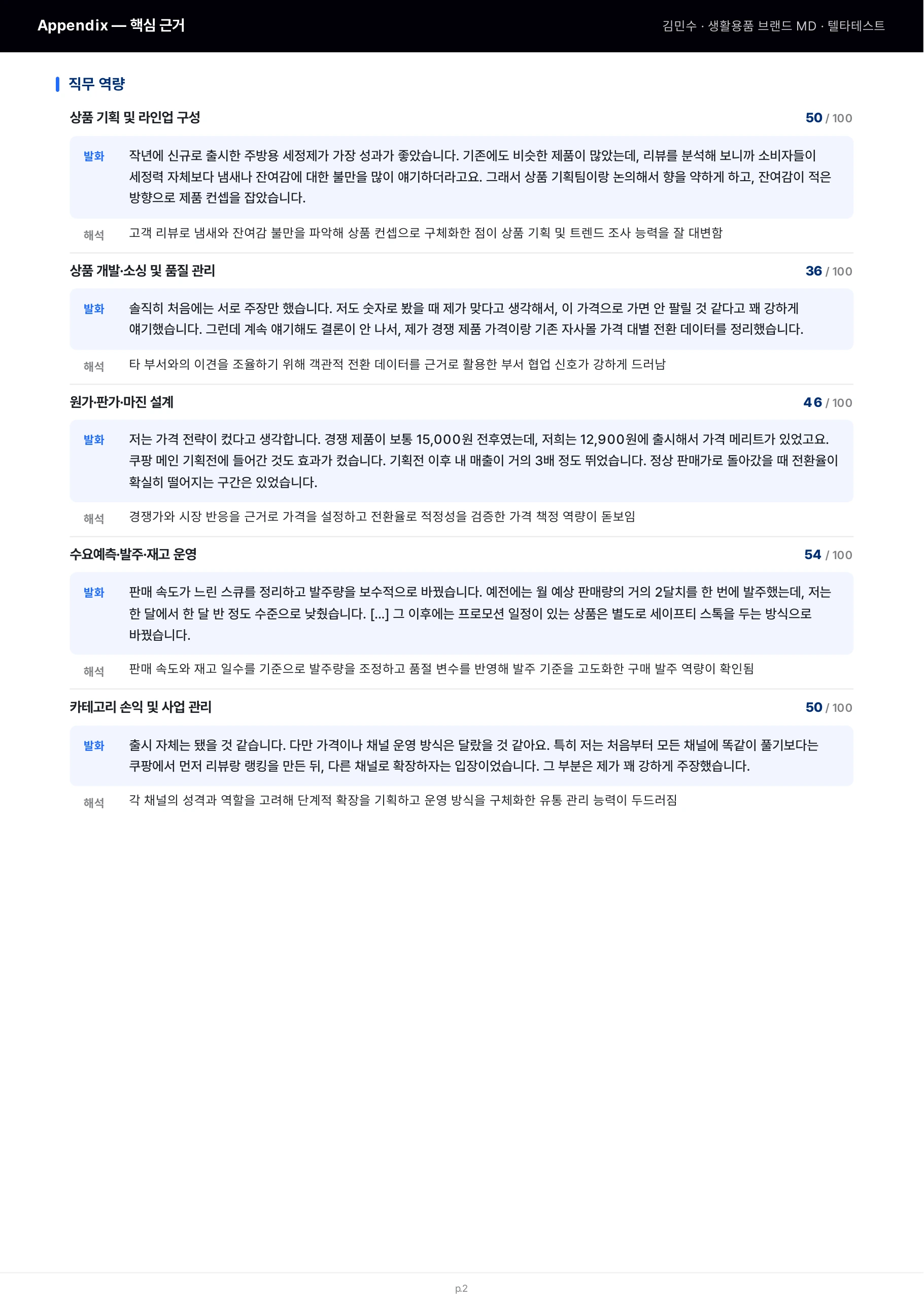
The section where you can review each competency judgment alongside the candidate’s actual statements.
Telta Interview Pro
Try resume- and JD-based interview prep and live follow-up questions for yourself
Upload a resume and job description, and Interview Pro prepares the questions to ask, each with its supporting evidence. During the interview, it takes notes and suggests follow-up questions that are easy to miss. Afterward, it compiles a report with the candidate statements behind each judgment.
Start Interview Pro for Free →
The Goal of Interview Intelligence Is More Evidence, Not More Evaluation
People still play a big role in interviews. Understanding the context of an answer, interpreting what it means for the organization and the role, and making the final hiring decision remain the interviewer’s job.
What AI does better is different.
AI shouldn’t take over more of the evaluation. It should help people evaluate with more evidence.
That’s the problem we set out to solve in building Interview Pro.
The Measure of Better Interview AI Isn’t How Much It Evaluates for You
It’s how much more evidence it helps you gather that you would have missed on your own. Now that note-taking is already good enough, that difference may become the more important performance benchmark for interview AI.
Test conditions: an AI-generated mock interview of about 23 minutes 30 seconds. We registered the resume of an MD candidate at a household goods brand and a detailed brand MD job description in Interview Pro, then played the audio through the browser microphone. The screenshots in this article come from runs after the October 2026 “view resume alongside” update. Of seven verification points planted in the script in advance, the AI Assistant suggested questions in the same direction for five. This does not mean the cases in this article will reproduce identically in every real interview. Part 1 compared live transcripts and summaries across tools.
Related Reading
- Interview Notes: Are Clova Note, Tiro, and Daglo Good Enough?
- What Is a Structured Interview? How to Reduce Rating Gaps Between Interviewers
Related Articles