Should a Candidate Lose Points for Bringing Coffee? Setting Interview Criteria


The “coffeegate” debate looks like a petty argument about etiquette, but it raises a far more important question for hiring teams: of everything you see in an interview, what will you actually treat as evidence for a hiring decision?
Key Takeaways
- Treating “the candidate brought coffee” as a separate reason to deduct points is not a sound way to evaluate interviews. Any information you score should have a relationship to job competencies that you can explain.
- Whether a piece of interview information is signal or noise comes down to three questions: Is it job-related? Was the standard defined in advance? Can it be applied consistently to every candidate?
- AI shouldn’t evaluate people in the interviewer’s place. It works best handling recording, organizing, and spotting points to verify, so interviewers can focus on judgment.
The debate started with a short TikTok video from Caitlin Wehniainen, who runs a recruiting agency in Florida. Her advice to Gen Z job seekers: don’t walk into an interview carrying an iced coffee. Showing up with a drink in hand, she said, makes the interview look like one more errand on your to-do list, and it’s too casual for a formal corporate interview. Drink your coffee before or after.[1]
The video racked up hundreds of thousands of views, and reactions split sharply. One camp agreed that the workplace has unspoken courtesies, and that bringing a drink to an important meeting signals you don’t take it seriously. The other camp, especially Gen Z job seekers, saw it the opposite way. One social media creator shot back, “What is professionalism, and who decides?” Trent Cotton of hiring software company iCIMS pointed out that a coffee is really no different from the water or coffee interviewers routinely offer candidates.[1]
Ashley Daugherty of staffing firm Randstad Professional summed it up: an iced coffee tells you almost nothing about whether someone will be good at the job, and the real issue is who gets to define “professional.”[1]
For HR teams that design hiring processes, it’s worth taking this one step further.
The question that matters more than “Is it okay to bring coffee to an interview?” is “What should interviewers base their evaluation of a person on?”
Should a Candidate Who Brings Coffee Lose Points?
The short answer: using “the candidate brought coffee” as a separate reason to deduct points is hard to defend as good interview evaluation.
Any information you evaluate in hiring should, at a minimum, have a relationship to the competencies the role requires that you can explain.
The U.S. Office of Personnel Management (OPM) describes the structured interview as an assessment method for measuring job-related competencies. In a structured interview, candidates are asked predetermined questions, and the same rating scale and response standards are applied to make evaluation more consistent.[2]
So if you want coffee to count, ask yourself this first: “Which job competency that we’re trying to assess does this behavior demonstrate?”
If you can’t answer that clearly, what you’re looking at is more likely an individual interviewer’s impression or personal norm than job-related information.
So Should First Impressions Never Count in an Interview?
Not quite. This doesn’t mean you can’t evaluate the behavior you observe in an interview.
For a role that involves frequent client contact, for example, communication style and responding appropriately to the situation may be important competencies. The problem is turning a vague impression like “seems professional” straight into a score.
To Interviewer A, professionalism might mean a suit. To Interviewer B, it might mean tone of voice. To Interviewer C, it might mean not showing up with an iced coffee.
Define the competency you want to assess as observable behavior, on the other hand, and the standard changes. Client communication, for instance, could be made concrete like this:
Example: Assessing Client Communication
- Uses language suited to the audience and the situation
- Accurately grasps the intent behind a question
- Makes their case logically
- Responds appropriately to unexpected questions
Now you’re evaluating the behaviors the job requires, not a feeling.
Three Questions to Separate Signal from Noise in Interviews
A real interview floods you with information about the candidate: tone, clothing, facial expressions, nerves, education, previous employers, how fast and how fluently they answer, and even whether they brought a coffee.
But having a lot of information you can observe is not the same as having information that is useful for hiring.
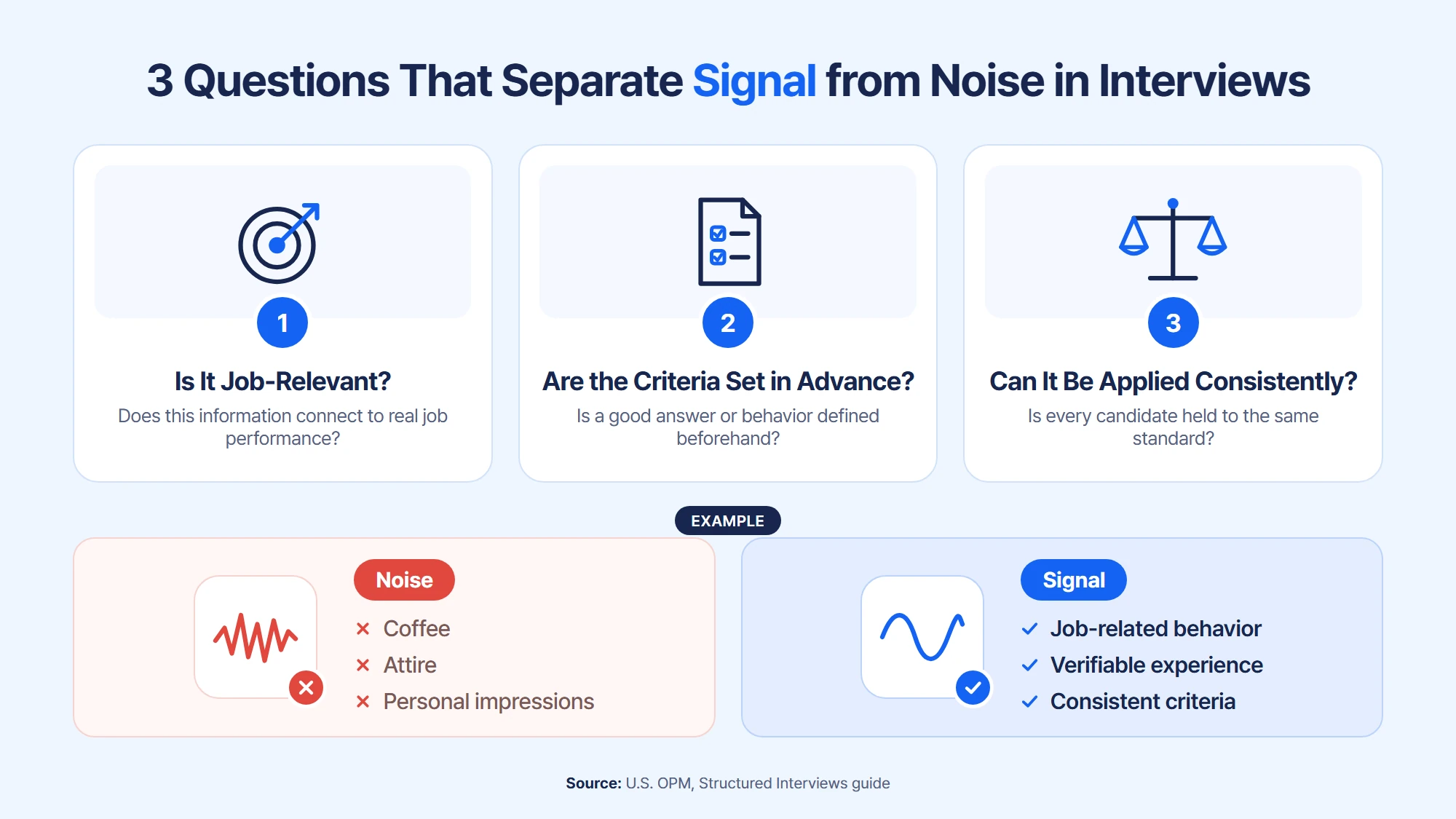
1. Is This Information Related to Actual Job Performance?
The first thing to check is job relevance. Don’t ask, “Does this behavior look good?” Ask, “Does this behavior show a competency needed to succeed in this role?”
2. Did You Define in Advance What Counts as Good Evidence?
Once you start interpreting what a candidate does on the spot, after you’ve met them, the evaluation standard drifts easily. That’s why structured interviews settle what to evaluate, which questions to ask, and how to rate which answers before the candidate walks in. OPM explains that as the degree of structure increases, so do agreement between raters, reliability, and validity.[3]
3. Can You Apply the Same Standard to Every Candidate?
If you deduct points from Candidate A for bringing coffee, what about a tumbler? Why is water fine but coffee not? And how do you rate a background that looks casual in a video interview?
If you struggle to answer these questions consistently, there’s a good chance that an interviewer’s personal tastes or norms, rather than job competencies, are creeping into the evaluation criteria.
Structured Interviews Are About More Than Asking the Same Questions
People often think a structured interview just means asking every candidate the same questions. But identical questions are only one part of the structure.
What matters more is shrinking the room for interviewers to interpret things at their own discretion.
Decide what you will verify, prepare questions that test those competencies, decide which information in an answer counts as evidence, and evaluate everyone against the same standard.
In the comparison of assessment tools OPM presents, the estimated validity of structured interviews is .51, versus .38 for unstructured interviews.[4] Those figures come from Schmidt & Hunter’s 1998 meta-analysis. When Sackett and colleagues reanalyzed the same body of research in 2022, the estimates came down across the board, but the gap actually widened: .42 for structured interviews versus .19 for unstructured ones, and structured interviews ranked highest among the selection tools compared.[5] There’s no need to read any single number as an absolute difference in performance, but it is clear that structure is a key design principle for improving the quality of interview evaluation.
We cover the step-by-step process for designing a structured interview in What Is a Structured Interview? Definition, BEI Comparison, and 4 Design Steps.
A Good Interviewer’s Job Isn’t to Evaluate Everything
It’s easy to assume a good interviewer is someone with sharp powers of observation. But the more important skill may be the opposite.
The ability to decide which of the things you see you will not evaluate.
You might like a candidate’s way of speaking. Their previous employer might impress you. You might discover a shared hobby. Or the opposite: they may seem overly nervous, their outfit may not be to your taste, or the iced coffee may bother you.
It’s hard for interviewers not to notice these things at all. So what you need isn’t simply the resolve to “not be biased.” It’s structuring in advance the evidence you will use for the hiring decision.
So Where Should AI Sit in the Interview?
There’s one more thing to consider here. None of this means it’s enough to record and analyze only what was said in an interview.
Some information you can only get by being in the room: how a candidate takes in a question, how they react to the unexpected, the context you pick up in the back-and-forth of a real conversation.
That’s exactly why interviewers need to focus even more on what’s happening in front of them. Instead of spending their attention writing down every word, recalling earlier answers, and hunting for the next question, they can observe the candidate in front of them and ask the follow-up questions that matter.
AI shouldn’t evaluate people in the interviewer’s place. It should lighten the interviewer’s cognitive load so they can evaluate people better.
AI can help, for example, by recording and organizing the conversation, flagging experiences the candidate mentioned earlier that need further verification, and suggesting questions that are easy to miss mid-interview.
There’s no need, on the other hand, to hand AI the judgment of how the candidate actually came across in the room, or what a particular reaction means in the context of the job.
That’s close to how Telta sees AI’s role in interviews. People concentrate on the judgments only people should make, and AI takes on what machines do well: recording, organizing information, and spotting points to verify. Telta’s interview support tool, Interview Pro, is designed on this principle. We explain how interview evaluation support differs from simple recording and meeting-note tools in Is a Meeting Transcription Tool Enough to Record and Analyze Interviews?
Good hiring decisions don’t start with automating more. They start with drawing a clear line between what people judge and what technology supports.
How Clear Are Your Company’s Interview Evaluation Criteria?
Before your next interview, open your current scorecard. For each item on it, ask:
“When we give a candidate a 5 on this item, what specific behavior or experience are they showing us?”
If each interviewer pictures something different, then even though the item has the same name, they are likely evaluating different things. To learn how to turn evaluation items into behavioral criteria, see Interview Scorecard Template & Examples: From Criteria to a 1–4 Scoring Scale.
In the end, the “coffeegate” debate isn’t really about iced coffee. Interviewers always face a flood of information.
The question is whether you’ve clearly decided which of it counts as evidence for a hiring decision.
That is where good hiring decisions begin.
Frequently Asked Questions
Should a Candidate Who Brings Coffee to an Interview Lose Points?
Rather than treating coffee itself as a standalone reason to deduct points, first check whether the behavior is actually related to job competencies, whether the evaluation criteria were defined in advance, and whether the standard can be applied equally to every candidate.
Can First Impressions Be an Interview Evaluation Criterion?
Rather than scoring a vague first impression, define it first as observable, job-related behavior, such as communication or how someone handles a situation when those matter for the role, and evaluate that.
Does a Structured Interview Just Mean Asking Every Candidate the Same Questions?
No. Beyond the same questions, the key is deciding in advance which competencies to evaluate, how to ask follow-up questions, what separates strong answers from weak ones, and the rating scale.
What Role Should AI Play in Interviews?
Rather than having AI evaluate candidates in the interviewer’s place, it’s more useful to put it in a supporting role that lightens the interviewer’s cognitive load: recording and summarizing the conversation, flagging points that need further verification, and suggesting follow-up questions.
Related Reading
- What Is a Structured Interview? Definition, BEI Comparison, and 4 Design Steps
- Interview Scorecard Template & Examples: From Criteria to a 1–4 Scoring Scale
References
- Fortune — Gen Z's iced coffee habit in interviews could be costing them jobs, recruiters warn · SBS — “Coffeegate” Becomes a U.S. Generational Debate: What Does “Professional” Mean? (in Korean) · SBS — Did One Iced Coffee Decide Who Got Hired? (in Korean)
- U.S. OPM — Structured Interviews
- U.S. OPM — Structured Interviews: Assessment Method Considerations
- U.S. OPM — Designing an Assessment Strategy (citing Schmidt & Hunter, 1998)
- Sackett, Zhang, Berry & Lievens (2022), Journal of Applied Psychology 107(11), 2040–2068
Sources accessed: October 6, 2026
Related Articles