.svg)
Interviewing in the AI Era: Why Your Scorecard Matters More Than Your Questions


You may have heard that more than half of Korea’s large enterprises (in Korean) have adopted, or are considering, AI interviews or data-driven screening. In LinkedIn’s 2025 Future of Recruiting report, 73% of talent acquisition professionals said AI will change the way their organization hires.
AI can now review résumés in seconds and support the interview process, but that does not make the final decision after the interview fair on its own. In the end, what candidates say in the interview, captured as it happens, has to become the evidence that describes them.
That is where the interview scorecard comes in. Used well, it turns an interviewer’s gut feeling into evidence grounded in what the candidate actually said. In this article, Telta looks at why interview evaluation criteria matter even more in the AI era, and how to put a systematic, evidence-based standard in place quickly.
Article Preview
- When questions and evaluation criteria vary from one interviewer to the next, in-person interviews end up being judged on instinct.
- An interview scorecard links the intent behind each question, the evidence in each answer, and the competency being assessed, so every candidate is compared against the same standard. As Google re:Work’s guide to structured interviewing and this Sample Scoring Rubric show, a good evaluation records why the interviewer reached their judgment.
- Telta Interview Pro transcribes the interview in real time, suggests follow-up questions, and generates a competency report. Your team can make decisions from the same evidence without building a complex scorecard from scratch.
What Should Objective Interview Evaluation Look Like in the AI Era?
Record What Candidates Said, Not Just the Impression They Left
If an evaluation contains only vague notes like “good communicator” or “seems proactive,” the decision-makers and team who review it later have little to go on. The evidence becomes clear only when the record captures the specifics: what conflict the candidate faced, how they persuaded others, and how they reflected on the outcome. Once the interview is captured as data, the team and hiring managers can review every candidate against the same standard.
Define Role-Specific and Core Competencies Separately
Interview evaluation works best when you look at a candidate’s competencies in two groups. The first is the role-specific competencies the position requires: criteria tied directly to the job, such as relevance of past experience, understanding of the market and customers, and technical expertise. The second is the core competencies every member of the organization needs: criteria rooted in how the team works, such as thinking skills, execution, collaboration style, and growth potential. Separating the two makes interviewers’ questions and ratings much sharper.
How to Build an Interview Scorecard
Take a Cue from Google’s Interview Evaluation Criteria
Leading global companies don’t let a hiring interview end as an ordinary conversation. From the interview itself onward, they capture what candidates say and how their competencies were assessed as data that later hiring stages can use. Google, for example, uses the same questions, the same rating scale, and predefined qualification criteria in its structured interviews.
Google also rates answers against four defined levels of behavior. Below is how Google builds its interview scorecard. Use it as a starting point for structuring your own hiring interviews.
💡 How Google re:Work Builds an Interview Scorecard
Google’s structured interview rubric starts by defining what is being assessed, such as problem solving. It then sorts candidate answers into four behavioral levels, from Poor to Excellent.
- Competency assessed: Problem solving
- Interview question: “Tell me about a recent time you solved a problem whose cause wasn’t clear. What was the situation, and how did you decide on a solution?”
- Follow-up question: “What alternatives did you not choose, and why did you rule them out?”
- Evidence to capture: Problem definition, root-cause analysis, the candidate’s own role, decision criteria, reflection on the outcome
Four Behavioral Levels
- Poor: Describes the problem, but the root-cause analysis, the candidate’s own role, and the path to a solution are unclear. Mentions only the outcome (“the team solved it,” “it wrapped up well”) with little reasoning behind decisions.
- Mixed: Explains the problem and how it was solved, but the decision criteria are weak. Some of the candidate’s own actions come through, but it is not clear why they chose that approach or whether they considered alternatives.
- Good: Breaks the problem down into its causes. Clearly describes their own role and the criteria behind their choices. Shows they weighed real-world constraints such as data, stakeholders, timelines, and risk.
- Excellent: Problem definition, comparison of alternatives, execution, and reflection on the outcome connect logically. Goes beyond the single experience to offer decision principles that apply to future situations.
Source: Google re:Work, Sample Scoring Rubric
No Scorecard Template? Assess Candidate Competencies Systematically with Telta Interview Pro
1. Telta Interview Pro Is an AI Interview Tool Built for Hiring Interviews
Even when you know rigorous criteria like Google’s rubric-based scorecard matter, designing and running one from scratch is hard. And the candidate you can’t afford to lose sometimes shows up with little warning. Telta Interview Pro is an AI tool built specifically for hiring interviews: it starts capturing the conversation right away, then quickly analyzes and organizes the data you need to evaluate the candidate.
2. Real-Time Transcription Keeps Interviewers Focused on the Conversation
Telta Interview Pro transcribes the conversation between interviewer and candidate in real time, then organizes it into an easy-to-review format when the interview ends. Subjective impressions scattered across interviewers’ personal notes give way to an objective record of the candidate’s answers that the whole team can review. With Telta Interview Pro, your standard for reviewing candidates stays consistent, no matter who conducts the interview.
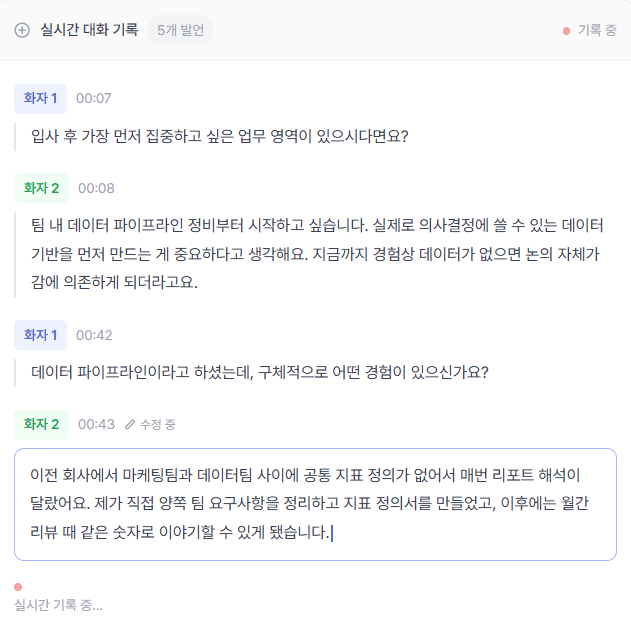
3. The AI Assistant Surfaces What Answers Reveal and Suggests Follow-Up Questions
As the interview runs, the AI Assistant quickly organizes the competency signals in each answer. It summarizes long answers on the spot, so interviewers don’t lose the thread and can move naturally to the next question. If the scorecard still has competencies you haven’t covered, or areas that need a closer look, it also suggests follow-up questions to fill the gap.
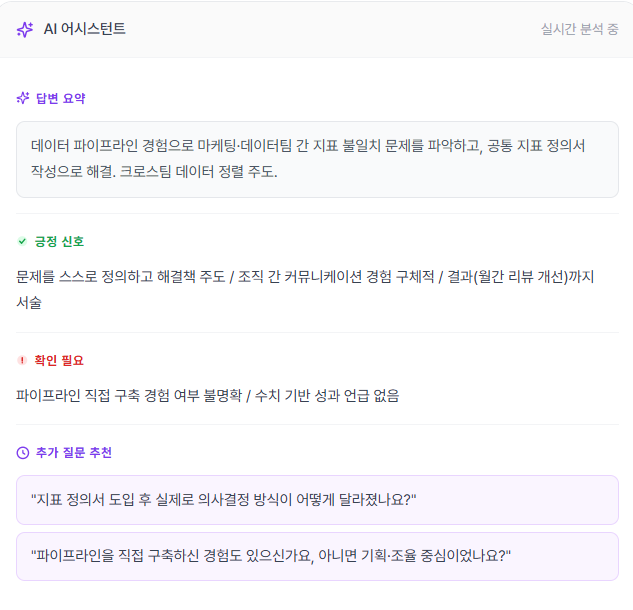
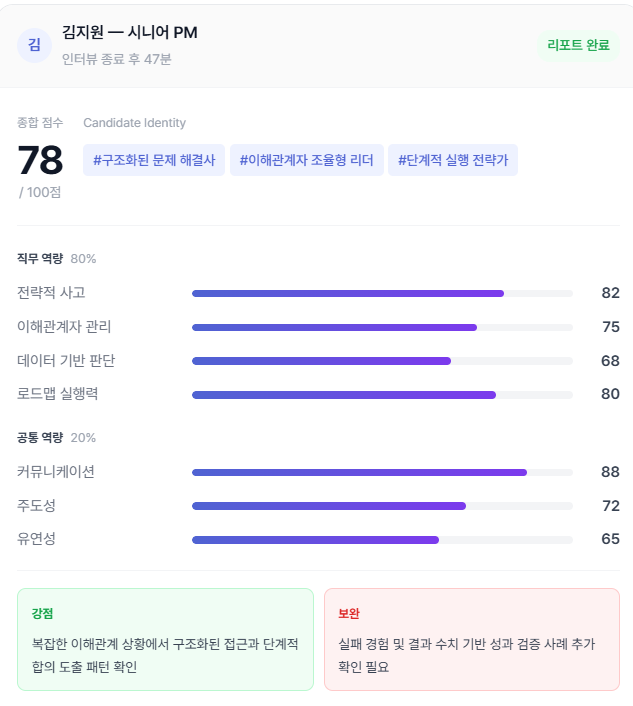
4. Interviewers, Recruiters, and Hiring Managers Discuss Candidates from the Same Competency Report
When the interview ends, Telta generates a competency report covering the candidate’s strengths, development areas, and points to verify further. Interviewers, the recruiting team, and hiring managers can discuss the candidate from the same report instead of relying on one interviewer’s memory or impression. The interview, now a structured record, becomes the basis for reviewing the hiring decision.
Struggling to Design a Scorecard? Log In to Telta One Minute Before Your Interview
Building a polished interview scorecard from day one is hard. Start by turning the interview conversation into an objective record. With Telta Interview Pro, simply starting the recording a minute before the interview gives everyone in your organization a shared base of evidence for reviewing candidates.
If you want to move beyond hiring decisions based on memory and impressions, it’s time to capture your interviews as data. Start making more consistent evaluations and faster decisions with Telta Interview Pro.
👉 Try Telta Interview Pro for Free
AI Interviews: Frequently Asked Questions
1. Do Companies Have to Tell Candidates They’re Using an AI Interview Tool?
Yes. Under Korea’s Personal Information Protection Act (in Korean), when a company processes personal information through automated decision-making, including AI, to decide whether to hire someone, it must notify candidates clearly in advance and is obligated to obtain their consent (in Korean).
2. Does Telta Interview Pro Act as an AI Interviewer?
No. Interview Pro does not talk to candidates the way an interviewer does. It is an AI tool designed from the ground up for hiring interviewers, providing the evidence they need to review candidates. It analyzes what candidates actually say, organizes the data by competency, and supports the final decision as a hiring assistant.
3. Which Competencies Can Telta Interview Pro Assess?
Based on what candidates actually say, Interview Pro produces a report with scores and supporting evidence for each role-specific and core competency. Its competency standards are built on global benchmark data, so you can analyze candidates against reliable criteria even for a position you’re hiring for the first time.
Reviewer’s Note
An interviewer’s intuition matters, but an evaluation becomes valid only when that impression is backed by concrete behavioral evidence. A good scorecard doesn’t add more boxes for scores. It is structured so interviewers record which words and actions their judgment was based on. Adding a review of observed facts to discussions that used to stop at impressions, and aligning on evaluation criteria in advance, can on their own sharply reduce hiring errors.
Dr. Younghoon Hwang
Co-founder & Head of Assessment and Consulting, Telta
Ph.D. in HR, Seoul National University
Former, National Human Resources Development Institute (Ministry of Personnel Management)
Former, HL Group Learning & Development Institute
Has designed competency models, assessments, and culture surveys. At Telta, he leads the design of competency models, rubrics, and scoring criteria, and oversees assessment quality.
Related Reading
- What Is a Structured Interview? How to Reduce Rating Gaps Between Interviewers
- K-Beauty Case: AI Interview Analysis for Consistent Interview Ratings
Related Articles
.webp)
.png)