Why LEGO Redesigned Its Leadership Framework



Most companies have a set of leadership principles somewhere. There’s the model people learned in training and the values a culture program emphasized. Each makes sense on its own, but when a real decision comes up, it can be hard to tell which one to follow first.
LEGO ran into exactly this problem when it set out to rework its leadership framework. According to a 2023 case study by the business school IMD, the company had accumulated as many as 28 overlapping leadership models and development and change programs. There was no shortage of language describing “good leadership,” but the behavior LEGO actually expected never came through clearly.
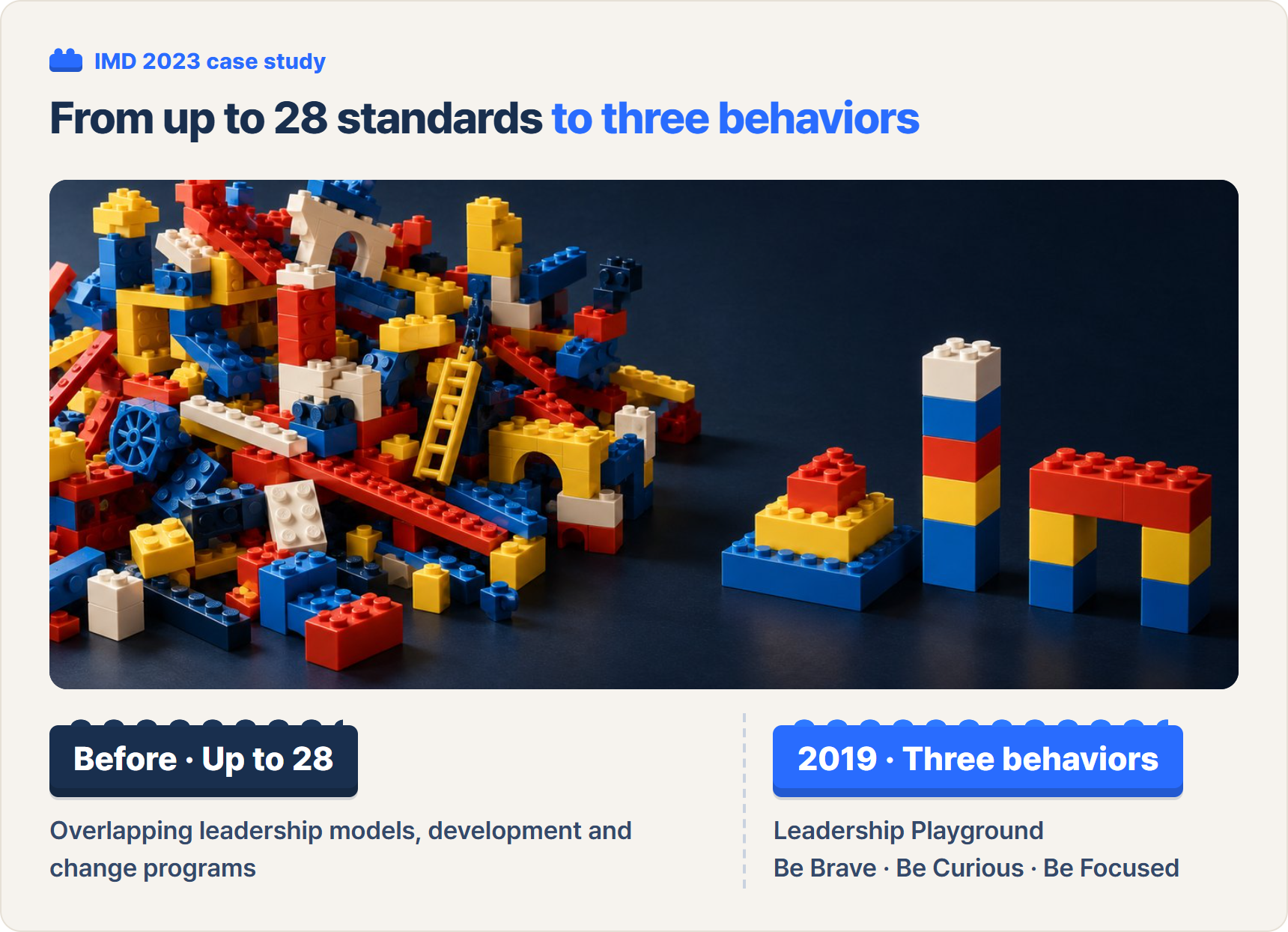
Instead of adding one more set of principles, LEGO revisited what to keep and how everything should work together. What stands out is not just the wording of the three behaviors. LEGO designed, at the same time, who would set the standard, what authority they would have to change the existing system, and how teams would actually talk about it.
Several Good Standards Can Still Leave Expectations Unclear
As an organization grows, training programs and principles multiply to meet new challenges. One period stresses execution; another stresses collaboration or experimentation. When a new framework is layered on while earlier programs are still in place, employees may have to absorb conflicting expectations at the same time.
The IMD case study notes that long-tenured employees were attached to the models they knew, and that turning multiple frameworks into behavior was hard. What mattered was less the number of programs than the fact that the behavior they expected wasn’t clear.
Imagine one program that emphasizes moving fast and another that emphasizes building consensus. A team deciding whether to launch a new product could fall under both. Without guidance on which decisions call for testing first and which call for reviewing together, the same action can look very different depending on who is evaluating it.
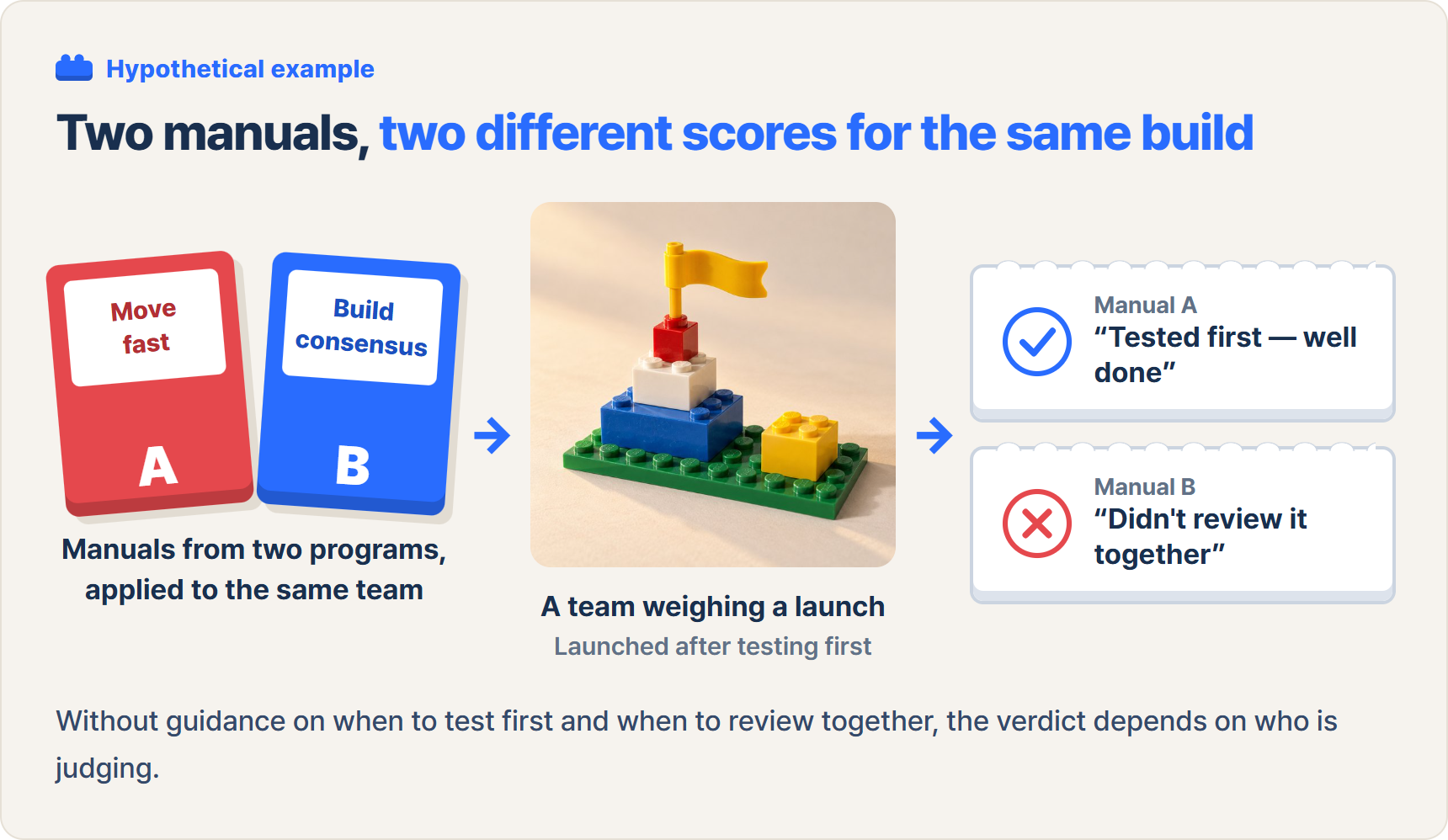
In a situation like this, start by asking whether you lack principles or whether the relationship between the principles you already have is unclear. Whether to add training or first sort out the existing standards depends on the cause of the problem.
Employees Helped Create the New Standard
LEGO formed a working group of 15 employees representing different regions and functions. Through three two-day workshops in 2018, run with IMD, the group designed the Leadership Playground, which LEGO introduced in 2019. The working group was also given the authority to scrap existing models and frameworks it didn’t need.
Focusing only on the fact that employees gave input misses the point of this process. Asking people whether they agree with wording that’s already been decided is different from letting them judge what’s needed and change the existing system.
A participating group can’t, of course, solve every problem on behalf of every employee. There is a business direction to follow and values to uphold. Still, the people who use the standard on the ground had room to describe the problems, challenge familiar ways of working, and choose which standards to keep.
When you design for participation, deciding who takes part and deciding who holds which decision rights go together. Participation leads to results when you can tell people what can change and what must stay, and which input was adopted on what grounds.
Three Behaviors Became a Shared Language at Every Level
LEGO’s official leadership culture page now presents the Leadership Playground as a way for anyone to explore leadership, regardless of position. The foundational behaviors are Be Brave, Be Curious, and Be Focused.

Be Brave means contributing constructively and challenging familiar ways of doing things. Be Curious means asking questions, learning, and experimenting. Be Focused means setting priorities in line with the company’s purpose and delivering on commitments.
None of the three words is unfamiliar. What matters is whether they mean roughly the same thing in day-to-day work. “Brave” could be read as license to take risks without enough scrutiny, and “focused” as an instruction to protect your own goals and ignore what other teams need.
In a hypothetical product team, that conversation might cover raising the risks in an existing plan with evidence, proposing a small experiment to test customer response, and deciding which of several requests to finish this week. Team members know what to try only when principles are explained as concrete work behaviors.
Shared Principles Turned Into Team Conversations
The IMD case study describes Playground Builders, who help teams discuss the new leadership model in their own context. The 2023 case study puts their number at 1,800. Rather than announcing the principles and leaving everyone to interpret them alone, LEGO had colleagues help facilitate team conversations.
Even when the whole company speaks the same principles, how they apply looks different from role to role. A team whose commitments to customers are hard to change and a team testing new ideas won’t practice “brave” in the same way. People need a chance to discuss what the shared behaviors mean in their own work while keeping them common.
If your team has this conversation, reviewing specific choices works better than trading abstract praise. You can talk about which opinions were hard to voice, what you learned from which experiment, and how you decided when priorities collided.
Problems that individual commitment can’t solve may also surface. If people are encouraged to experiment but never get a chance to explain a failure, you can’t expect brave behavior. If leaders say “do the important work first” while piling on new requests, no amount of personal effort will keep a team focused. The conversation has to look at these conditions too.
Behind Simple Principles, the Work of Running Them Remains
The LEGO case shows how streamlining leadership principles ties into how an organization runs. Who takes part in setting the standard, what they have the authority to change, and how each team interprets it all come up together.
That said, this program alone can’t explain the company’s business performance. Products, markets, distribution, strategy, and many other factors play a role. IMD also helped design the program, so this case study is that partner’s account and interpretation of the process.
If you bring this case into your own organization, you don’t need to start by copying LEGO’s three words. First look at where the principles you already use help people decide and where they clash. That’s why it’s worth laying the existing system out on the table and talking it through before deciding whether to bring in a new model.
Asking employees to remember principles is different from helping them explain and make real work decisions with those principles. Once you’ve streamlined a leadership framework, you also need to decide who will help people apply it to their work, and how.
References
- IMD · Building a new strategy, top-down and middle-out: 2023 case study. The 28 includes development and change programs as well as models; the 1,800 figure is as of the case study’s publication.
- LEGO · Our Leadership Culture: The three shared behaviors and a leadership culture open to everyone regardless of position.
Related reading: Culture and Leadership Assessments: What to Do After the Results Arrive
Related Articles