Executives Are Twice as Likely as Employees to Trust AI Over Their Own Judgment
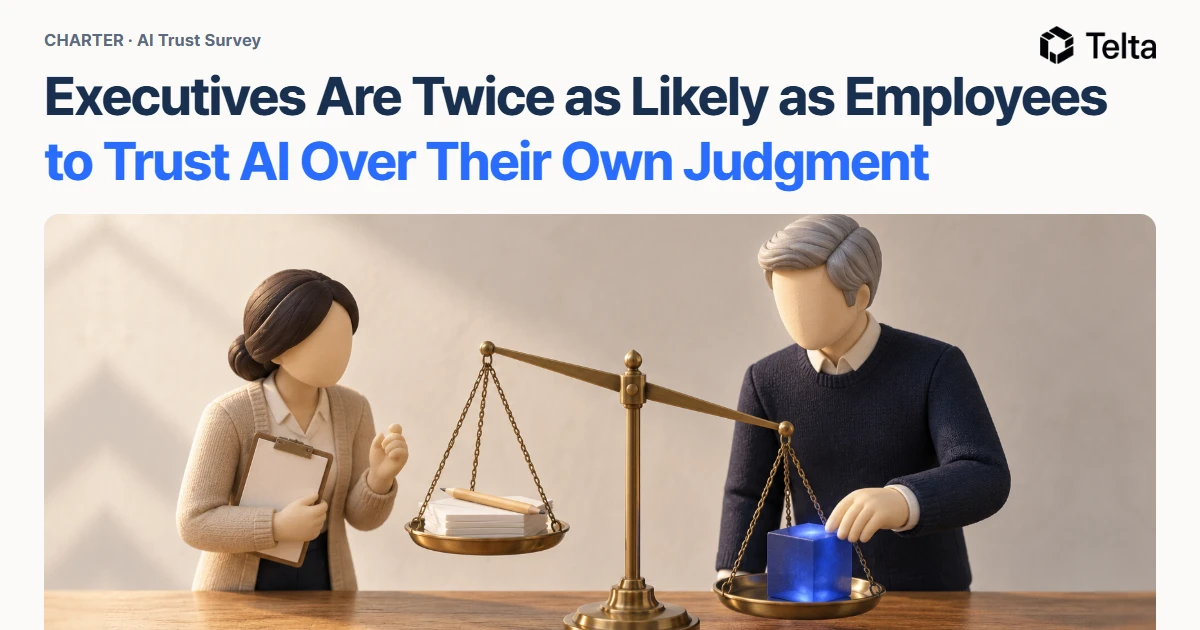


When an AI’s answer and your own judgment disagree, which one do you go with? In the Charter AI Pulse, released on October 21, 2026, executives were more likely than employees to side with the AI. Executives were about twice as likely as the employees they lead to trust AI over their own judgment.
If the people who trust AI most are the ones making decisions, who checks the AI answers behind those decisions? The Charter AI Pulse has several findings that help trace that question. Who benefits from AI, how managers’ support looks to employees, and who hides their AI use all varied by level.
5,002 People Were Asked Whether AI Had Made Their Work and Life Better
The survey covered 5,002 U.S. office workers, managers, and executives who use AI. To understand the reasons behind the survey results, the researchers also interviewed 91 people. The research was led by Charter’s Brian Elliott and Christina Janzer, formerly SVP of Research and Analytics at Slack.
Charter didn’t measure how often or how quickly people use AI. It asked whether AI had actually made their work and their lives better. About two-thirds said their work had improved at least somewhat, but fewer than half said the same about their lives.
42.7% of AI users said both their work and their life had improved at least somewhat. Only 10.5% said both had improved “significantly.” Charter singled out this 10.5% as the people who are “thriving” with AI. Both figures use all AI users as the base, and the 10.5% is part of the 42.7%.

Executives Trusted AI’s Answers More Than Employees Did
Charter compared how much executives and employees trust AI on three measures. Executives were 2.5 times as likely as employees to trust AI output. They were about twice as likely to trust AI over their own judgment, and more than twice as likely to trust AI over a colleague they know well. Each multiple comes from a different question.
Charter headed this finding “Bosses are the ones handing over their thinking to AI.” In the same section, it added that about one in five executives regularly uses AI output they have doubts about. Trusting AI more and using questionable output both showed up in the same group of executives.
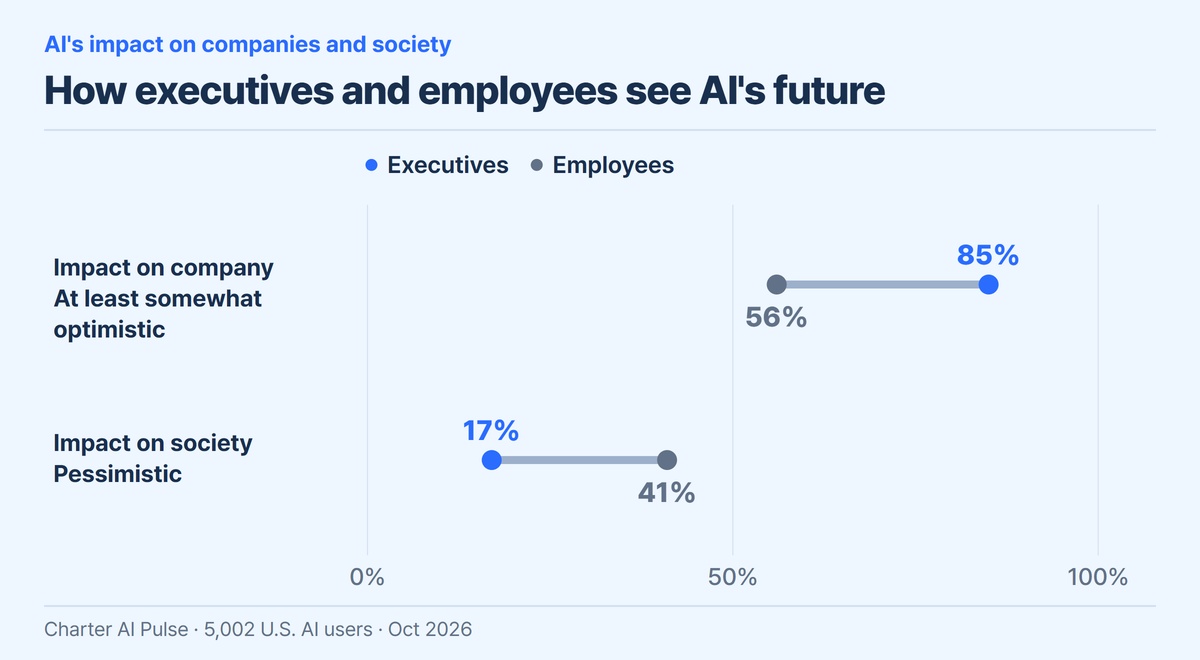
Views of AI’s future also split by level. 85% of executives were at least somewhat optimistic about AI’s impact on their organization, compared with 56% of employees. Conversely, 41% of employees were pessimistic about AI’s impact on society, compared with 17% of executives.
Agency, Not Advanced Skills, Set Apart Those Who Benefited
So who actually benefits from AI? The strongest predictor Charter identified was “agency”: how much people take part in deciding how AI comes into their own work and how much they can influence the way they use it.
Answers also varied with frequency of use. People who use AI daily were twice as likely as weekly users to say it helps both their work and their life. Advanced uses, such as building agents themselves, were far less related to whether people benefited. Charter summed it up in a heading: “Agency matters more than agents.”
Managers Said They Were Helping, but Employees Rarely Saw It
Of the top 14 factors linked to employees benefiting from AI, 11 were manager behaviors. Yet managers and employees remembered those behaviors differently. Managers were twice as likely to say they provided the recommended support as employees were to recall seeing their managers do so. According to Charter’s introduction to the study, the two responses differed by 23 to 30 percentage points. Charter calls this the “demonstration gap.”
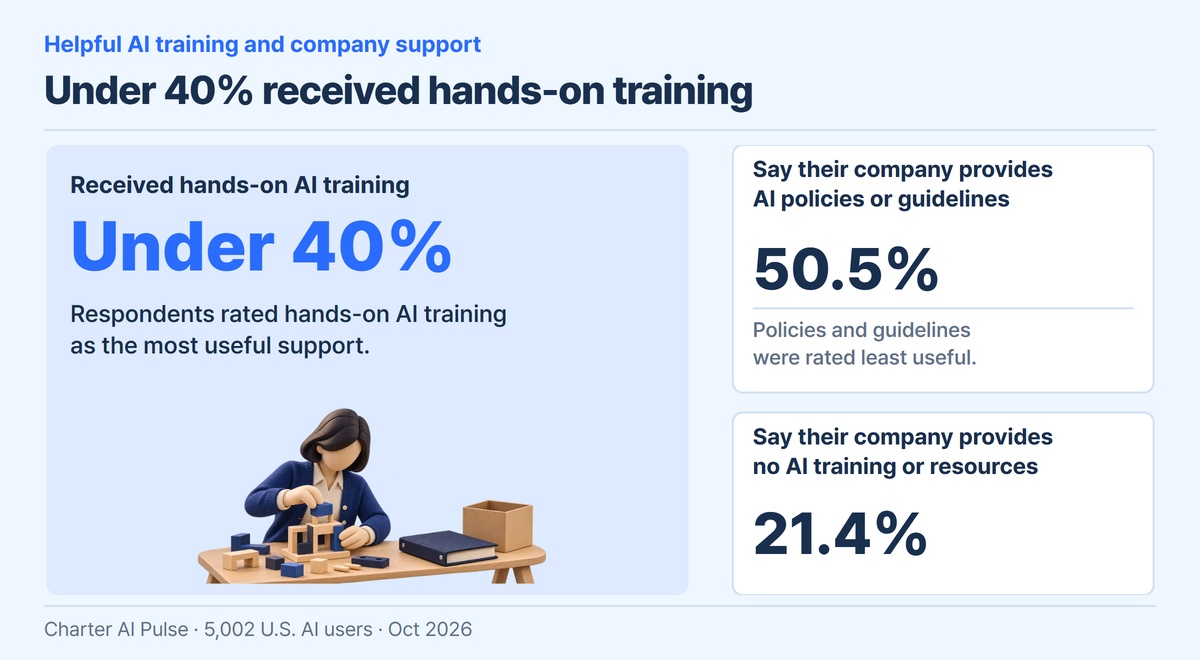
Training showed a similar mismatch. The support AI users valued most was hands-on training, yet fewer than 40% had received it. Users were 2.3 times as likely to name hands-on training as valuable as they were to name dedicated time to experiment. AI policies and guidelines were rated the least useful resource, and 50.5% said their company provides them. 21.4% said they had no AI training or resources at all.
Hiding AI Use Was the Behavior Most Strongly Tied to Burnout
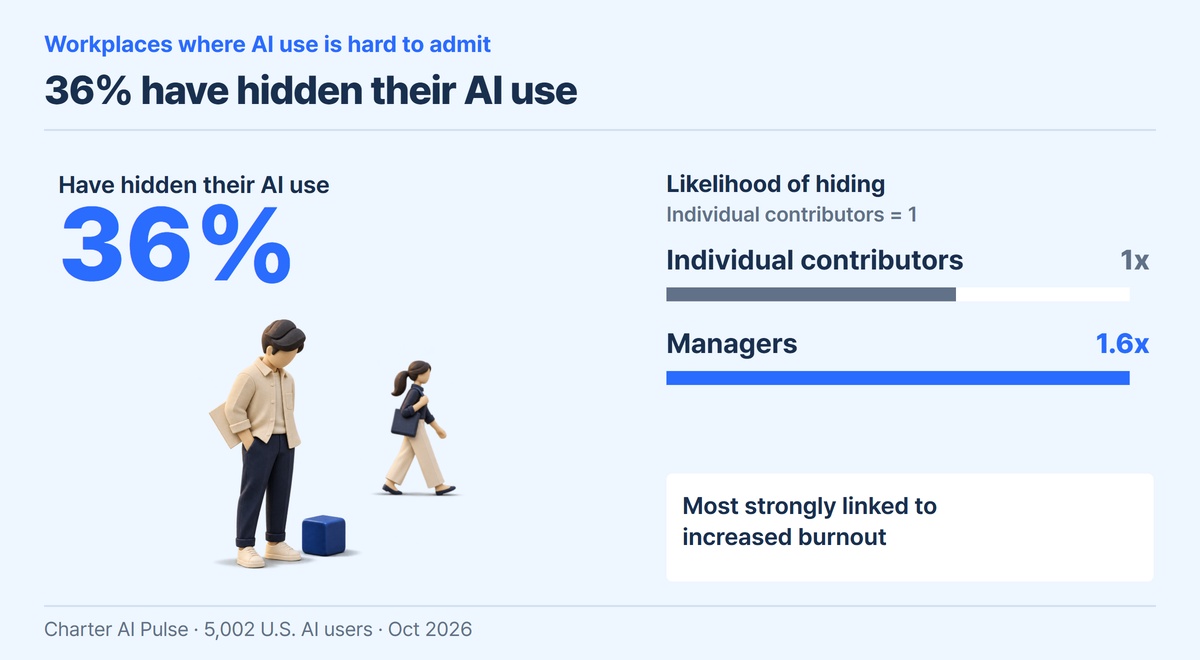
36% of AI users had hidden their AI use from a manager, colleague, or client. The most common reason was not wanting to look incompetent. Managers were more likely to hide it: 1.6 times as likely as individual contributors.
In Charter’s analysis, hiding AI use was the biggest factor raising the likelihood of burnout. It was also what most clearly separated people whose burnout rose while working with AI from those whose burnout fell.
When Decision-Makers Trust AI, Who Reviews Its Answers With Them?
The Charter AI Pulse breaks down AI users’ self-reported experience by level. Put the findings side by side and a picture of one organization emerges. Executives trust AI more and feel more optimistic about it. Managers believe they are offering support, but employees rarely see it. And roughly one in three people hides the fact that they used AI. In an organization like this, it’s hard to see what checks an AI answer went through before it shaped a decision.
That’s why leaving the review of AI answers to frontline employees alone isn’t enough. When leaders share a draft made with AI, they need to show which sources they checked and where the uncertainty lies, so that their teams can push back. And saying you used AI must not read as a sign of incompetence, or the review process stays hidden. The faster AI helps you prepare a decision, the more you need a place where people can challenge it.
References
Charter AI Pulse research summary · Introducing the Charter AI Pulse (Oct. 21, 2026)
Related Articles