Shopify’s Peer Bonus, Explained by Founder Tobi Lütke


Three months in, one new hire wasn’t working as effectively as Shopify had expected when it hired them. As the probation period came to an end, the company set up a one-on-one and opened the records in Unicorn, an internal tool. They held an unusually large number of thank-you messages addressed to that employee. What had colleagues been getting from this person?
Shopify co-founder Tobi Lütke told this story in a 2011 Business of Software talk. He explained that the employee had been spending a lot of time solving other people’s small problems. The colleagues’ records, pulled up to prepare for the meeting, showed contributions that deserved to be weighed alongside the results the company had expected. [1]

The Days of Knowing Everything Over Lunch Were Over
To understand the story, start with how big the company was at the time. According to Shopify’s official announcement on October 17, 2011, it had 20 employees in 2009 and expected to reach about 100 by the end of 2011. The way people in a small company kept up with each other’s work needed rethinking. [2]
In his 2011 talk, Lütke said headcount had grown from 30 to 80 that year. He saw the stretch from 30 to 70 as the hardest. It was no longer possible for everyone to have lunch together and talk about what was happening across the company, and developers found it hard to know what the sales team had accomplished. [1]

In this setting, Unicorn was a channel for making colleagues’ work visible across the company. When someone did something good, others could leave them a thank-you that the rest of the staff could also see. In the 2011 talk, Lütke explained that employees could browse the records or get a daily email digest. It was a way to hear what was happening elsewhere without sharing a lunch table. [1]
The Money in Your Account Wasn’t Yours to Keep
The tool tied money to the thank-yous. In a July 9, 2010, Mixergy interview, Lütke explained that employees received money in their accounts twice a month. The size of the allocation depended on how the company was doing, but each allocation gave every employee the same amount. In effect, the company put up the money and let employees pass it on. [3]
Employees couldn’t withdraw their own allocation. They had to send it to colleagues who had done good work. When someone helped them, or when they learned that a colleague had solved a problem, they sent that person part of their allocation. Money received from others, on the other hand, could be cashed out. The rules for money you were allocated and money you received were different. [3]
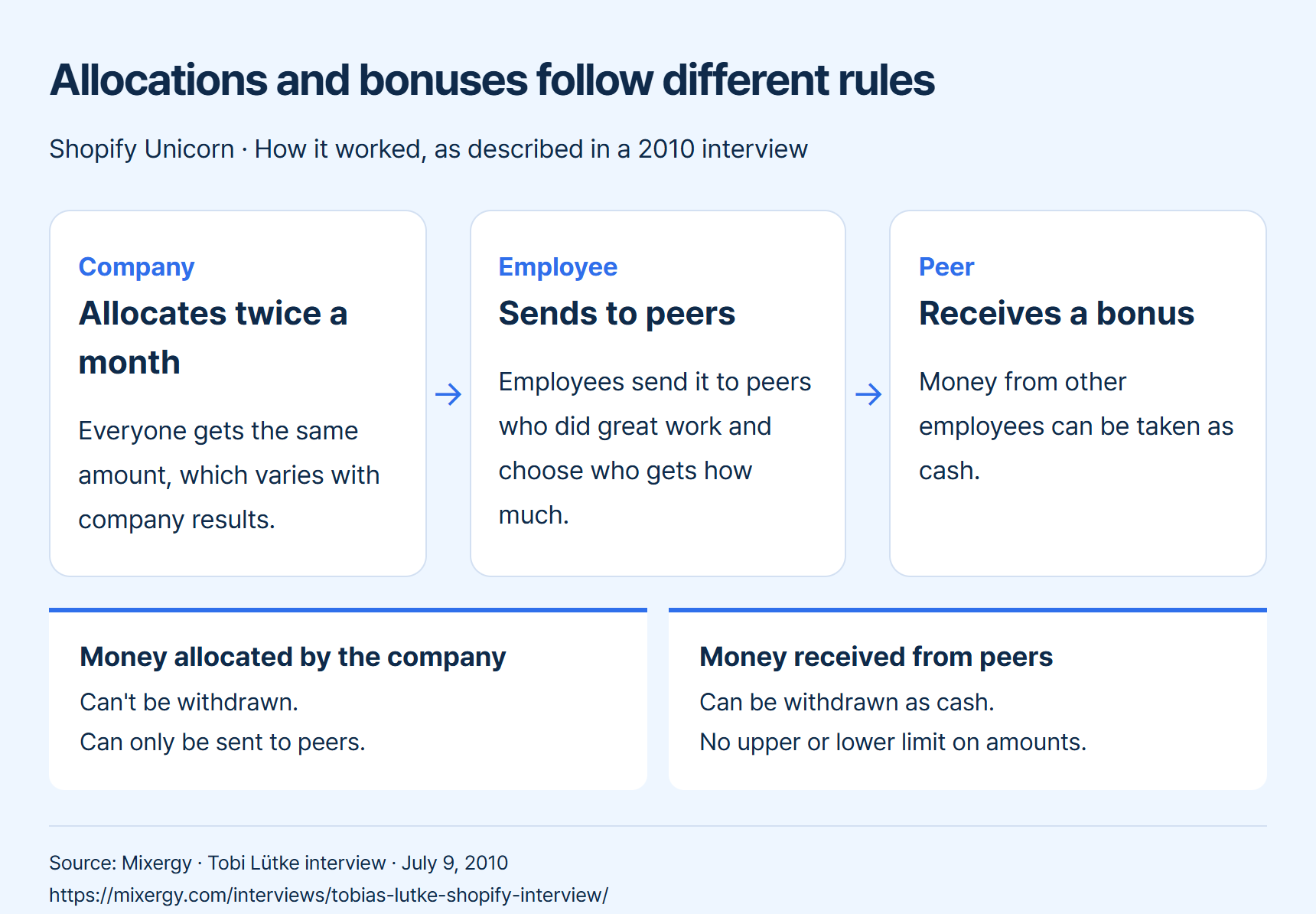
Employees also decided whom to send money to and how much. When the interviewer asked whether there was a cap or a minimum on the amounts, Lütke said there wasn’t. The company provided the money; colleagues chose the recipients and amounts based on the contributions they had seen. Where the money came from and who decided how to split it were kept separate. [3]
Helping a Customer Got Noticed by Colleagues
The example Lütke gave in the same interview came from customer support. A support rep builds a small application to fix one customer’s problem. When the customer thanks Shopify on Twitter, colleagues point out who did the work, and sometimes send that employee a Unicorn bonus. [3]
In that account, the customer who got help, the employee who did the work, and the colleagues who noticed appear one after another. That is a much wider field of view than leadership seeing and remembering every moment itself before handing out rewards. Through this example, Lütke showed colleagues spotting work done across the company and reflecting it in how bonuses were shared. [3]
If your organization collects records like these, you could ask people to note what happened along with the thank-you: who solved whose problem, what they helped with, and how the other person’s work changed as a result. The aim is to write it down specifically enough that whoever prepares a review later can understand the situation.
The Reason Performance Looked Weak Was in the Records
What the new hire’s records revealed was time spent helping colleagues. According to Lütke’s 2011 talk, the employee was spending a lot of time solving other people’s small problems. Lütke said this was how the employee was finding their way into the company, and that it was a big help to Shopify as well. Opening the thank-you records showed where the employee’s time had gone. [1]
That month, the employee received the second-largest bonus in the company. Lütke said that if it continued at that level, it would amount to roughly a 30% raise in base pay. [1]
As the meeting was being prepared, performance measured against expectations at hiring met the experience of the colleagues who had been helped. The employee the company saw as underperforming was already getting thanks and a sizable bonus from peers. In Lütke’s telling, the records became a way to look more broadly at the work this employee had been doing. [1]
This is the founder’s own account of how things worked at the time, describing what he found while making a call about one employee. To apply it in your organization, a good starting point is to work out how you will bring together what managers know and what the people someone works with know.
Before You Judge Performance, Ask the People Who Worked With Them
If you bring this case into your organization, start by asking whose experience you hear when you prepare a review. On top of the output a manager has checked, ask the people who worked with the employee what help they received. If you hear a story that differs from your first judgment, look together at which work each person is talking about and what each of them actually observed.
Ask colleagues for a concrete moment from recent work: what the problem was, what the employee did, and how their own work changed afterward. On your team, that conversation can go a step past a vague “They helped me a lot” and gather behaviors and situations a reviewer can actually examine.
When you read thank-you records, lay out the work originally expected of the employee alongside them. If time spent helping colleagues competed with their assigned work, you can discuss how the organization values that help and what the priorities should be going forward. Rather than turning a message count into a score, start by confirming whose problems they solved and what those problems were. That is closer to the question this case raises.
At your next review, if someone’s performance looks weak, hear more from the people they work with before you reach a conclusion. Put what they have contributed next to what they still need to deliver, and judge the two together. The last question before a review could be this: “To explain what this person contributed, whose story do I still need to hear?”
References
- Business of Software · Tobi Lütke talk and transcript · 2011: Growth from 30 to 80 employees, communication problems between 30 and 70 people, shared thank-you records in Unicorn, and the three-month employee’s contributions and bonus that month, as recounted by the founder.
- Shopify · Shopify Raises $15 Million in Series B Funding · Oct. 17, 2011: 20 employees in 2009 and about 100 expected by the end of 2011.
- Mixergy · How Shopify Became Profitable By Helping Anyone Open An Online Boutique · July 9, 2010: Equal allocations twice a month, sending them to colleagues, cashing out what you receive, who decides the amounts, and the customer support example.
- Shopify · Unite 2018 Keynote Roundup: Bringing Commerce to Everyone, Everywhere · May 18, 2018: Source of the photo of Tobi Lütke on stage at Unite 2018.
Related Articles