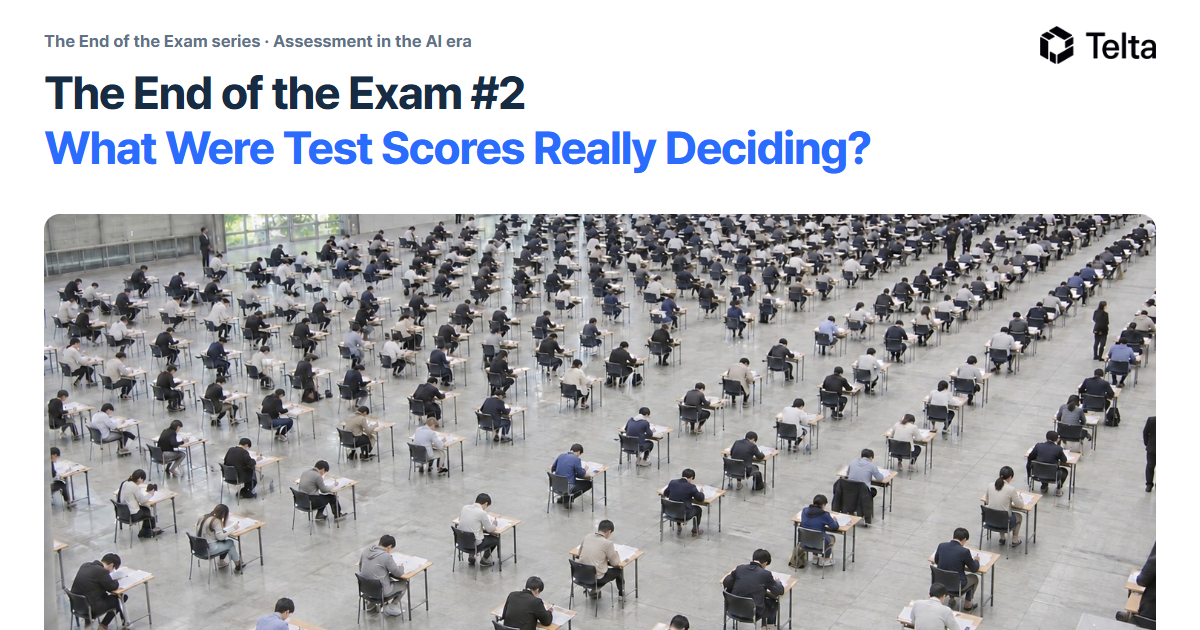
The End of the Exam #3 — When Exams Lose Their Meaning, What Should We Judge People By? Assessing Candidates in the AI Era



The top scorer on Korea’s certified tax accountant exam photographed the questions, sent them to a generative AI tool, and got back the answers. As Part 2 showed, test scores have long served as a proxy for the question employers really care about: will this person get the job done? AI has shaken both assumptions that proxy rested on: that people solve the problems on their own, and that knowing the right answer means doing the work well. The more a test hinges on a single right answer, and the shorter that answer, the easier it is to copy one over from AI. Right-answer tests, used for decades because they are easy to score, have become the most vulnerable form of assessment in the AI era. A reanalysis of selection methods likewise found that the best predictors of on-the-job performance were tools designed around the work itself, such as structured interviews.[1]
So when exams lose their meaning, what should we judge people by? The answer is to put AI to work on the evaluator’s side. When AI handles the scoring and note-taking, written assessments and in-depth interview analysis, once limited by cost to small groups such as senior officials and executive candidates, can reach far more people. Part 3 looks at the ways AI can be used in assessment, which kinds of assessment each one suits, and why they offer more reliable evidence now that answers are so easy to get from AI.
Assessments that ask for the reasoning behind a judgment play out differently from right-answer tests. Candidates have to read several sources and write out their judgment at each step, so they can’t simply photograph a question, send it off, and copy back a short answer. More importantly, interviewers can follow up on what candidates wrote and said to confirm the judgment was their own. And if an assessment allows AI and evaluates how candidates use it, there’s no reason to hide it.

Assessments That Look Beyond Knowledge Were Labor-Intensive, So They Were Mostly Kept for Senior Candidates
Methods for assessing abilities beyond knowledge have been around for a long time. The U.S. Office of Personnel Management (OPM) points to three leading examples: structured interviews, which ask every candidate the same predetermined core and follow-up questions and score the answers against set criteria; work samples, which have candidates perform tasks that mirror the actual job; and assessment centers, which combine several exercises observed by multiple assessors.[2][3][4]
The catch was cost. According to OPM, work samples take considerable time and money to both develop and administer, and assessment centers need several trained assessors and plenty of space, so large applicant pools must first be narrowed through prescreening. Structured interviews, too, are often used for final selection late in the process or when there aren’t many applicants.[2][3][4]
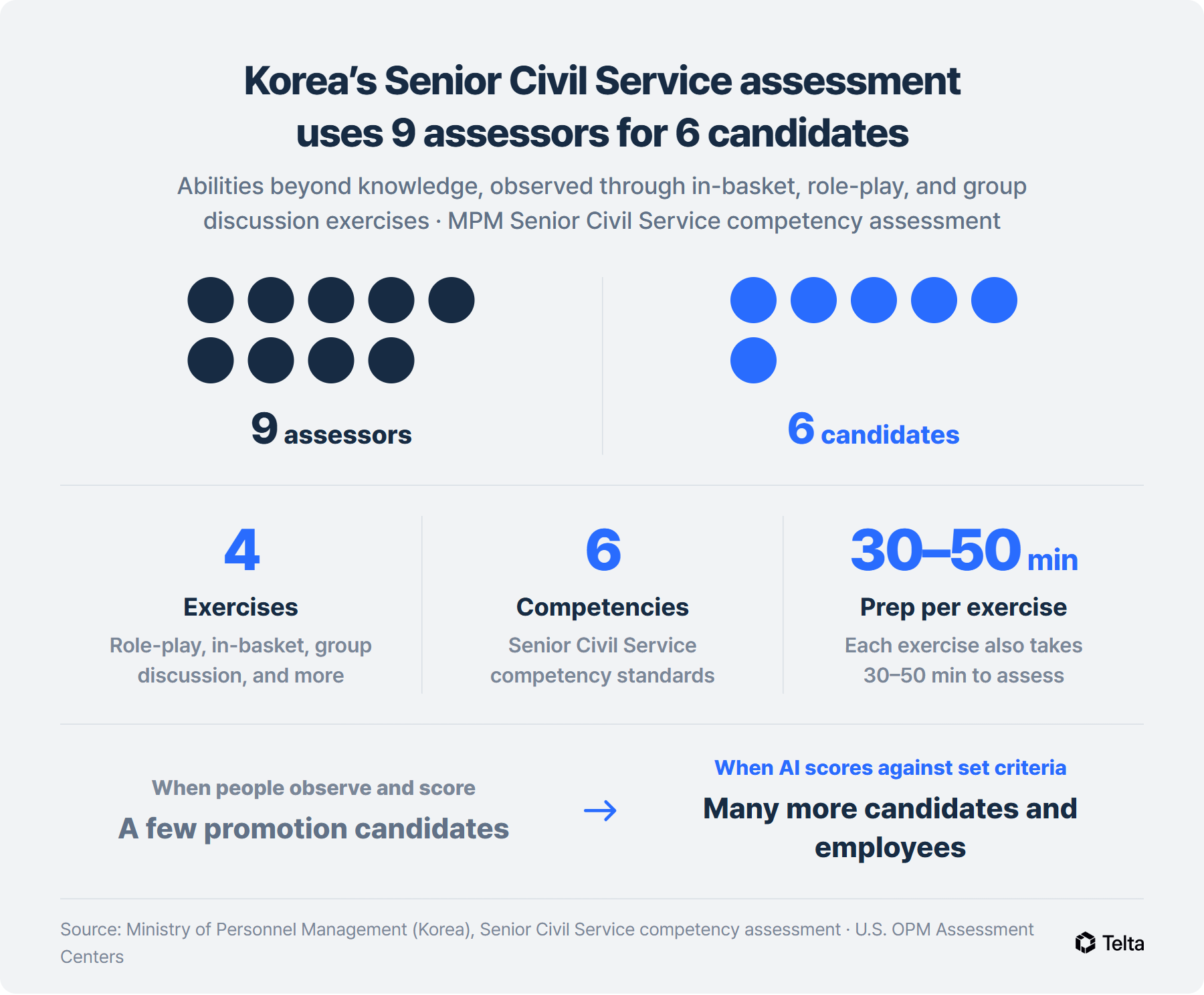
Korea was no different. When the government launched the Senior Civil Service in 2006, it introduced competency assessments built on the assessment center model. Under the current rules, candidates complete four exercises, including a role-play, an in-basket exercise, and a group discussion, while nine assessors jointly observe and evaluate six candidates.[5] Because multiple assessors watch each candidate work, these assessments take a lot of people to run. In companies, too, written and observational assessments were used mostly where the pool was small, such as promotions to executive and team leader roles or selecting high-potential talent. In the early stages of high-volume hiring, right-answer tests that are easy to score did the work.
With AI Handling Scoring and Note-Taking, These Assessments Can Now Reach Many Candidates and Employees
What AI changes is this cost structure. People design the assessment criteria; AI scores written answers against those criteria, records what candidates say in interviews, and organizes the evidence. Assessments once reserved for a handful of executive candidates can then be used with large numbers of candidates and employees.
AI does three main jobs in assessment. It extracts and organizes evidence from candidates’ application materials and interview responses, scores written answers against the assessment criteria, and makes the way a candidate uses AI something to assess in its own right. Applied to the assessment stages of hiring, promotion, and training, these jobs add up to four approaches that can serve as grounds for selection.
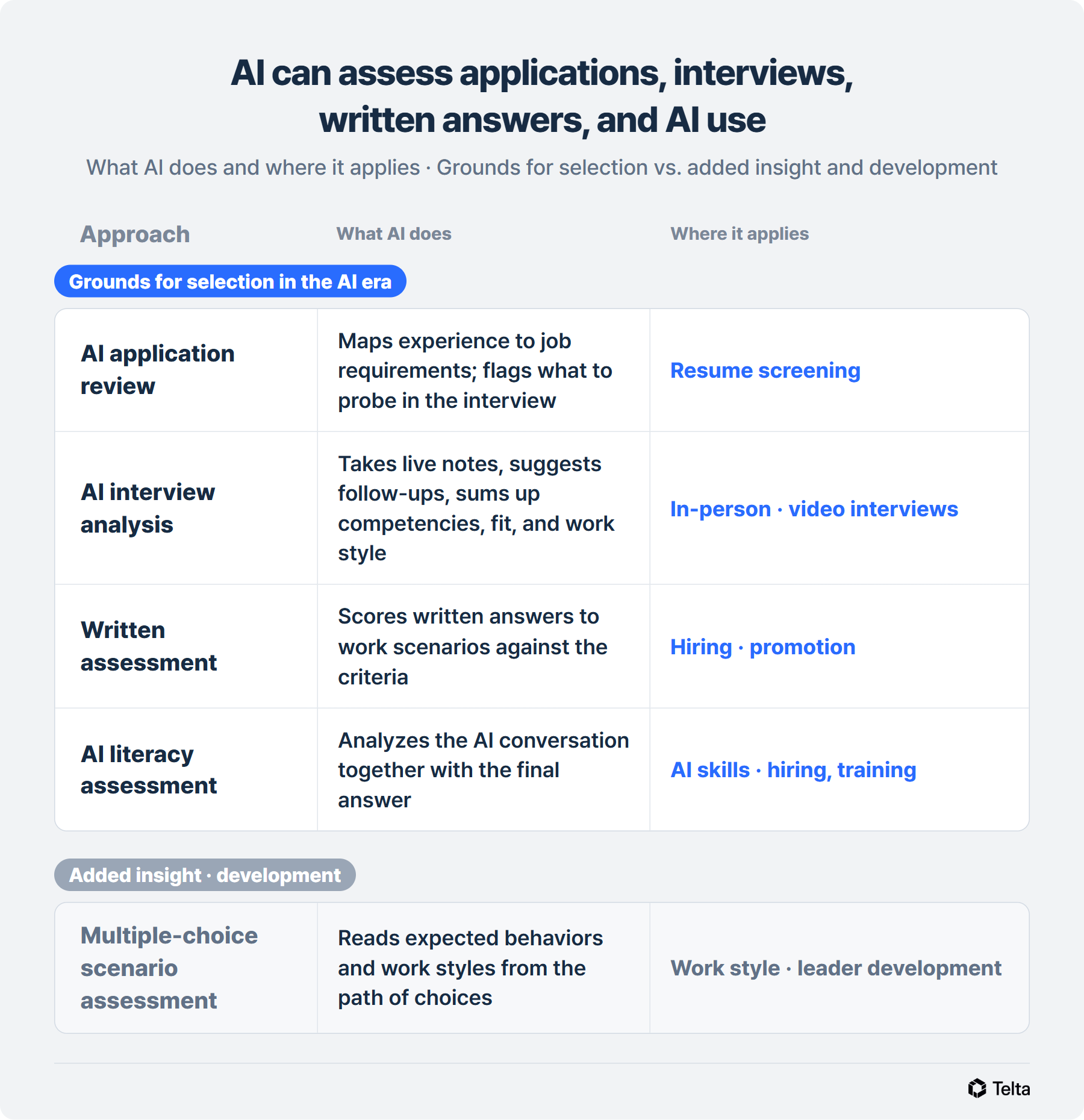
AI application review: Looking past polished prose to experience that fits the role. At the resume screening stage, AI uses the requirements in the job description as its benchmark, examines the roles candidates played on projects and what they achieved, and summarizes the experience that fits the role. It also notes reasons to review a candidate first and points to check in the interview. AI can polish an application’s wording as much as anyone likes, but how a candidate’s experience connects to the job requirements can be checked again in the interview with verification questions. A state-owned energy company took this approach in a hiring validation project, linking resume screening and interview verification under the same criteria.[6]
AI interview analysis: Turning a face-to-face conversation into evidence. When an interviewer sits across from a candidate and follows up on the spot, AI can’t easily answer for the candidate. Interviewers run the interview themselves, while AI interview analysis records the conversation in real time and suggests questions to verify how the candidate actually did what their application describes. After the interview, it produces a candidate analysis grounded in what the candidate actually said, covering verification results for their experience, job competencies, fit with the company’s ideal talent profile, and even their work style.[7]

A K-beauty company (Company A) needed to hire quickly for overseas channel sales, brand MD, and performance marketing roles across several brands, but each of the business leaders conducting interviews judged candidates by different standards. After adopting Telta Interview Pro, interviewers stopped transcribing and focused on the conversation, and candidates seen by different interviewers could be compared on the same role-specific competency criteria, each based on what the candidate actually said. When reporting to executives, the team explained hiring decisions with candidates’ own words rather than impressions.[8]
Written assessments: Extending an assessment once reserved for a few to many candidates. These assessments present a work scenario and ask candidates to write out how they would handle it. For a B2B sales role, a candidate might review data on a client whose sales have declined and plan a strategy for the next meeting, while the assessment looks at problem diagnosis, judgment about the client, and prioritization.[9] Because candidates must read several sources and write out their judgment at each step, cheating is harder than on a right-answer test, where photographing a question and copying back a short answer is enough. The judgments in a written answer can also be probed in the interview. Asking why the candidate chose to meet that client first, or why they ruled out other options, shows whether the judgment was really their own. In Telta’s job simulations, HR experts first design assessment criteria suited to the role, and AI scores and analyzes the answers against those criteria to produce a report. Because assessors no longer have to read and score every answer by hand, the assessment can run even in high-volume hiring.[10][11]

AI literacy assessment: Evaluating how people work with AI. In June 2025, the design platform Canva replaced the fundamentals interview for its backend and frontend engineering hires, in which candidates solved algorithm problems without AI, with an “AI-assisted coding” interview. Canva explained that nearly half of its engineers already use AI coding tools every day and that catching candidates secretly using AI was difficult, so it chose to let them use it openly. In return, it sets problems a single prompt can’t solve, such as building an air traffic control system for a busy airport, and watches when and how candidates use AI and whether they find and fix problems in the code it generates. According to Canva, where candidates with less AI experience struggled was judgment more than coding skill.[12]
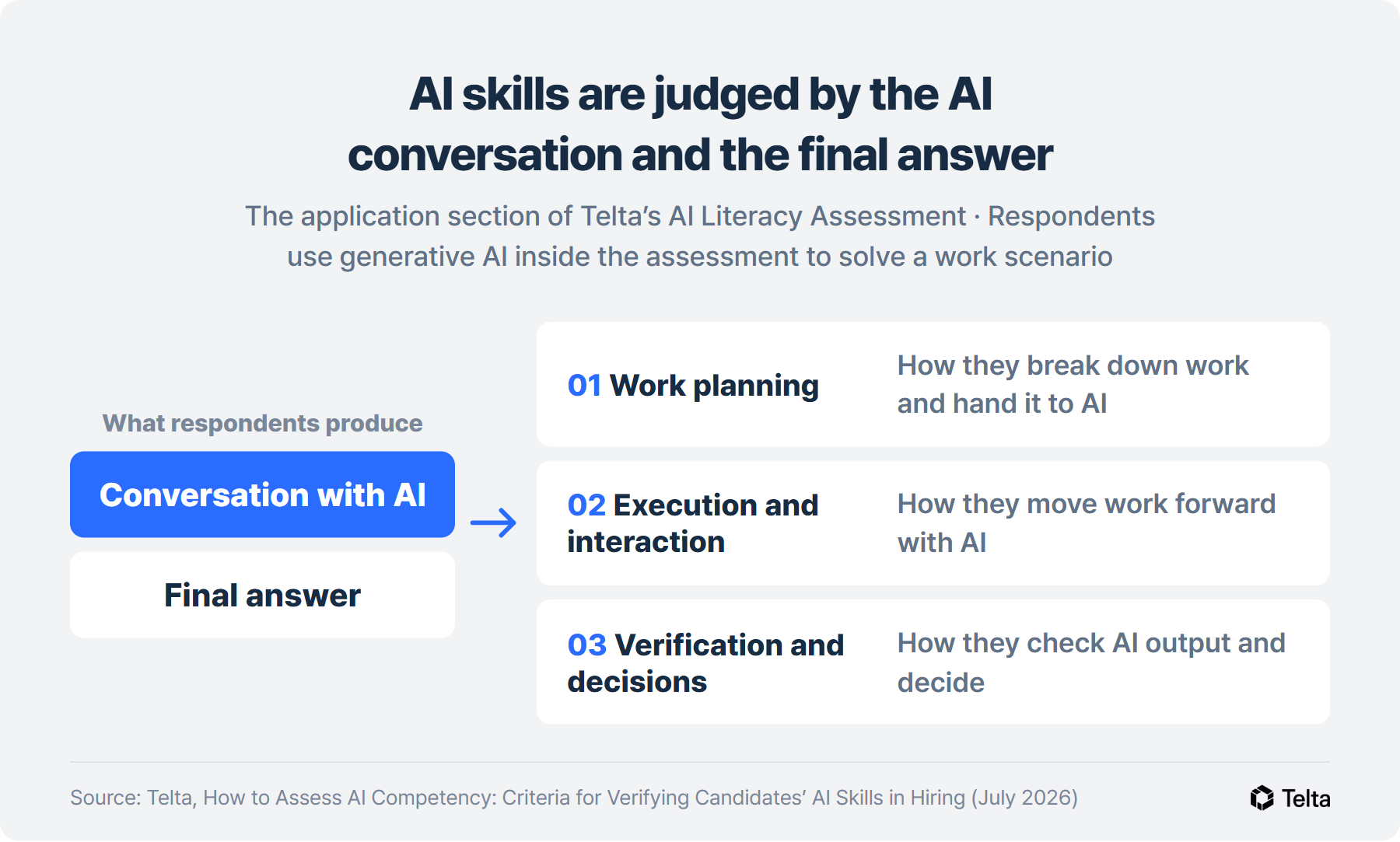
The same approach works outside engineering. At the heart of Telta’s AI Literacy Assessment is its application section, which evaluates hands-on AI skills. Respondents use generative AI directly inside the assessment to solve a work scenario, and their conversation with the AI is analyzed together with their final answer. The evidence comes from how they break down the work and hand parts of it to AI, how they move it forward through back-and-forth with AI, and how they verify AI’s output before making a decision.[13] This is also the assessment taken by the four reporters from Maeil Business Newspaper’s digital tech desk featured in Part 2. The task cast them as IT staff at a company, solving internal problems with AI. The reporter who placed first overall earned high marks for meta-prompting: before drafting the report, they had AI write the prompt for the draft.[14] What they handed to AI, and how, became the evidence for the assessment.
The assessment is used in training, too. A global logistics company (Company B) knew that most of its employees used AI routinely, but adoption metrics such as login counts couldn’t show whether they were using it well in their work. In practice, some employees had pasted AI-generated demand forecast drafts into reports without checking them, or entered client information into AI as is. Before rolling out company-wide training, Company B gave an AI Literacy Assessment to about 50 high-potential employees to find out first where the gaps were.[15] Assess the starting point before training, then reassess with the same version after a set period, and you can compare what changed in each sub-competency.[16]
Multiple-Choice Scenario Assessments Look Past Right Answers to Expected Behaviors and Work Styles
There are also multiple-choice scenario assessments, which present a situation and ask test takers to pick one of several options. They are multiple choice, but they differ from tests built around a single right answer. In Telta’s Immersive Scenario Assessment, test takers move through one continuous work story, such as their first weeks at a company or their first year as a team leader, and choose one of four actions in each scene; the characters’ reactions and the next situation unfold from the action they pick.[11] Say a new team leader is asked at the first team meeting to redraw how work is divided across the team. The test taker chooses whether to keep the existing structure, get briefed on the current state and draft an allocation plan themselves, or rearrange things on the spot in the meeting.
Which choice is better depends on how that company expects people to act in the same situation. Scenario assessments can be designed around a company’s own work situations and assessment criteria,[11] and they record the whole path of choices rather than a single choice to reveal a test taker’s judgment patterns and tendencies. Even an AI that knows the textbook answer will struggle to fully match the behavior a particular company expects, and because the story branches in different directions with each choice, the same path is hard to repeat. That’s why scenario assessments are most useful as information on whether a candidate fits the company’s way of working and what tendencies they have, and, for employees, as a development assessment that helps them reflect on their judgment patterns and find a direction for growth.

Telta’s New Team Leader Leadership Simulation opens with an individual contributor of 10 years suddenly becoming a team leader in charge of four team members with different levels of experience and personalities. It looks at the choices participants make across five core responsibilities: managing performance, managing work, managing people, managing stakeholders, and building team culture. In the report, participants compare their choices side by side with alternative responses to identify development priorities. Unlike 360-degree feedback, which needs at least six months of working together, it takes 15 minutes and can be used from a new team leader’s first day, so it was designed as a development assessment for new team leaders. For promotion or selection decisions, Telta recommends reviewing it alongside 360-degree feedback.[17]
So Results Serve Either as Grounds for Selection or as Added Insight Into Candidates
When using AI in assessment, start by deciding what the results are for. AI application review, AI interview analysis, written assessments, and AI literacy assessments leave evidence of judgment against consistent criteria, so they are used to make hiring and promotion decisions. Multiple-choice scenario assessments, trait assessments, and test-style assessments such as aptitude and personality tests serve as additional information for understanding candidates and employees better and confirming a baseline of fundamentals.
The same analysis can play different roles depending on how it is used. Results from an application review can inform a selection decision or help prepare interview questions. So first decide whether results will feed directly into selection decisions or be used to shape interview questions and training assignments, then design the criteria for that purpose. Using scores from an assessment built for development as a promotion cutoff, or rejecting candidates based on trait results that have no right answer, puts the results to a use the assessment was never designed for.
Either Way, People Make the Final Call After Reviewing the Evidence AI Organizes
The evidence AI records and organizes is there to inform human judgment. Telta’s assessments, too, focus on helping people make more accurate decisions.[18] AI application review lays out experience that matches the job requirements and points to check in the interview, and Interview Pro organizes verification results for a candidate’s experience along with their competencies, fit with the ideal talent profile, and work style, all grounded in what they actually said. Recruiters and hiring managers review this evidence and make the final hiring decision.[6][7] The AI that found answers for test takers in the exam hall in Part 1 becomes, on the evaluator’s side, a tool for seeing people more precisely.

Having people review the evidence and make the decision also matters under Korea’s AI Basic Act, which took effect on January 22, 2026. If you use AI in hiring, it’s worth checking how much the tool actually influences decisions and whether someone with the authority to change a decision is actually involved in making it.[19]
Frequently Asked Questions
Can we stop using aptitude tests and certifications now?
No. Aptitude and personality tests, along with qualifications and certifications, remain useful as additional information for confirming a baseline of fundamentals. Whether someone can actually do the job is a different question, though, so it’s best to check that as well with written assessments and interviews.
Couldn’t candidates use AI on written assessments, too?
Written assessments are much harder to hand off to AI than right-answer tests. Candidates have to read several sources and write out their judgment at each step, so photographing a question and copying back a short answer doesn’t work. The judgments in a written answer can also be probed in the interview to confirm they are the candidate’s own. If the role involves AI, you can allow AI outright and evaluate how candidates work with it, as an AI literacy assessment does.
Where to Start
You don’t need to overhaul every assessment at once. Start with one stage that currently relies only on right-answer tests.

- Hiring: Use AI application review for resume screening, written assessments to check job competencies, and AI interview analysis for interviews, so the same job competencies carry through from stage to stage. A scenario assessment can also show whether candidates fit your company’s way of working. Decide, too, at which stages to allow AI and at which to look at candidates’ own judgment.
- Promotion and leadership development: Help employees who have just become team leaders find a direction for growth with a scenario assessment, and for promotion reviews, combine methods that leave evidence of judgment, such as written assessments and 360-degree feedback.
- Training: If AI training is coming up, start by establishing a baseline for key people with an AI literacy assessment, then reassess with the same assessment after training to see what changed.
If you’re not sure which approach fits, tell Telta which role you want to assess and which competencies you want to verify. We’ll work with you to design an assessment that fits your organization.
Sources
- Sackett, Zhang, Berry, Lievens · Revisiting meta-analytic estimates of validity in personnel selection · Journal of Applied Psychology, 2022 — validity estimates in Table 3.
- U.S. OPM · Structured Interviews — definition, administration costs, and guidance on use.
- U.S. OPM · Work Samples and Simulations.
- U.S. OPM · Assessment Centers.
- Ministry of Personnel Management (MPM) · Competency Assessment for the Senior Civil Service (in Korean).
- Telta · Blind Hiring at State-Owned Enterprises in 2026: One Standard From AI Resume Screening to Interview Verification (in Korean) · September 17, 2026.
- Telta · Interview Pro Overview (in Korean).
- Telta · K-Beauty Case: AI Interview Analysis (in Korean) · June 29, 2026.
- Telta · How Can You Tell Whether a Candidate Will Do the Job Well Before You Hire? (in Korean) · October 12, 2026.
- Telta · Aptitude Tests vs. Job Simulations: What’s the Difference? (in Korean) · October 12, 2026.
- Telta · Assessment Overview (in Korean).
- Canva Engineering Blog · Simon Newton · Yes, You Can Use AI in Our Interviews. In fact, we insist · June 11, 2025.
- Telta · How to Assess AI Competency: Criteria for Verifying Candidates’ AI Skills in Hiring (in Korean) · July 31, 2026.
- Maeil Business Newspaper · Kang Young-woon · “AI Doesn’t Go by Seniority, Does It?” (in Korean) · April 20, 2026.
- Telta · Global Logistics Case: AI Literacy Assessment for High-Potential Talent (in Korean) · June 30, 2026.
- Telta · AI Literacy Assessment Overview (in Korean).
- Telta · Team Leader Leadership That 360-Degree Feedback Misses: How to Fill the Gap (in Korean) · May 22, 2026.
- Hankook Ilbo · Telta Helps Companies Assess Employees and Organizations Objectively With HR AI (in Korean) · November 6, 2026.
- Telta · A Must Before Adopting AI Hiring Tools: The AI Basic Act Checklist for Recruiters (in Korean) · August 4, 2026.
Related Articles