NVIDIA Reinstates Huang Six Days After Saying It Had No Plans to Do So
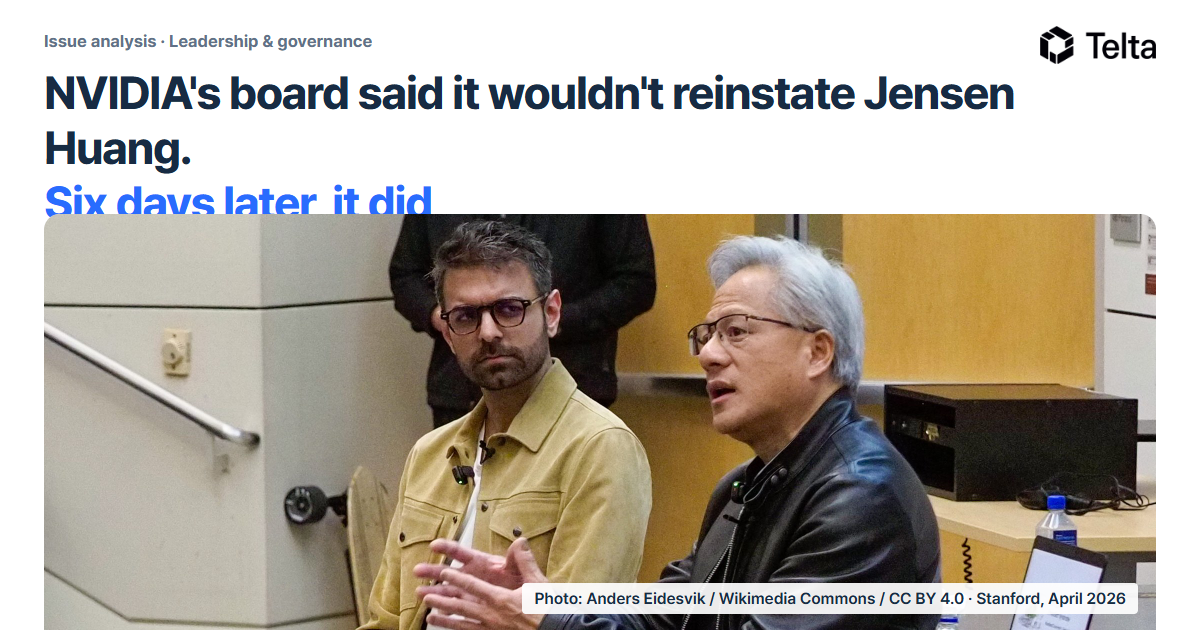


Before discussing quarterly results on NVIDIA’s November 17 earnings call, Board Chair Harvey C. Jones revisited the circumstances of Jensen Huang’s resignation. He also said the board did not intend to reinstate Huang as CEO. Six days later, on November 23, the same board unanimously reinstated Huang as president, CEO, and board director, effective immediately.
Can a company hold someone it depends on to the same standards as everyone else? NVIDIA’s reinstatement announcement offers some clues. In the same document that announced Huang’s return, the board described the investigation and oversight that would continue.
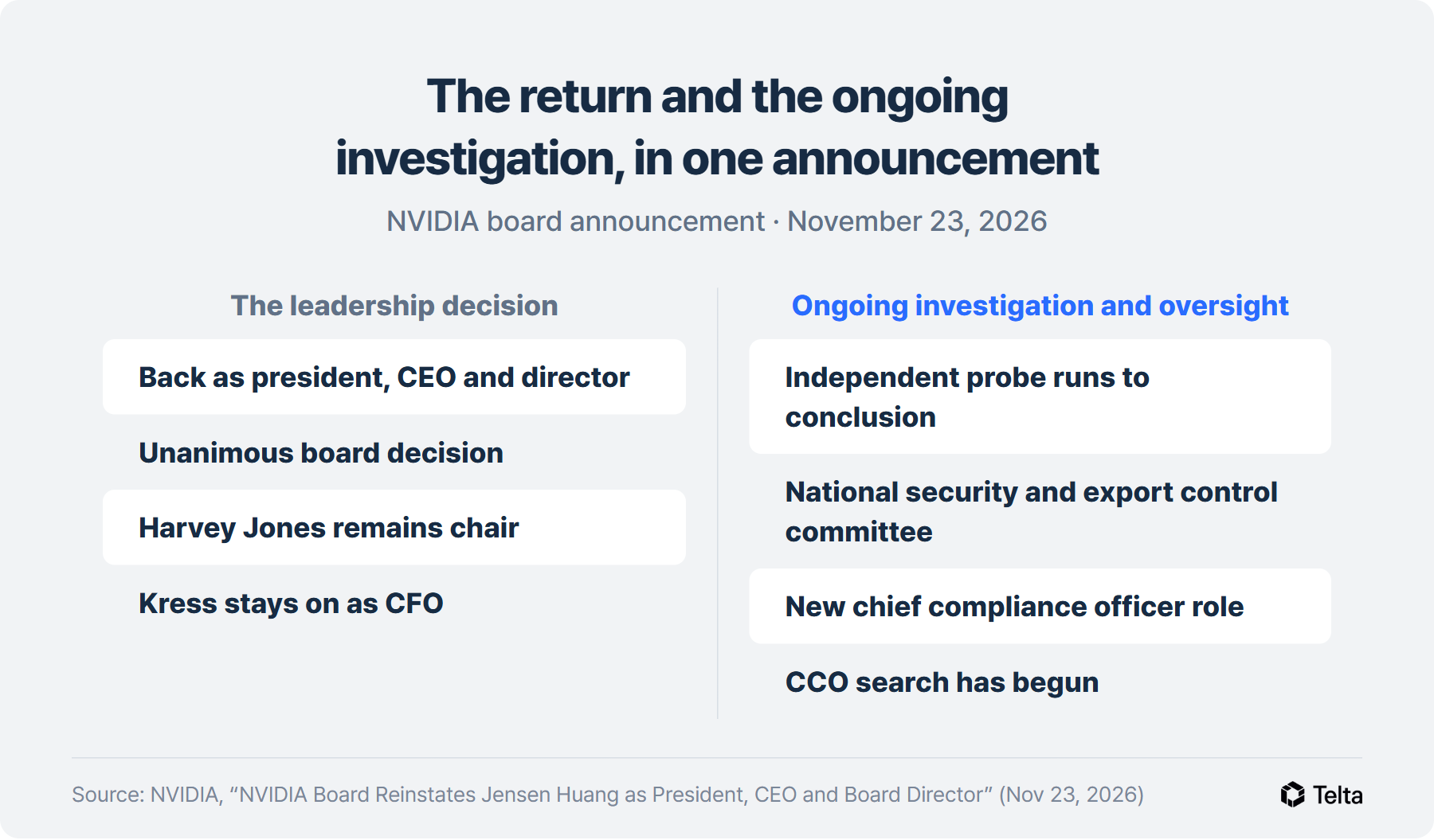
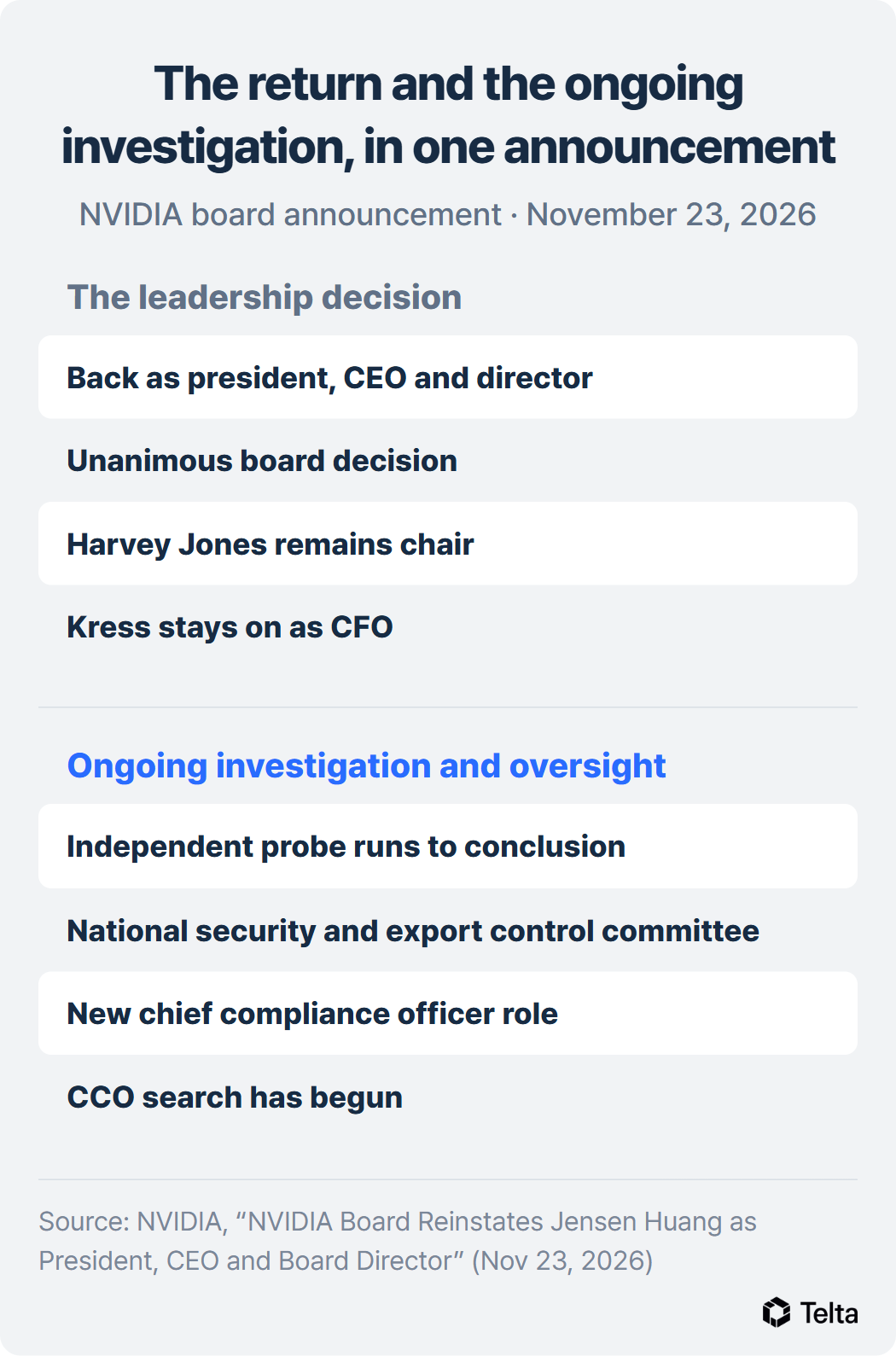
Key answer — NVIDIA’s board reinstated Jensen Huang as president, CEO, and board director on November 23, 2026. In the same announcement, it committed to completing an investigation led by a committee of independent directors and described its national security and export control committee and a newly created chief compliance officer (CCO) role. The search for a CCO had begun. Reinstatement is a decision about management authority; the investigation has yet to reach a conclusion.
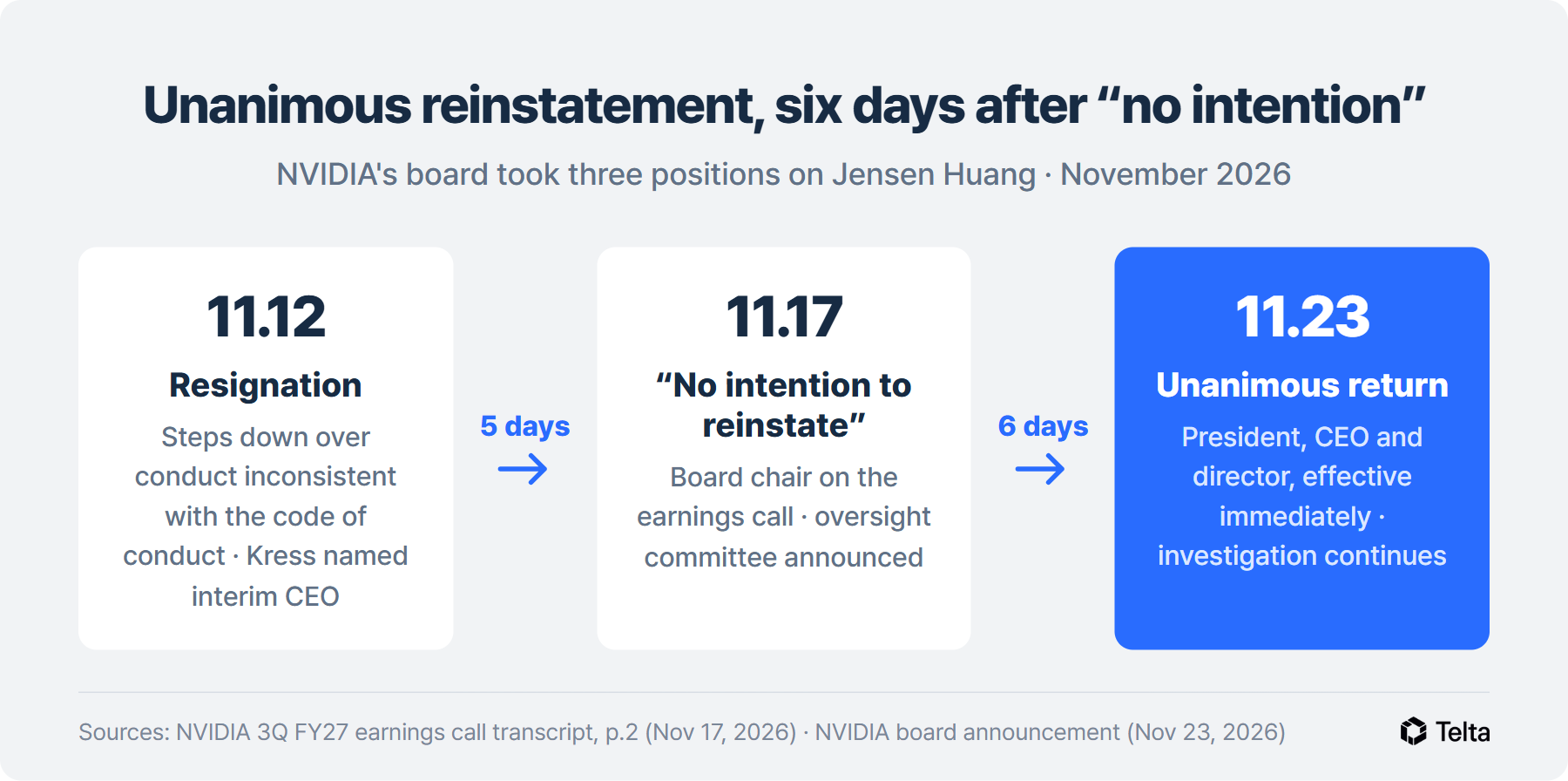
The Board Issued Three Statements in 11 Days
The sequence began on November 12. As Jones recounted on the November 17 call, the board announced that day that Huang had voluntarily stepped down as president, CEO, and board director after personal conduct came to light that was inconsistent with the company’s code of conduct, standards, and cultural norms. The board unanimously accepted his resignation and appointed longtime Chief Financial Officer Colette Kress as interim CEO. It announced a search for a successor and disclosed on the November 17 call that it had engaged executive search firm Heidrick & Struggles to conduct the search.
Kress led the November 17 earnings call as interim CEO. That morning, the company announced that the board had established a national security and export control oversight committee. Jones explained that several independent directors, outside advisers, and legal counsel were involved in the committee. He said he would not take questions about the circumstances of Huang’s resignation or the ongoing investigation. Kress reported record quarterly revenue of $116 billion.
Then, on November 23, the board announced Huang’s return: 11 days after announcing his resignation and six days after saying it had no plans to reinstate him.
The Announcement Addressed Both Huang’s Return and the Investigation
The reinstatement announcement gave two reasons for the board’s decision. After multiple discussions and meetings with Huang, the board said it had gained confidence in his candor and ability to lead the company. It also said it had received input from senior levels of the United States government and, on that basis, was confident his return posed no national security risk.
The same document described work that remained unfinished. Following reports that Huang had been targeted by foreign intelligence activity, the board established a committee composed entirely of independent directors and engaged independent counsel to investigate. The board reaffirmed that the investigation would proceed to its conclusion. Huang also expressed his support for the investigation and committed to cooperating.
The announcement also outlined oversight at the company level. According to the November 23 statement, the national security and export control committee consists entirely of independent directors and oversees trade compliance and national security risks. The committee is also in the process of engaging legal counsel with national security experience. The company created a chief compliance officer role responsible for company-wide compliance, reporting to the board’s nominating and corporate governance committee. Jones remains board chair, and Kress concludes her interim CEO assignment and continues as CFO.
In the announcement, Jones said Huang was the right person to lead NVIDIA and that his return was in the best interests of shareholders, employees, partners, and customers. Huang said he would take on the responsibility with deep humility and renewed resolve. The announcement did not identify the personal conduct that prompted his resignation or explain how it related to the reports of foreign intelligence activity.

The Same Decision Prompted Different Concerns
When news of Huang’s return was shared on Reddit, discussions in the investing community r/stocks and the technology community r/technology focused on different issues. Comments in the investing community emphasized management capability and shareholder value. Comments in the technology community questioned the message sent by making exceptions for powerful leaders.
The decision involves two needs: bringing back the leader who has guided the company so he can continue running it, and demonstrating that company standards do not change depending on the person involved. If the rationale sounds like nothing more than “we need this person,” concerns about the second need are likely to grow.
The Board Explained Its Decision and What Still Needed Review
A closer reading of the announcement shows that the board addressed four points alongside the reinstatement decision: why Huang was the person for the job (its assessment of his ability to lead), what it had checked (meetings and government input), what remained under investigation (the independent committee’s inquiry), and what additional oversight the company would provide (the national security and export control committee and the CCO).
The announcement alone cannot tell us whether other employees would go through the same process. But if “the same standards” means that even an indispensable person undergoes the same scrutiny, rather than that everyone receives the same outcome, these four points illustrate what that scrutiny should cover. The more a decision depends on bringing back someone the company needs, the more the company has to explain to employees and the market.
Smaller Companies Face the Same Question About Hard-to-Replace People
This question extends beyond companies with large market capitalizations. Companies with dozens or hundreds of employees also have people who are difficult to replace: a sales leader who holds major customer relationships, a developer who alone understands a critical product, or the founder who built the company. When their behavior conflicts with company standards, the company’s first consideration tends to be the business impact of losing them.
Suppose a company receives a report that a sales leader responsible for a substantial share of revenue has repeatedly raised their voice at team members in meetings. Had another employee done the same, it would have led to a warning or reassignment. But without this leader, next quarter’s renewals could be at risk. In that situation, it is easy to settle for a quiet warning and move on. The problem comes afterward. The team member who reported the behavior and the colleagues who witnessed it see only the outcome. If they are not told what the company established and why it made its decision, employees conclude that standards change for high performers. That understanding makes them hesitate to report the next incident.
NVIDIA’s decision carried the same risk. In six days, the board went from having no intention of reinstating Huang to unanimously approving his return. From the outside, the outcome was the first thing people saw. Including the continuing investigation and new oversight measures in the reinstatement announcement can be read as an effort to reduce the likelihood that the outcome alone would be taken as evidence that standards had broken down.
Even a company that cannot establish an independent committee and a CCO role like NVIDIA’s can explain its decision along similar lines. First, it can state whether it assessed the person’s performance separately from the conduct at issue. Employees hear very different messages when performance is used to excuse behavior and when the company addresses the behavior separately while keeping the person in their role. Next, it can explain what it has established and what remains unknown. If the facts are not yet clear, it can acknowledge that and say what else it will examine and by when. Finally, it can decide who will monitor what going forward. If someone who does not report to the leader, such as an HR leader or an external adviser, shares that responsibility with the CEO, even a small company can distribute some of the responsibilities an independent committee would otherwise handle.
When performance is the only thing on record, decisions can easily tilt in its favor. Revenue, contract counts, and launch schedules are recorded in numbers, while the experiences of people working with the leader often go undocumented until someone files a report. A company needs an ongoing record of how colleagues and team members view the leader’s behavior. That evidence allows it to give equal weight to “we need this person” and “we need to uphold our standards” when a problem arises.
This announcement alone does not establish that Huang was held to the same standards as other employees. The evidence for that judgment will come from how the investigation and oversight described by the board continue after his return. The next clues will be the independent committee’s findings, who becomes chief compliance officer, and whether the board explains the results. The same applies to smaller companies. Once a company decides to retain someone who is difficult to replace, that decision will be judged less by the announcement itself than by what the company monitors and explains over the months that follow.
Sources
- NVIDIA · NVIDIA Board Reinstates Jensen Huang as President, CEO and Board Director · 2026-11-23 — Reinstatement decision, unanimous vote, rationale, independent investigation, national security and export control committee, CCO search, and continuation of the board chair
- NVIDIA · 3Q FY2027 Earnings Call Transcript · 2026-11-17 — p. 2: Chair Harvey Jones’s remarks on the circumstances of the November 12 resignation announcement, the board’s lack of intent to reinstate Huang, the interim CEO appointment and successor search, and the establishment of the oversight committee; p. 3: quarterly revenue
- NVIDIA IR · Identical Reinstatement Announcement · 2026-11-23
- Reddit · r/technology Post and Comments on Huang’s Reinstatement · 2026-11-23
- Reddit · r/stocks Post and Comments on Huang’s Reinstatement · 2026-11-23
Related Articles