Work Sample Task Example: From Brief to Answers, Rubric, and Evaluation Notes



You give marketing candidates a campaign performance report, and every response sounds convincing. One recommends putting the entire budget into the channel with the highest ROAS. Another compares the channels by first-time customers. Yet the scorecards tell you little: “Analysis: 4. Writing: 5.”
A hiring work sample gives candidates materials that resemble the job and assesses what they investigate and how they respond. Design the brief, reference materials, deliverables, and scoring rubric together. That gives evaluators a consistent standard across responses and reveals the judgment behind a polished submission.
Consider a skincare brand with about 50 employees that sells through its own online store and is hiring an experienced performance marketer. The task uses results from a two-week customer acquisition campaign. Below are the candidate brief, two sample responses, a rubric with performance levels, evaluation notes, and follow-up interview questions. The U.S. Office of Personnel Management (OPM) defines work samples and simulations as assessments that ask candidates to perform tasks modeled on employees’ actual work, emphasizing that those tasks should represent the job. Reviewing campaign performance and recommending the next spending plan are exactly what this marketer would do after joining.
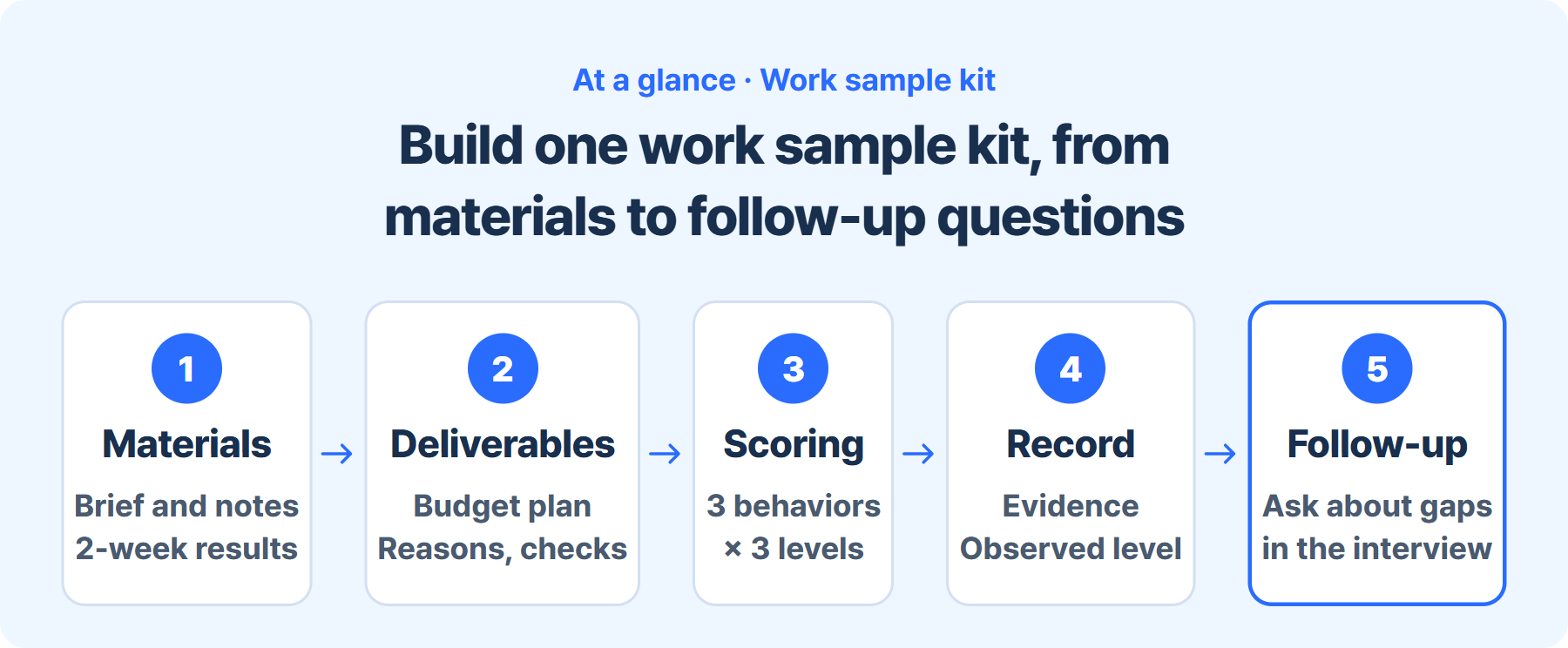
Define the Behaviors You Want to See
This role calls for an experienced performance marketer who runs ads and recommends budget adjustments and promotions. Discounts require coordination with the operations lead, who handles products, inventory, and customer service. Budget increases need the marketing lead’s approval. The task assesses three behaviors: separating verified numbers from assumptions, considering how spending and discounts affect new customers and profitability, and checking inventory, discount terms, and approval limits with the relevant people before launch. This single task does not assess creative instincts or proficiency in operating individual ad platforms.
Set expectations to match your hiring scorecard. OPM recommends work samples only when candidates must already possess the assessed competencies upon entry. In a 2023 paper, University of Minnesota professor Paul Sackett and his coauthors also noted that work samples are generally difficult to use for entry-level hiring when candidates will acquire the relevant knowledge and skills through training or experience on the job. For entry-level candidates, adapt the task: ask them to interpret the report and identify what else they need to know, rather than write a budget allocation plan. Pilot the task to establish a realistic completion time before telling candidates how long to allow.
The Candidate Brief and Materials
| Item | Sample Candidate Materials |
|---|---|
| Scenario | A customer acquisition campaign has run for two weeks. Recommend how to allocate the next two weeks’ advertising budget of KRW 10 million across two channels. |
| Notes | Ad-attributed revenue includes all purchases made within seven days of an ad click, including repeat purchases by existing members. The terms of an additional discount promotion for next week have not yet been finalized with the operations lead. Budget increases require the marketing lead’s approval. |
| Deliverables | Provide a budget allocation for the next two weeks, your rationale, and what you would verify before spending. If you need more information, specify whom you would ask and what you would ask them. |
Use One Rubric for All Three Behaviors
A rubric defines performance levels through behaviors visible in a candidate’s response. OPM’s sample structured interview rating scale pairs definitions with behavioral examples at each level from 1 to 5. This task uses three levels: “Insufficient Evidence,” “Partial Evidence,” and “Specific Evidence.”
When a behavior is missing, record it as something to investigate further, rather than simply deducting points. Its absence from one response does not establish that the candidate cannot do it. OPM likewise describes work sample scoring as trained assessors observing candidates’ behavior. Before scoring, have evaluators review sample responses together and align on what each performance level looks like.
| Behavior | Insufficient Evidence | Partial Evidence | Specific Evidence |
|---|---|---|---|
| Separates Data From Assumptions | Treats ad-attributed revenue and ROAS as measures of new customer acquisition | Mentions repeat purchases by existing members but does not account for them in the recommendation | Flags repeat purchases in ad-attributed revenue; distinguishes what the report establishes from what needs verification and limits conclusions accordingly |
| Considers New Customers and Profitability | Compares channels using ROAS alone | Compares first-time customers but does not assess profitability after discount costs | Uses both ad spend per first-time customer and revenue after discount costs to support the allocation |
| Checks Before Launch | Commits to discounts, coupons, or budget changes without verification | Identifies either discount terms or budget approval as needing verification, but not both | Checks discount terms and inventory with the operations lead and approval limits for budget increases with the marketing lead before announcing or executing the plan |
Two Responses, Different Evidence
Response A: Put Everything Into the Highest-ROAS Channel
“I would spend the entire KRW 10 million budget for the next two weeks on Channel A, which has the higher ROAS at 300%. To drive more purchases, I would also offer an additional 15% discount coupon.”
Candidate A quickly reaches a decision using the report’s most prominent metric. But the notes state that ad-attributed revenue includes repeat purchases by existing members, and A treats it as evidence of new customer acquisition. Channel B generated 140 first-time customers versus Channel A’s 90, yet A never compares the channels against that campaign objective. The additional 15% coupon is also presented as a settled decision, although its terms have not been finalized with the operations lead. Score the clarity of the recommendation separately from the strength of its supporting evidence.
Response B: Compare First-Time Customers and Flag Open Questions
“If the campaign’s goal is new customer acquisition, Channel B’s ad spend per first-time customer is about KRW 36,000, lower than Channel A’s roughly KRW 56,000. Channel A has a higher ROAS, but ad-attributed revenue includes repeat purchases by existing members, so I would not decide on that metric alone. In the first week, I would spend KRW 6 million on Channel B and KRW 4 million on Channel A, then adjust based on the results. I would announce any additional discount only after checking inventory and terms with the operations lead.”
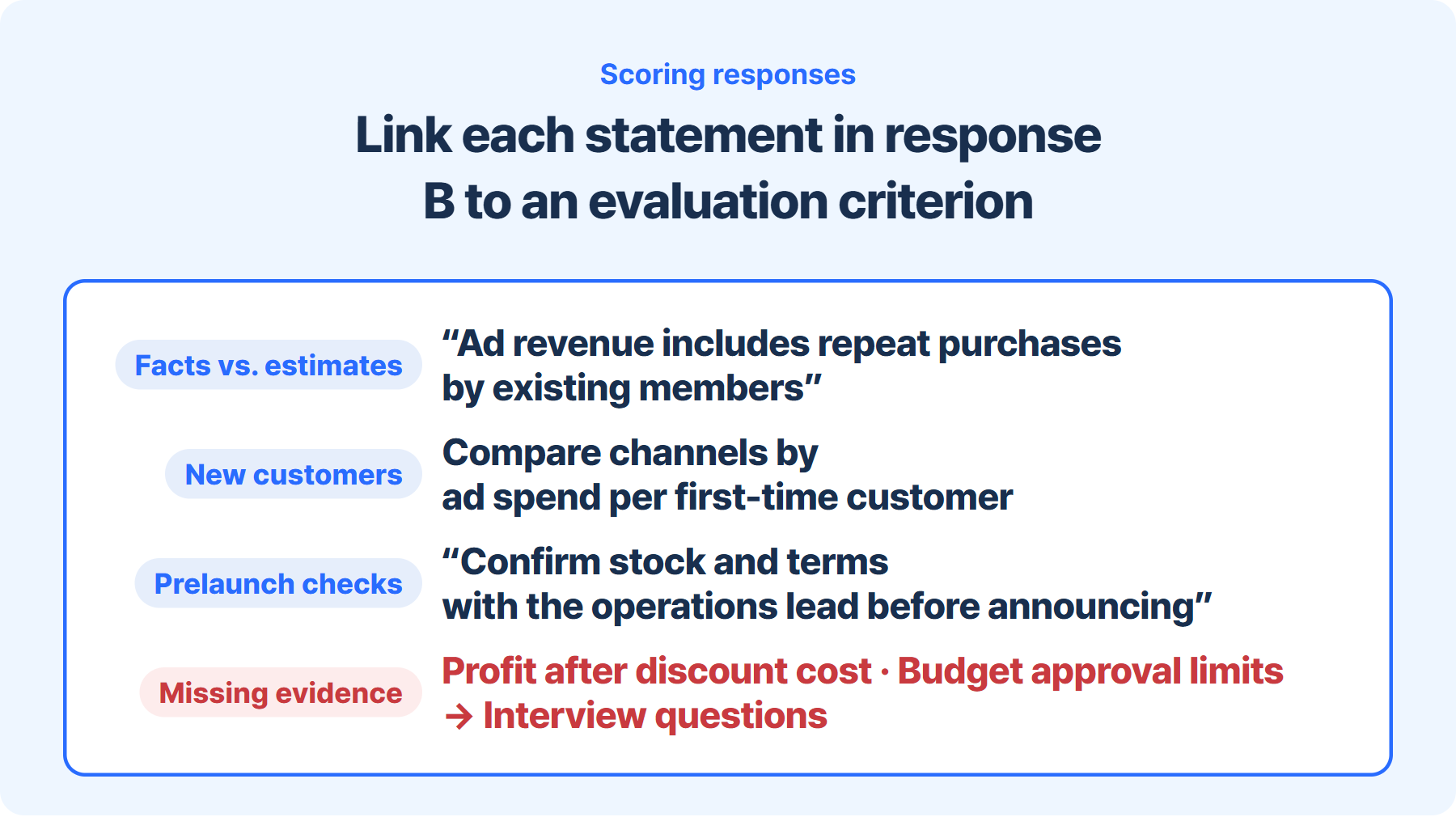
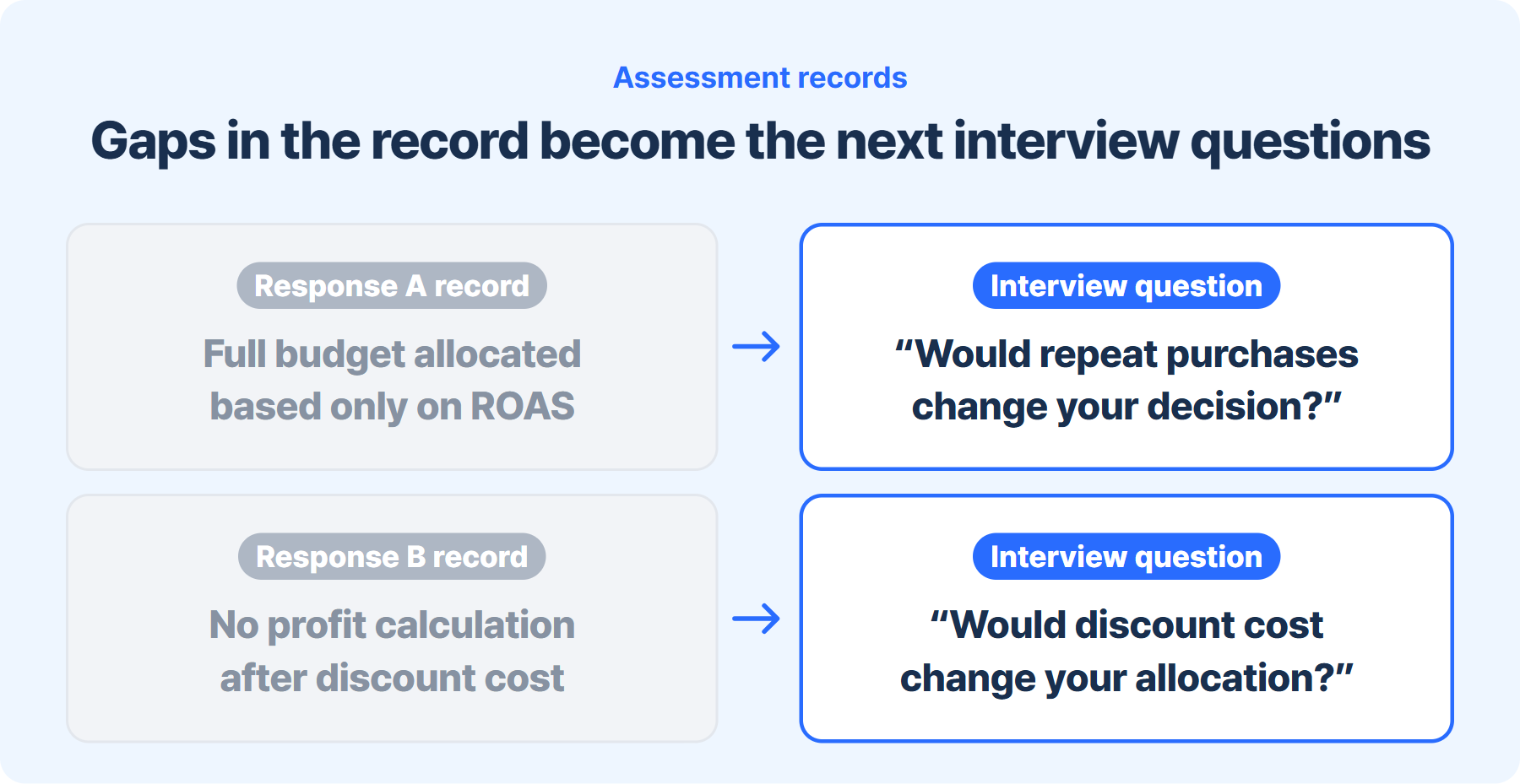
Candidate B starts with the campaign objective and compares the channels by ad spend per first-time customer. The response flags repeat purchases in Channel A’s higher ROAS and proposes reviewing the first week’s results before making further budget adjustments. It also makes announcing an additional discount conditional on checking inventory and terms with the operations lead. Two gaps remain: B does not calculate profitability after coupon discount costs or explain how to verify the marketing lead’s approval limits if a budget increase is needed. Both belong in the follow-up interview.
| Behavior | Response A | Response B | Follow-Up Question |
|---|---|---|---|
| Separates Data From Assumptions | Insufficient Evidence Allocates the entire budget to Channel A based solely on its 300% ROAS | Specific Evidence Explicitly declines to rely on ROAS alone because it includes repeat purchases | What can’t you determine from this report alone? |
| Considers New Customers and Profitability | Insufficient Evidence No comparison based on first-time customers | Partial Evidence Compares ad spend per first-time customer but does not calculate profitability after discounts | Would subtracting coupon discount costs change your allocation? |
| Checks Before Launch | Insufficient Evidence Commits to a 15% coupon without checking with the operations lead | Partial Evidence Checks discounts before announcing them but omits budget approval limits | Whose approval would you need to increase the budget, and what would you ask them to approve? |
Record the Evidence and the Questions It Leaves Open
For each criterion, write one line that connects the observed performance level, the supporting statement, the standard applied, and anything still to verify. For B, the statement “ad-attributed revenue includes repeat purchases by existing members, so I would not decide on that metric alone” supports “Specific Evidence” for separating data from assumptions. Under new customers and profitability, note the missing calculation of profitability after discount costs. A score alone does not tell the interviewer what to ask next.
Telta Assessment provides evidence from workplace decisions, written responses, or candidates’ use of AI, depending on the assessment format. Multiple-choice scenarios use predefined scoring; written-response and AI proficiency assessments use criteria specific to each format. Survey formats interpret responses from the individual or people around them. The published report guide explains the result categories and how to interpret them.
Use the Interview to Resolve Open Questions
Ask A why they allocated the budget based on ROAS alone, how knowing that ad-attributed revenue includes repeat purchases would change their decision, and whom they would consult about what before adding a coupon. Ask B whether subtracting coupon discount costs changes the allocation, what approval they would seek from the marketing lead for a budget increase, and whether they have actually adjusted a similar campaign’s budget. Assess the same competencies in both candidates, but tailor follow-up questions to the evidence missing from each response.
For guidance on managing follow-up questions, see the structured interview guide. To choose assessments for your role, start with the comparison of hiring assessment methods. When considering Assessment, review the work it measures, the instructions candidates receive, and how supporting evidence appears in the report.
Frequently Asked Questions
Does a Strong Work Sample Predict Strong Job Performance?
A work sample score provides useful evidence about likely job performance, but it cannot settle the decision alone. When Sackett and his coauthors recalculated earlier meta-analyses, the average correlation between work sample scores and overall job performance, expressed as corrected validity, was .33. That was lower than structured interviews (.42) and similar to general cognitive ability tests (.31). Use the behaviors observed in this task as evidence, then use interviews and additional materials to investigate performance on other tasks, in collaborative settings, and over longer periods.
Should Longer Responses Receive Higher Scores?
Score the behaviors your criteria describe, not the word count. A short response can clearly separate data from assumptions and identify checks before launch. A long one can still omit the verification the task requires.
Related Reading
- How to Reduce Bad Hires: A Hiring Improvement Guide for Growing Companies
- When the CEO and the Team Lead Are Looking for Different People
- Hiring Assessment Methods Compared: Interviews, Work Samples, and SJTs
- What Is a Structured Interview? Definition, BEI Comparison, and 4 Design Steps
Sources
- OPM · Work Samples and Simulations — Definition of work samples, their use when competencies are required upon entry, and scoring based on assessor observations.
- OPM · Structured Interview: Example Question and Rating Scale — A rating scale with definitions and behavioral examples for levels 1–5.
- Sackett, Zhang, Berry, and Lievens · Revisiting the design of selection systems, Industrial and Organizational Psychology (2023) — Average work sample validity of .33 from the 2022 reanalysis and applicability to entry-level hiring.
- Telta · Assessment — Assessment formats and guidance on interpreting results.
Related Articles