Hiring Assessment Methods Compared: Interviews, Work Samples, and SJTs


You’re hiring an experienced salesperson. You’ve added a work sample and a personality test to the interview. The assessment file is thicker, but you still don’t know what this person would promise a customer when a delivery runs late. Before adding another assessment, write down what you still need to learn.
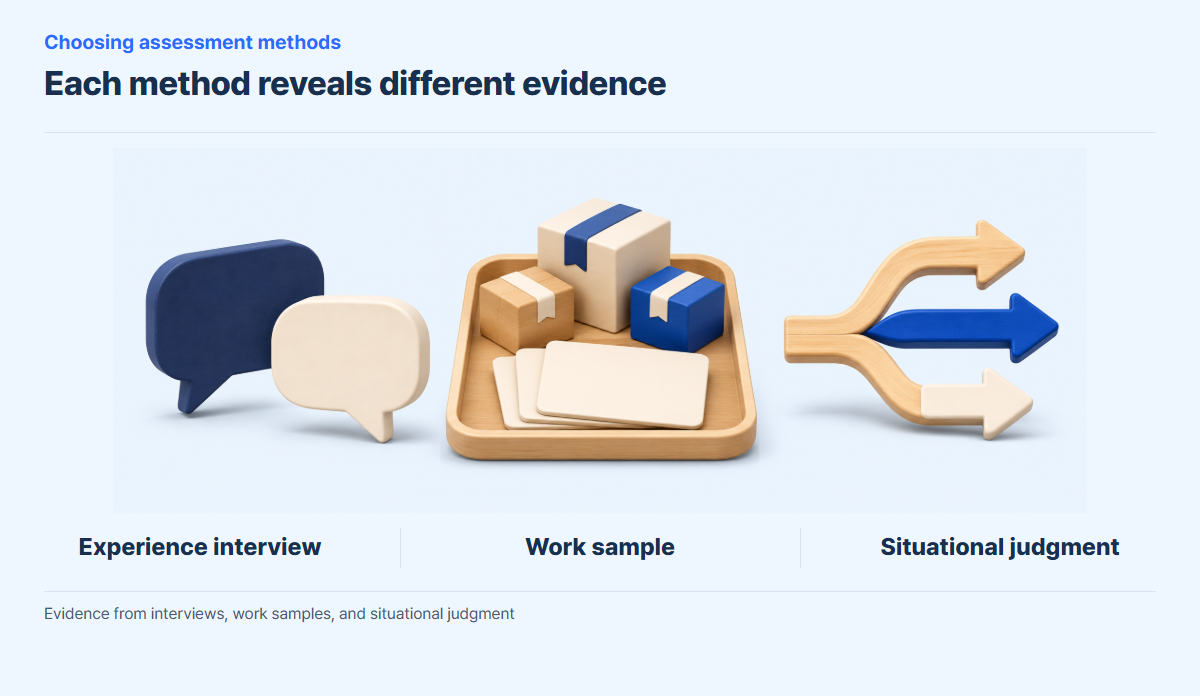
Choose hiring assessment methods around the evidence you need. A structured interview explores what candidates did and why. A work sample shows how they handle a task with the materials provided. A situational judgment test (SJT) reveals which response they choose in a specific scenario.
Research supports this approach. In 2022, University of Minnesota professor Paul Sackett and his colleagues recalculated the results of meta-analyses on selection tool validity. Their 2023 follow-up reported that methods tailored to the job, including structured interviews, job knowledge tests, and work samples, predicted job performance better on average than general ability and personality tests. Results still varied widely across studies using the same method. Those findings help put the numbers in context as you compare what interviews, work samples, SJTs, surveys, and AI proficiency assessments can reveal.

Start With the Question You Need to Answer
“Do you have sales experience?” and “What would you explain to a customer first if the delivery date were uncertain?” ask for different evidence. The first establishes the scope of someone’s experience. The second probes how they interpret information and make decisions. Add “When a customer’s expectations and the delivery schedule didn’t line up, what did you do first, and why?” to explore past behavior and the reasoning behind it.
The same delivery delay can support several assessment formats. Give candidates delay information and ask them to write a customer update: that’s a work sample. Ask them to select their next action after receiving notice of the delay: that’s an SJT. Have them draft the update with AI and submit their revision history: that’s an AI proficiency assessment. Define the behaviors you expect at entry in your hiring scorecard, and you have a basis for choosing among them.
What Each Method Reveals—and Where It Stops
| Method | Evidence | Preparation | Limitations |
|---|---|---|---|
| Structured interview | Experience, reasoning, and descriptions of behavior | Job-related questions, shared criteria, answer records | Accounts of past experience don’t establish the full picture of actual performance. |
| Work sample (including written simulations) | Work produced or actions taken using supplied materials | Representative task, materials, constraints, rubric | Behavior beyond the task and sustained execution need further assessment. |
| Multiple-choice SJT | Judgment and decision-making in a specific situation | Job scenarios, response options, preset scoring | A selected response doesn’t establish how someone will act. |
| Ability and knowledge tests | Abilities or knowledge the test was designed to measure | Review of purpose, reliability, and suitability for the candidate population | Check what each test measures before grouping all aptitude and personality tests together. |
| Behavior and personality surveys | Behaviors and tendencies reported by candidates or others | Questions, respondents, boundaries for interpretation | Distinguish self-reports from direct observation. |
| AI proficiency assessment | Task performance demonstrated through prompting, review, and revision | Shared task, tool conditions, evaluation criteria | Finished text alone doesn’t establish the AI workflow or overall job competency. |
The US Office of Personnel Management (OPM) describes situational judgment tests as assessments that present workplace problems or critical situations and ask candidates how they would respond. Scoring reflects subject matter experts’ judgments about the best and worst options. A candidate’s selection shows how closely their judgment aligns with that standard; it doesn’t establish that they would act that way.
Before adopting a test, replace a vague question about “accuracy” with three specific ones: What does it measure, for which roles and populations? What conclusions do the scores support? How should you interpret results when administration conditions change? Ease of use, personal data handling, accessibility, and candidate instructions also belong in the decision.
Job-Specific Methods Predicted Performance Better on Average
Sackett and his colleagues recalculated the validity estimates for selection tools reported by Schmidt and Hunter in 1998. Studies limited to people who were hired and remained employed capture a narrower range of scores, which makes validity appear lower than it is. Earlier research adjusted the estimates upward to account for this. Sackett’s team concluded that those corrections were often larger than warranted, inflating the results. They recalculated the estimates, applying corrections only where the evidence clearly justified them.
Here, validity is a number from 0 to 1 that describes how closely assessment scores track subsequent overall job performance: a correlation coefficient corrected for measurement error. A value closer to 1 means higher scorers also tended to perform better at work; a value closer to 0 means little relationship between scores and performance. Structured interviews ranked highest at .42, followed by job knowledge tests at .40, work samples at .33, and general cognitive ability tests at .31. Knowledge-based and behavioral-tendency SJTs both scored .26; unstructured interviews scored .19. Compared with the 1998 estimates, validity fell by .21 for work samples, .20 for cognitive ability tests, and .19 for unstructured interviews.
The averages don’t tell the whole story. Results varied considerably even among studies of structured interviews. The researchers estimated that 80% of structured interview validity values fell between .18 and .66, an 80% credibility interval. They advised reading .42 as a value that varies by roughly .24 in either direction. The same “structured interview” label covers differences in how well companies design questions and run interviews. The researchers also cautioned against treating the ranking as a mandate to start with structured interviews in every setting. Cost, time, candidate volume, score differences across candidate groups, and candidate reactions all matter.
Build the Mix Around What Candidates Need on Day One
OPM’s guidance on work samples recommends using them only when candidates must possess the assessed competency at entry. Sackett and his colleagues likewise noted that work samples and job knowledge tests generally have limited applicability to entry-level hiring when people acquire the knowledge and skills through training or experience after joining. Requiring entry-level candidates to use internal tools fluently while claiming to assess learning ability confuses the purpose of the task. Decide first whether you want to assess judgment with basic information provided or performance that already requires proficiency.
| Hiring Situation | Example Combination | Additional Context Needed |
|---|---|---|
| Junior hire | Data interpretation task + experience-based interview on learning and feedback | Explain expected domain knowledge and the scope of training after entry. |
| Experienced salesperson expected to work independently | Customer response task + experience-based interview on individual contribution and coordination | Establish the context behind past results and the candidate’s actual authority. |
| First-time team leader | Prioritization and feedback scenarios + experience-based interview on leadership | Separate individual contributions from team results and account for different organizational conditions. |
For an operations or customer service role, you might ask candidates to categorize recurring inquiries and escalate them based on customer impact. Supply the internal policies they would learn after joining, then assess which requests they prioritize under those conditions.
When you combine two methods, read the results together. Suppose an experienced sales candidate says in the interview, “When a delivery ran late, I first aligned with logistics on the arrival date.” In the delivery delay task, however, they present an estimated shipping date as a confirmed delivery date. Their account and their performance conflict. Record the discrepancy before deciding which to trust, then ask in the next interview how they distinguished estimates from confirmed dates when communicating with customers.

Account for Team Capacity and Candidate Effort
The UK’s Chartered Institute of Personnel and Development (CIPD) recommends combining methods for fair, effective selection in its selection guidance, while emphasizing candidate experience and time to hire regardless of the methods used. With a large applicant pool, giving everyone an in-depth written task creates grading and support backlogs. Consider checking requirements and relevant experience first, then assigning deeper assessments to candidates who need them. Keep questions relevant to the job, even when unrelated items would be easy to automate.
Document how many interviewers you need, who has the expertise to score responses, the assessment environment, disability accommodations and accessibility support, retake and error procedures, and who will explain results. Tell candidates the purpose of the assessment and what to submit. Check whether you’re asking them to repeat something another stage has already established. The goal is sufficient evidence, not a longer list of methods.
Understand What Each AI Hiring Tool Does
AI hiring tools help teams prepare materials, document assessments, and review information. Compare them by the work they support and the evidence they retain.
Interview Pro supports human-led interviews with question preparation, conversation records, follow-up questions, and organized evidence from answers. Assessment provides evidence from workplace scenario choices, written responses, AI workflows, or survey responses, depending on the assessment format. Multiple-choice scenarios use preset scoring; written-response and AI proficiency assessments use criteria specific to each format; surveys interpret responses from candidates or people around them.
For a closer look at interview and task design, compare the work sample brief, answers, and rubric with the structured interview guide. When considering Assessment, use a consultation to confirm the roles and formats currently supported, the actual outputs, and the conditions for running it.
To examine the reasoning behind AI-written applications or assignments, see the questions and supporting materials in our guide to verifying AI-assisted applications.
Frequently Asked Questions
Are Aptitude and Personality Tests Better Than Work Samples?
Different tests measure different things. First decide whether you need evidence of general ability, personality, job knowledge, situational judgment, or direct performance. Then compare how well each method serves the role and expected entry level. In Sackett’s reanalysis, work samples (.33) and general cognitive ability tests (.31) had similar average validity, but work samples are often difficult to use for entry-level hiring. Our comparison of aptitude and personality tests with job simulations explores the differences in more detail.
Do You Need Both an Interview and a Work Sample?
You don’t need the same combination for every hire. Choose based on which evidence would reduce the uncertainty around an important decision and whether the additional information justifies the effort required from candidates and the hiring team.
Related Reading
- How to Reduce Bad Hires: A Hiring Improvement Guide for Growing Companies
- When the CEO and the Team Lead Are Looking for Different People
- Work Sample Task Example: From Brief to Answers, Rubric, and Evaluation Notes
- What Is a Structured Interview? Definition, BEI Comparison, and 4 Design Steps
Sources
- Sackett, Zhang, Berry, and Lievens · Revisiting the design of selection systems, Industrial and Organizational Psychology (2023) — Average validity and between-study variation from the 2022 reanalysis (Table 1), the 80% credibility interval for structured interviews, and applicability to entry-level hiring.
- CIPD · Selection methods — Combining selection methods, candidate experience, and time to hire.
- OPM · Work Samples and Simulations — Using work samples when candidates must possess the competency at entry.
- OPM · Situational Judgment Tests — SJT formats and scoring based on expert judgments.
- Telta · Assessment — Currently published assessment formats and scoring explanations.
Related Articles