.svg)
Aptitude Tests vs. Job Simulations: What’s the Difference?


Aptitude and personality tests are good at comparing shared traits such as general cognitive ability and personality. Job simulations are good at showing directly how candidates judge and perform on realistic tasks. Each gives you different information.
Aptitude and personality tests, structured interviews, and job simulations aren’t substitutes for each other. Each fills in a different piece of information.
Basic cognitive ability, personality, general potential
- Strong on standardization and high volume
- Some distance from real work situations
Past experience, reasons behind decisions, how problems were solved
- Can probe the context of experience in depth
- Interview quality control matters
Judgment and performance in realistic situations
- High similarity to the actual job
- Telta’s AI auto-scoring enables high volume
In large-scale entry-level hiring built around Korea’s open recruitment (gongchae), employers need to compare many candidates quickly, and aptitude and personality tests can still play a clear role there. But in rolling and experienced hiring, the question companies ask most often is: “Can this person step in and do this job right away?”
What Aptitude and Personality Tests Measure Well
They are strong at measuring, in a standardized way, traits that can be compared across roles: cognitive ability, personality, and general problem-solving potential. The more candidates you have, the bigger the operational convenience. Their similarity to the actual work, however, can be limited.
What Job Simulations Measure Differently
Job simulations give candidates materials or situations that resemble the real work and have them make decisions or produce deliverables. Examples include work sample tasks, situational judgment tasks, exercises in prioritizing multiple assignments, and role plays with customers or colleagues. The information you get is less about “Are they generally smart?” and closer to “How do they judge and perform in situations like this job?”
The Old Wisdom That Cognitive Tests Predict Best Has Been Shaken by Recent Reanalysis
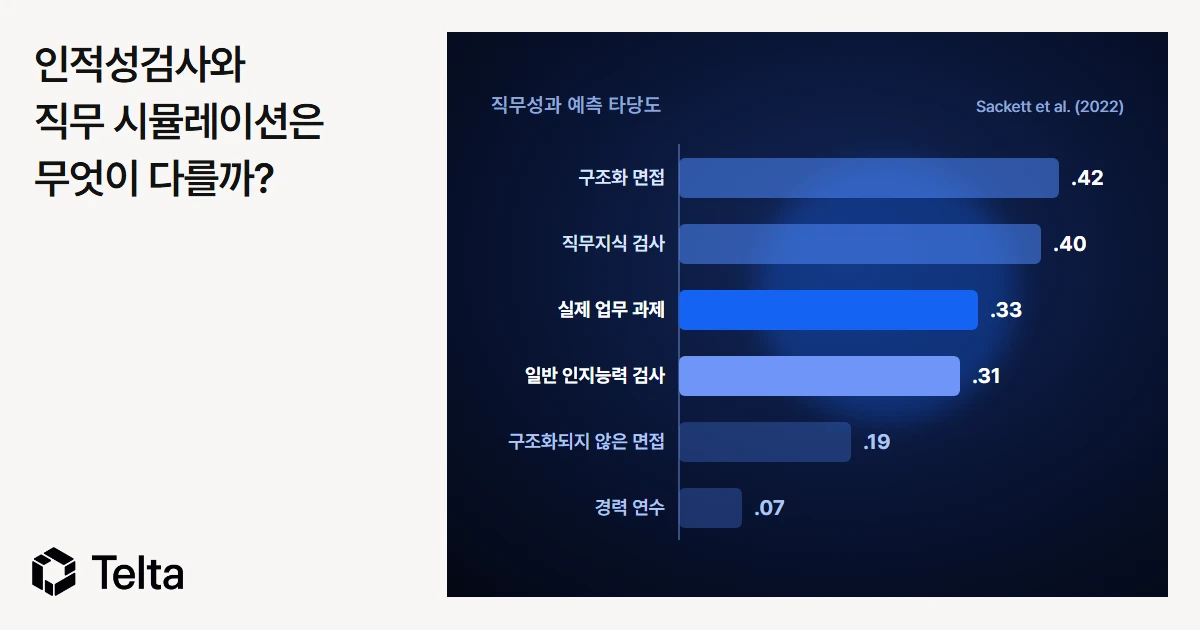
In 2022, Sackett et al. recalculated validity estimates that had long been cited in personnel selection research. The most notable change: general mental ability (GMA) tests are no longer the clear number one. The re-estimated validities for predicting job performance were .42 for structured interviews, .40 for job knowledge tests, .33 for work sample tests, and .31 for general cognitive ability tests.
This doesn’t mean cognitive ability tests are the least reliable. They remain a useful tool. The key point is that it’s hard to see them as the single strongest tool that outperforms every other assessment, as was widely believed. A follow-up paper sums it up: “cognitive ability is no longer the stand-out predictor”, and it identifies the structured interview as the selection tool with the highest average validity.
That said, Korea’s aptitude and personality tests as a whole shouldn’t be equated with the .31 figure for general cognitive ability tests. Korean tests can mix several elements, including cognitive ability, personality, and situational judgment. The practical message of this research is simpler: looking only at general potential doesn’t tell you enough about how someone will actually perform on the job.
A higher correlation coefficient (r) means that, on average, scores on that assessment were more strongly related to later job performance. No single number can judge the overall quality of a hiring tool, but it helps show where tools stand relative to each other.
So how should you apply this in practice?
The conclusion isn’t to drop aptitude and personality tests. They can still be useful for getting standardized information about potential in large-scale hiring. But rather than relying on them alone to decide that someone will excel in your role right away, it’s more convincing to combine general potential assessment + structured interviews + performance assessments close to the actual job to fit your purpose.
In TestGorilla’s 2025 employer survey, 85% said they use skills-based hiring and 76% said they use skills tests. In the same survey, only 16% used real work assignments, so performance-based assessment isn’t yet standard in every hiring process, but interest is clearly growing.
Results from TestGorilla’s 2025 survey of 1,084 hiring decision-makers in the UK and US.
Can Simulations Work for High-Volume Hiring? It Comes Down to Scoring
The biggest constraint on traditional job simulations is the time and people needed for scoring. When people read and evaluate written responses and deliverables by hand, cost and time grow with every additional candidate.
Assessors score by hand. Effort and cost rise sharply as candidate numbers grow.
Designed for high-volume and always-on hiring through AI auto-scoring, response analysis, and report generation.
About Telta’s Product
Telta automatically scores candidate responses with AI, analyzes the evidence behind each rating, and generates a report. So there’s no need to assume the traditional trade-off that simulations are precise but unsuited to high-volume hiring. Actual predictive validity, however, still needs to be validated by role, item, and scoring criteria.
Aptitude Tests, Interviews, and Simulations Each Have a Different Job
| What you want to know | Best-fit tool |
|---|---|
| Basic cognitive ability, personality, and general potential | Aptitude and personality test |
| Past experience and the reasoning behind decisions | Structured interview / behavioral interview |
| Performance on realistic work | Work sample task / simulation |
| Job knowledge | Job knowledge test |
Related Reading
- How Can You Tell If a Candidate Will Do the Job Well Before You Hire?
- Can AI Certifications Like AICE Show Real-World AI Competency?
References
- Sackett et al. (2022): A study that revisited validity estimates for major selection tools. Source
- TestGorilla, State of Skills-Based Hiring 2025: A survey of employers’ use of skills-based hiring, skills tests, and work samples. Source
- Highhouse & Brooks, Hiring People in Organizations: The State and Future of the Science: An Annual Review that places Sackett et al.’s re-estimates in the context of current selection research, comparing structured interviews (.42), job knowledge (.40), work sample tests (.33), and general cognitive ability (.31), among others. Source
Note: Figures and findings are summarized from the original materials published by each organization.
Related Articles