.svg)
How Can You Tell If a Candidate Will Do the Job Well Before You Hire?


Resumes and interviews can’t fully tell you how someone will actually perform. To see it more directly, give candidates the kinds of materials, constraints, and stakeholders they would face on the job, and have them make decisions and produce real work.
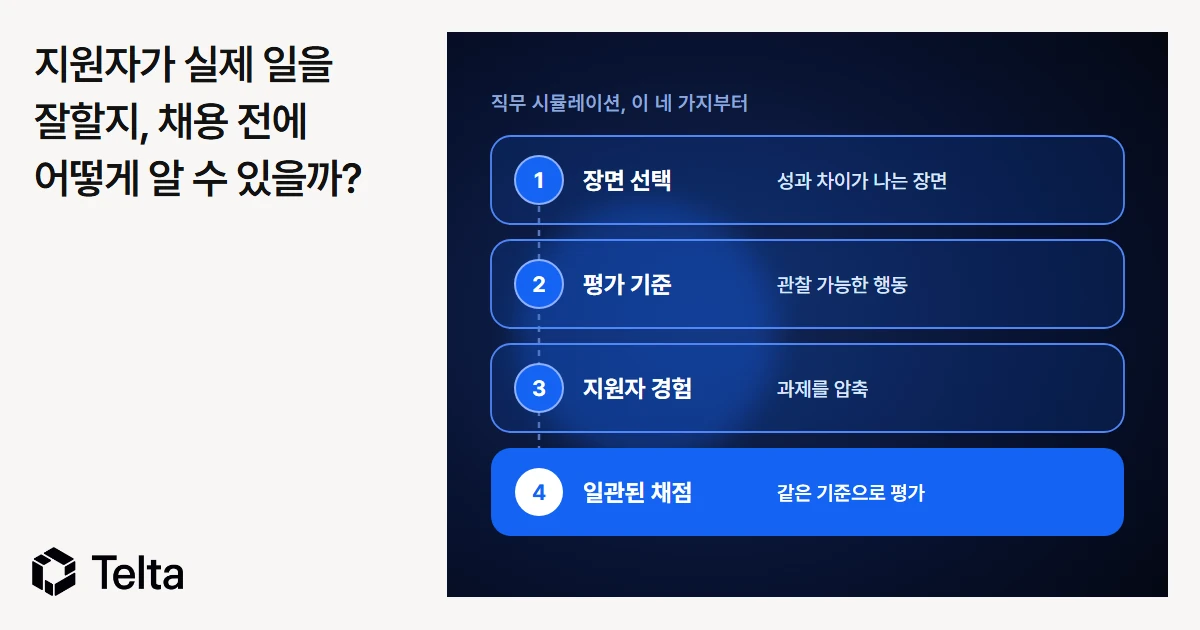
A good job simulation isn’t a test full of hard problems. It’s a short recreation of the situations where the judgment and behavior that matter on the job become visible.
Choose a work situation where performance differences actually show
Define good performance as observable behavior
Keep it tight so it doesn’t become an overly long assignment
Apply the same criteria whether a person or AI is scoring
Doing well in an interview doesn’t guarantee doing well on the job. An impressive track record doesn’t guarantee results in your organization from day one, either. In rolling and experienced hiring especially, you can rarely count on a long ramp-up period, so there is growing pressure to check not just potential but how well someone can handle this specific work if you hand it to them now.
In Experienced Hiring, “Can They Do the Job Now?” Matters More
In LinkedIn’s Future of Recruiting 2025, 93% of recruiting professionals said accurately assessing candidates’ skills is important to improving quality of hire. In Deloitte’s 2025 Global Human Capital Trends, 66% of managers and executives said their most recent hires were not fully prepared, and lack of experience was the most common gap they cited.
These figures come from separate LinkedIn and Deloitte studies, so they are shown by source.
Recruiting professionals who say accurately assessing candidate skills is key to quality of hire
Managers and executives who say recent hires weren’t fully prepared
Employers who raised experience requirements in the past three years
A Job Simulation Isn’t Just a “Fun Take-Home Assignment”
A good simulation brings the moments that separate strong and weak performance on the job into the assessment itself. The goal isn’t to make the problem deliberately hard. What matters is deciding up front which behaviors and judgments will count as evidence of good performance.
It Works for Frontline Roles, Not Just Office Jobs
| Role | Simulation scenario | What the assessment reveals |
|---|---|---|
| B2B sales | Review data and emails from a client whose revenue has dropped sharply, then plan the next meeting | Problem diagnosis, customer judgment, prioritization |
| Strategy/planning | Write a decision proposal from incomplete data and conflicting requests | Structuring, analysis, judging what to give up and what to prioritize |
| Production/logistics floor | Decide the order of response when a delivery delay, a safety issue, and a staffing shortage hit at once | Safety, operational priorities, escalation |
| Customer service | Decide on responses, compensation, and escalation across multiple customer issues under policy constraints | Customer focus, applying policy, judgment |
Building Your First Job Simulation? Decide These Four Things First
1. Choose a Scenario That Separates Strong Performers From the Rest
The goal isn’t simply to pose a hard problem. Look for situations that come up often in the role and where differences in judgment affect results: in B2B sales, meeting again with a client whose revenue has fallen; on a production floor, handling a delivery delay and a safety issue at the same time.
2. Define What Good Looks Like Before You Write the Answer Key
If you evaluate in abstract terms like “strong problem-solver,” every scorer will judge differently. Instead, define the behaviors you’ll actually look for in a response: whether the candidate caught the critical information, how they reconciled stakeholders’ demands, and why they set the priorities they did.
3. Don’t Give Candidates a Longer Task Than You Need
If what you want to assess shows up in 30 minutes, a three-hour assignment can make strong candidates drop out, or turn the assessment into a measure of how much free time someone has at home. Provide only the information and context needed, and trim the task until it’s just long enough to reveal the judgment and behavior you want to see.
4. Make Sure Anyone Scoring Applies the Same Criteria
Even a well-designed task produces scores that vary by interviewer if the criteria are vague. Whether a person scores it or AI analyzes it automatically, decide in advance which responses rate highly and which need improvement. Even with AI auto-scoring like Telta’s, designing those criteria comes first.
For High-Volume Roles, How You Run It Is What Matters
Job simulations aren’t only for senior roles or key talent. In the past, design and scoring effort simply made that the easiest way to use them. If you can standardize scenarios and automate scoring, they extend to frontline, service, and office roles with high-volume, recurring hiring.
Telta rates its fit for high-volume hiring at ★★★.
Because it handles AI auto-scoring, response analysis, and report generation for candidate responses, it reduces the bottleneck of traditional human scoring. This describes the product’s operational scalability. It does not mean predictive validity is automatically secured for every role; role-specific validation is still needed.
Telta Looks at How the Answer Is Built, Not Just the Answer
Real work often has no single right answer. That’s why Telta looks beyond right-or-wrong at how the candidate arrives at an answer: what information they checked, what they prioritized, and what risks they missed.
Related Reading
- Aptitude Tests vs. Job Simulations: What’s the Difference?
- Can AI Certifications Like AICE Show Real-World AI Competency?
References
- LinkedIn, Future of Recruiting 2025: 93% of recruiting professionals said accurate skills assessment is important to improving quality of hire. Source
- Deloitte, 2025 Global Human Capital Trends: Closing the experience gap: Survey in which 66% of managers and executives said recent hires were not fully prepared. Source
- Deloitte 2025 HCT Press Release: Key findings of the 2025 Human Capital Trends, based on about 13,000 respondents worldwide. Source
Note: Figures and findings are summarized from the original materials published by each organization.
Related Articles