.svg)
Can AI Certifications Like AICE Show Real-World AI Competency?
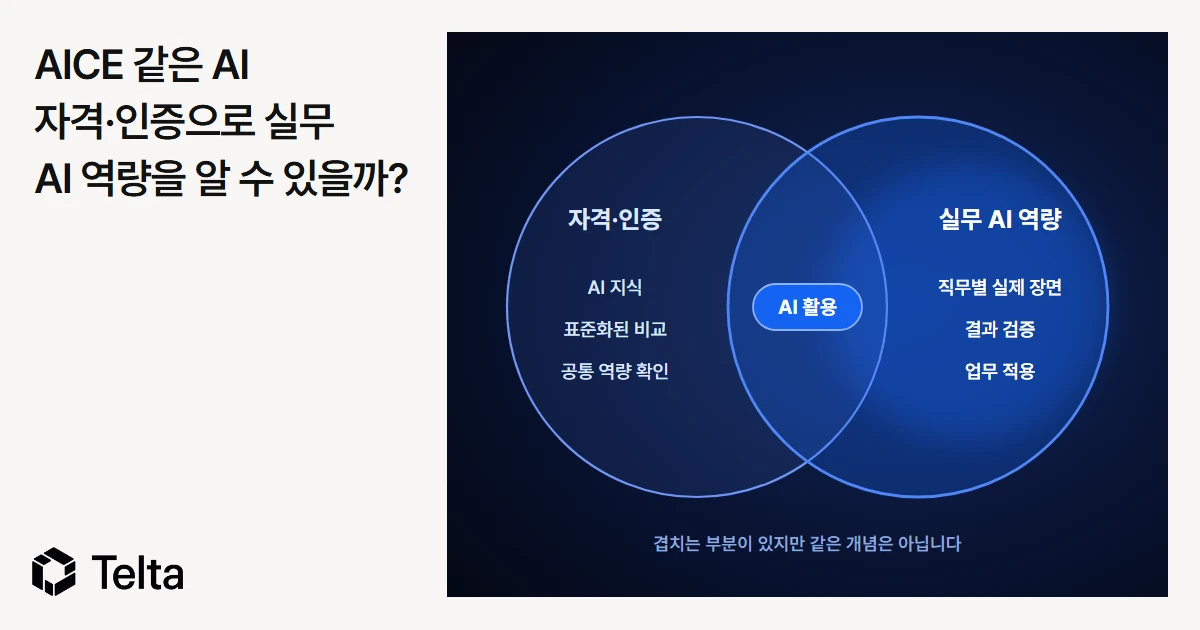


AI certifications are useful for confirming knowledge and performance on defined tasks against a standardized benchmark. But if the question your company really wants answered is “Can this person use AI to get better results in our work?”, you also need an assessment that looks at performance in situations close to the actual job.
Using AI well on a standardized exam and using it to improve results in your company’s actual work overlap, but they are not the same thing.
Does this person meet the required standard for AI knowledge and use in a defined exam setting?
- Learning goals and a baseline
- Standardized comparison
- Shared, cross-role competencies
Can this person use AI in our work context to solve problems, verify the results, and produce better output?
- Real, role-specific scenarios
- Problem definition and tool choice
- Verifying results and applying them
When companies set out to check AI competency, certifications are usually the first yardstick that comes to mind, because they show at a glance whether someone has met a defined standard. That said, some certifications, like AICE, include hands-on tasks and real-world scenarios, so they can’t be written off as simple knowledge tests. What matters is how closely the abilities an exam measures match the abilities your company actually wants to see on the job.
What Does AICE Actually Assess?
AICE is an AI proficiency exam in Korea, developed by the telecom company KT and administered jointly with the Korea Economic Daily. According to its official pages, the Basic level assesses the ability to analyze business data and build AI models to solve problems in a no-code environment, while the Generative level assesses practical skills such as prompt engineering, content generation, data analysis, and workflow automation. The Generative exam is 100% hands-on and, per the official description, tests how well candidates solve problems drawn from everyday work scenarios faced by non-technical professionals.
Companies Care Less About Certificates Than About Work Results
A recurring theme in Telta’s client conversations
Executives at Korean companies didn’t want “people who know a lot about AI.” They wanted “people who use AI to deliver better work.” What mattered was not course completion or certification in itself, but whether the quality of work output and decisions actually improved.
Outside research points the same way. In Mercer’s 2024 Global Talent Trends study, 40% of C-suite executives expected AI to raise productivity by more than 30%. BCG’s AI at Work 2025 stresses that the bigger payoff comes from redesigning workflows themselves, not just rolling out tools. In KPMG’s 2025 global study, nearly three in five employees said they intentionally use AI at work on a regular basis, and many reported gains in efficiency, access to information, work quality, and decision-making. Yet 66% also said they had relied on AI output without checking its accuracy, and 56% said AI had caused them to make mistakes in their work.
These figures come from separate global studies by Mercer and KPMG, so each study is shown on its own.
Executives who expect AI to lift productivity by more than 30%
Have used AI output without checking its accuracy
Have made mistakes at work because of AI
Responses in BCG’s 2025 AI at Work survey, split by whether employees had strong leadership support.
Four Questions That Show Whether Employees Use AI Well at Work
1. Can They Tell Whether a Problem Calls for AI?
Putting AI on every task is not good AI use. People need to distinguish work where AI can save time, like simple summaries or first drafts, from work where privacy, accuracy, or accountability concerns are serious enough that a person should make the call. So before asking “Can they use AI?”, look at whether they can judge where AI is the right fit.
2. Can They Choose the Right Tool and Approach for the Task?
Generative AI tools have different strengths: search, writing, data analysis, image generation. It also matters whether people supply the right source material, keep sensitive information out, and give the tool enough context and criteria for the output they need. Writing a polished prompt is not enough on its own.
3. Do They Check AI Output Instead of Taking It at Face Value?
They should be able to confirm that numbers and facts are correct, that nothing important is missing, and that the logic holds together, then re-prompt or fix what’s wrong. When the output feeds into important decisions, the habit of checking the evidence and questioning possible errors matters most.
4. Do They Actually Make the Work Better?
In the end, what a company wants to know is not how often someone uses AI. It’s whether the work itself actually got better: stronger output in the same amount of time, faster decisions, higher-quality customer service or analysis. That’s why a practical AI competency assessment works best when it uses tasks that closely resemble real work and looks at this entire process together.
Certifications and Work-Scenario Assessments Are Not Substitutes
| Certification Exams | Company-Specific Work-Scenario Assessments | |
|---|---|---|
| Question it answers well | Does this person meet a defined standard of AI competency? | Can this person deliver results in our work? |
| Strengths | Standardization, learning benchmarks, comparability | Grounded in job context; close to real decisions |
| Watch-outs | May be far removed from your company and role context | Requires role-specific design and scoring criteria |
| Best used for | Training baselines, shared learning goals, credential checks | Hiring, placement, training needs, and readiness to take on real work |
Telta Looks at AI Use in Real Work Situations
Telta’s AI competency assessment focuses less on how much someone knows about AI and more on how they use it to solve problems in realistic work situations and how they verify what it produces. It isn’t meant to replace certifications. It adds the evidence companies want to see about performance on the actual job.
Related Reading
- Aptitude Tests vs. Job Simulations: What’s the Difference?
- How Can You Tell If a Candidate Will Do the Job Well Before You Hire?
References
- AICE Official Overview: Basic — Overview of the hands-on exam covering business data analysis and modeling in a no-code AI environment. Source (in Korean)
- AICE Official Overview: Generative — Overview of the certification that assesses generative AI use through hands-on tasks and real-world work scenarios. Source (in Korean)
- Mercer Global Talent Trends 2024 — Global survey of more than 12,000 respondents, including figures on executives’ expectations for AI-driven productivity. Source
- BCG, AI at Work 2025 — Global survey on AI use, leadership support, training, and the importance of redesigning workflows. Source
- KPMG, Trust, attitudes and use of AI 2025 — Global study of AI use, trust, and verification behavior, including figures on uncritical reliance and work mistakes. Source
Note: Figures and findings are based on the original materials published by each organization.
Related Articles