Which 11 Korean companies changed how they hire to test AI literacy?



Nexon, Doosan, SK hynix, Shinhan Bank, LG CNS, CJ OliveNetworks, HD Hyundai, KT, Krafton, POSCO DX and Kia. These 11 flagship Korean companies now have one thing in common in how they hire.
Each has added a stage that assesses how well candidates use AI. We compared this year’s job postings, official announcements and news reports quoting company representatives, and rechecked them on November 25. For Doosan, we referred to its standing guide to the hiring process.
Each Company Assesses It Differently
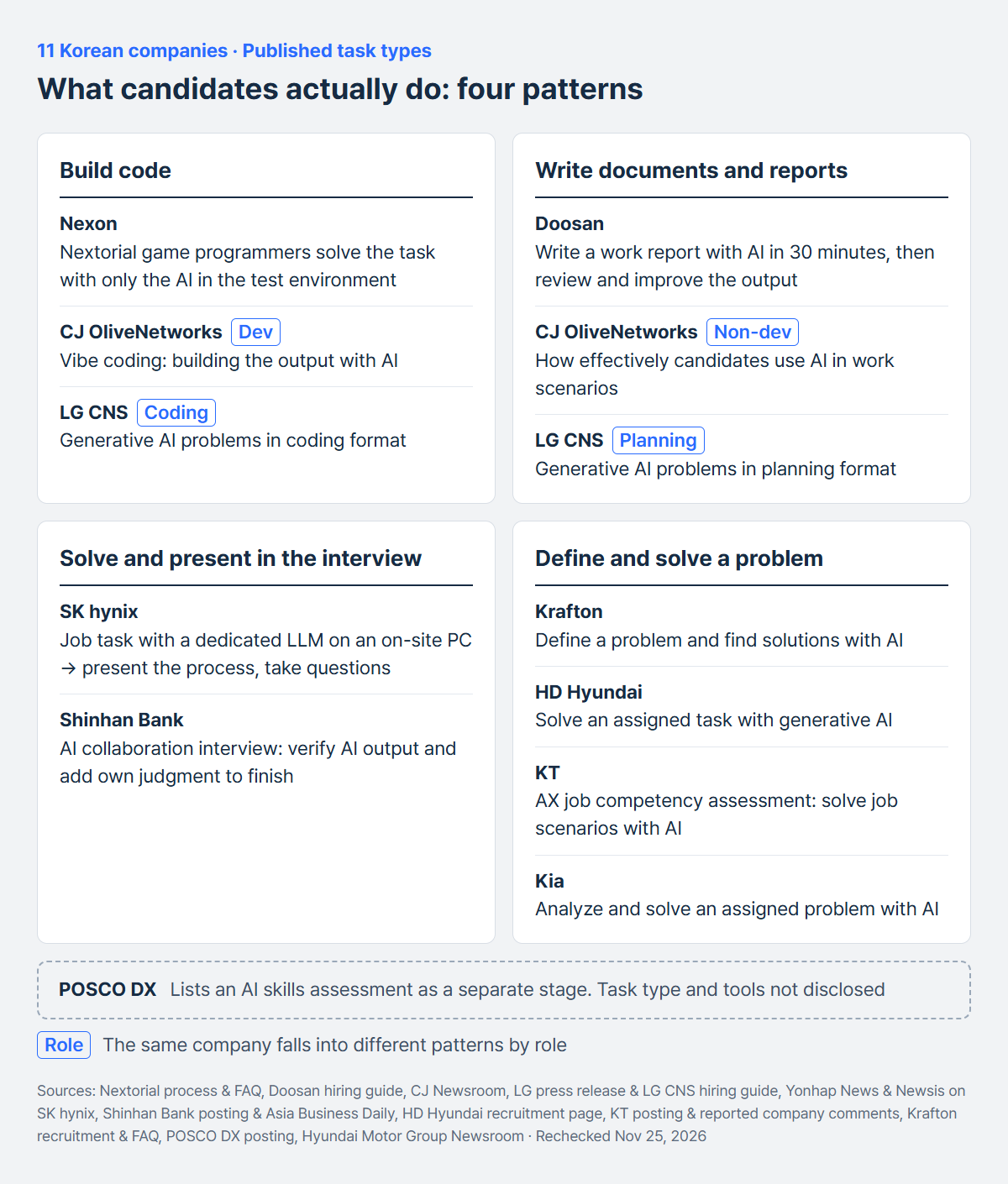
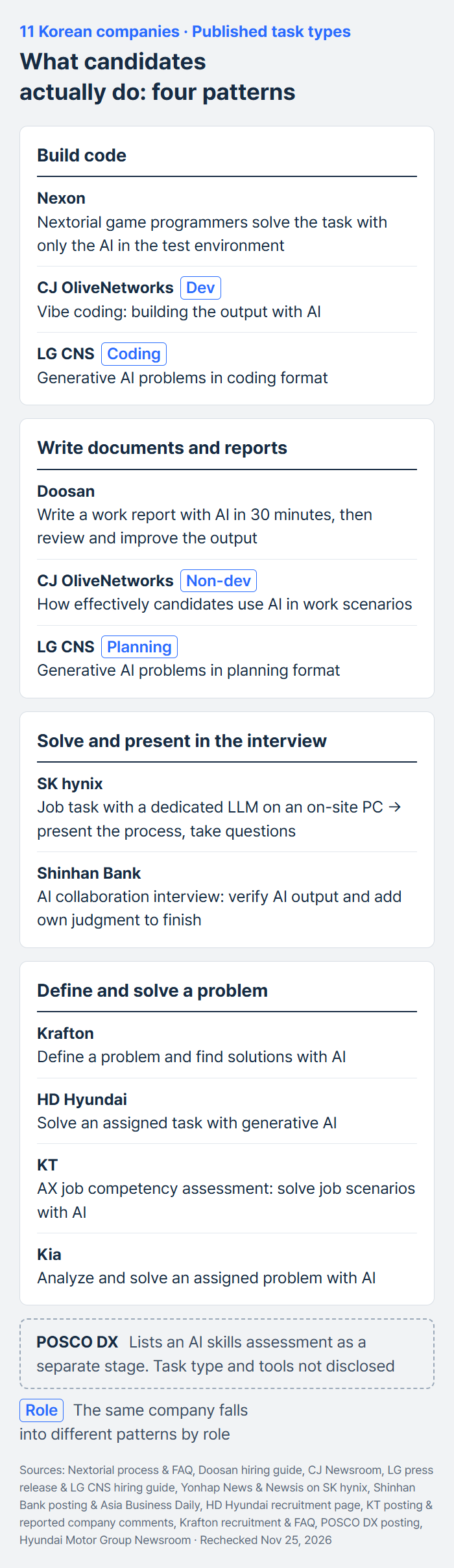
Nexon swapped its coding test for an AI task. In its 2026 Nextorial game programmer recruitment, it dropped the coding test; after an AI interview, candidates solve a task using only the AI provided in the test environment. Nexon looks at their understanding of AI, how they approach the problem, how they use AI along the way and the final output. Nextorial recruitment guide and FAQ
Doosan focuses on how candidates handle what AI produces. Those who pass DCAT, its comprehensive aptitude test, write a work report with AI within 30 minutes during the job interview. Interviewers look at whether candidates build prompts that fit the task and whether they review and revise the AI’s draft. Doosan hiring process guide
SK hynix has candidates solve a task and then explain how they did it. It replaced interviews that ran roughly 20 to 30 minutes with a half-day in-depth interview. According to coverage of its recruitment info session, candidates solve a job task with a dedicated LLM on a PC at the interview site, then present how they solved it and answer interviewers’ questions. Shinhan Bank added an AI collaboration interview to its integrated interview, looking at how candidates verify AI output and add their own judgment to complete the work. Yonhap News · Newsis · Asia Business Daily
LG CNS separates knowledge from use. Alongside the common aptitude and personality test, it runs a CNS Fit Test: every candidate is asked about technology and industry knowledge, while generative AI problem-solving is split by role into a coding type and a planning type. CJ OliveNetworks overhauled its coding test and introduced an AI competency assessment for every role. Development roles are tested on vibe coding, building output together with AI; non-development roles on how effectively candidates use AI in work situations. LG press release · CJ Newsroom
The 11 Companies Side by Side: Stages and Tasks
Grouped by where the assessment sits, the companies fall into two camps. Seven of them (Nexon, CJ OliveNetworks, LG CNS, HD Hyundai, KT, Krafton and POSCO DX) assess AI skills through a separate test or assessment outside the interview. Six of the seven do it before the interview; Nexon runs a separate online assessment after its AI interview. Those that disclosed the task type mainly assess how candidates use AI to work through a job scenario or an assigned problem; POSCO DX has not disclosed its task type. The other three (Doosan, SK hynix and Shinhan Bank) assess AI skills within the interview. Doosan and Shinhan Bank look at how candidates review and verify AI output, while SK hynix looks at how candidates present their process and answer questions. Kia has added a stage that verifies AI problem-solving skills but has not disclosed where it falls relative to other stages.
Nexon and CJ OliveNetworks stand out: both put the AI assessment where a coding test used to be, dropping it in one case and reworking it in the other.
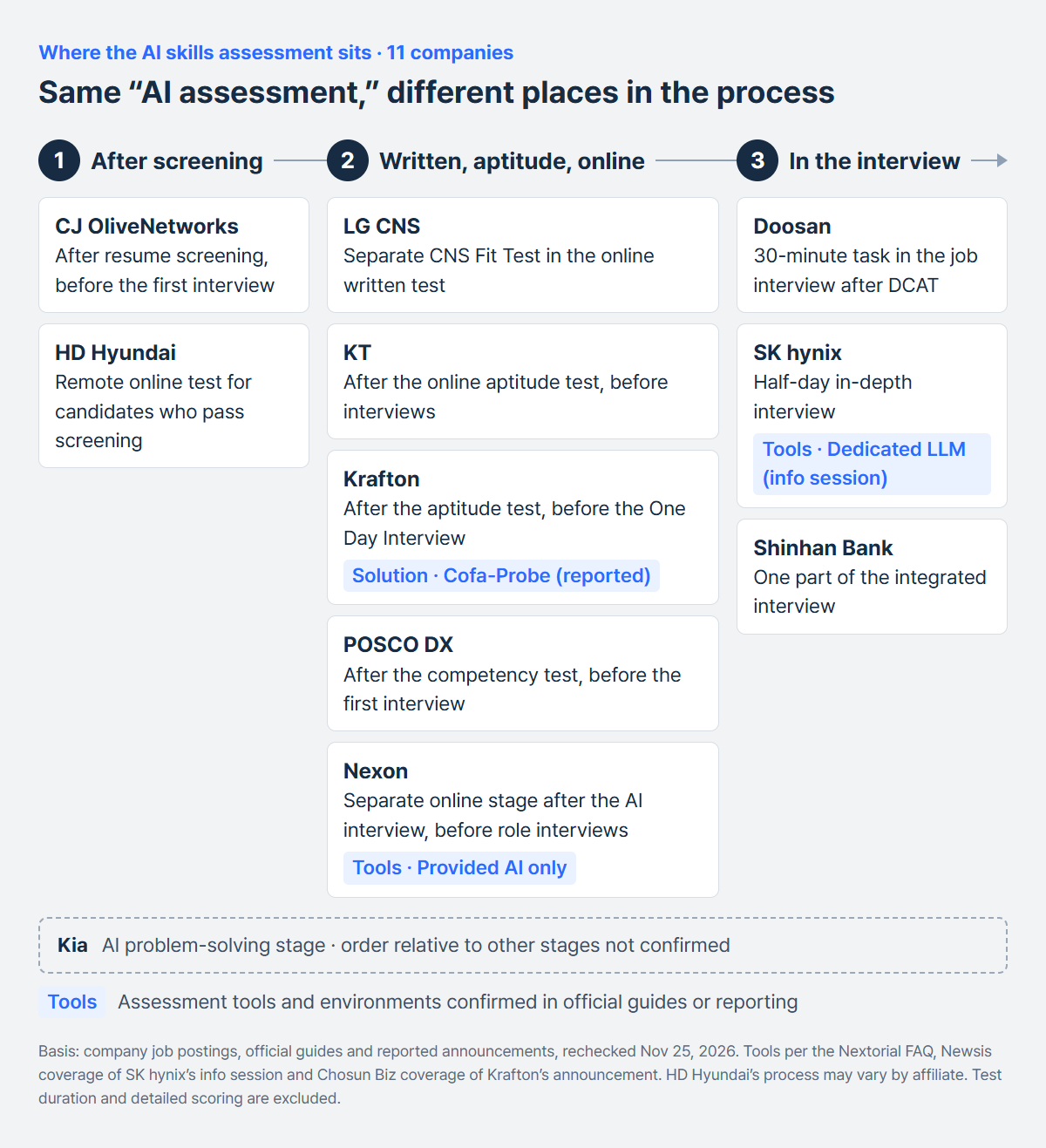
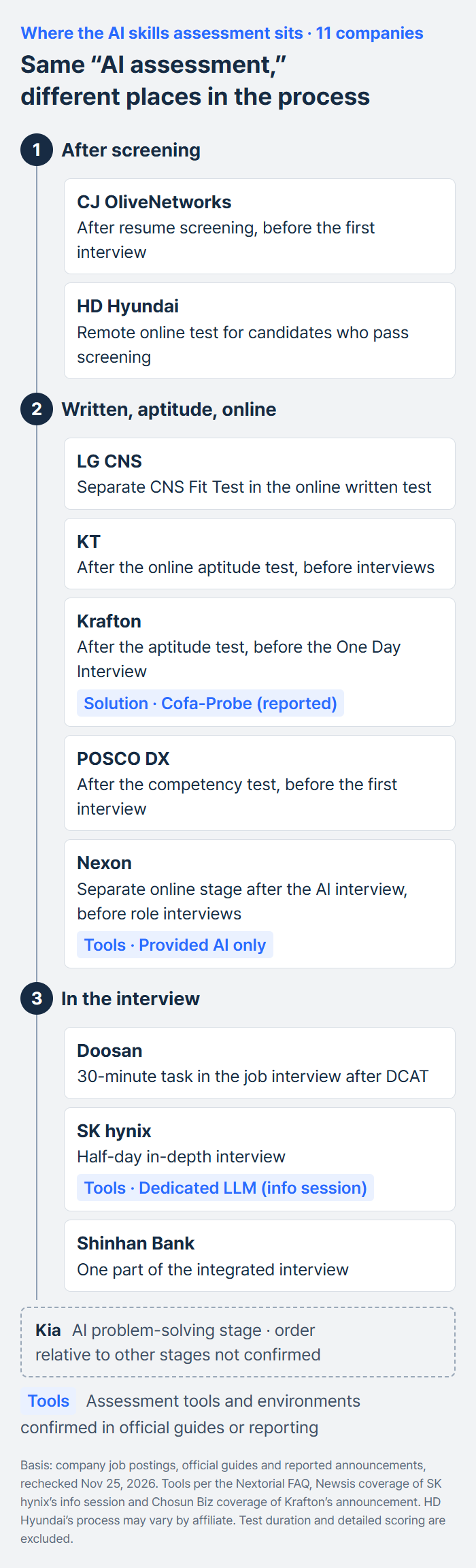
| Company and program | When | What candidates do and what is assessed |
|---|---|---|
| Nexon · 2026 Nextorial game programmers | Separate online assessment after the AI interview | Drops the former coding test; candidates solve tasks using the company-provided environment and AI. Assesses understanding of AI, approach, how AI is used and the output. Official recruitment page and FAQ |
| CJ OliveNetworks · H2 2026 entry-level | After resume screening, before the first interview | AI competency assessment for all roles. Development roles: vibe coding, building output with AI. Non-development roles: using AI in work situations. CJ Newsroom |
| LG CNS · H2 2026 entry-level | Online written test | A CNS Fit Test separate from the common aptitude and personality test. Technology and industry knowledge for everyone; generative AI problem-solving split by role into coding and planning types. LG press release · Official hiring process |
| Doosan · Entry-level hiring process guide | Job interview after DCAT | Candidates write a report with AI in 30 minutes. Assesses how they build prompts for the task and review and improve the output. Doosan official hiring guide |
| SK hynix · H2 2026 entry-level rolling recruitment | Half-day in-depth interview | Tasks and interviews assess job expertise, AI use, logical thinking and more. According to coverage of its info session, candidates solve a job task with a dedicated LLM, present their process and take questions. Yonhap News · Newsis info session coverage |
| Shinhan Bank · H2 2026 general entry-level bankers | Part of the integrated interview | An AI collaboration interview alongside in-depth and group interviews. According to the bank, it looks at how candidates use AI for the task, verify the results and apply their own judgment. Shinhan Bank posting (reposted) · Coverage of the bank’s explanation |
| HD Hyundai · H2 2026 college-graduate entry-level | Separate online test after resume screening | Assesses how candidates solve an assigned task with generative AI. The posting listed it as a remote test in early October; the process may vary by affiliate. HD Hyundai recruitment page |
| KT · 2026 college-graduate entry-level | After the online aptitude test, before interviews | A separate AX job competency assessment for network operations, B2B and B2C roles. KT said it presents job scenarios and focuses on how candidates use AI to solve them. KT posting (reposted) · KT’s explanation (Yonhap News) |
| Krafton · 2027 internship with a path to full-time hire | After the aptitude test, before the One Day Interview | An online assessment of how candidates define a problem and find solutions with AI. According to a report on the company’s announcement, it uses its own assessment solution, Cofa-Probe. Krafton recruitment and FAQ · Report on the announcement |
| POSCO DX · H2 2026 entry-level | After the competency test, before the first interview | The posting lists an AI skills assessment as a separate stage. It does not specify the task type or tools. POSCO DX posting (reposted) |
| Kia · H2 2026 entry-level | AI problem-solving verification stage | Assesses how candidates analyze and solve an assigned problem with AI. The company announcement does not specify where the stage falls relative to others or the task details. Hyundai Motor Group Newsroom |
Test duration and detailed scoring, which the postings do not disclose, are excluded from the comparison.
Where the Assessment Sits Is Tied to How a Company Views AI Skills
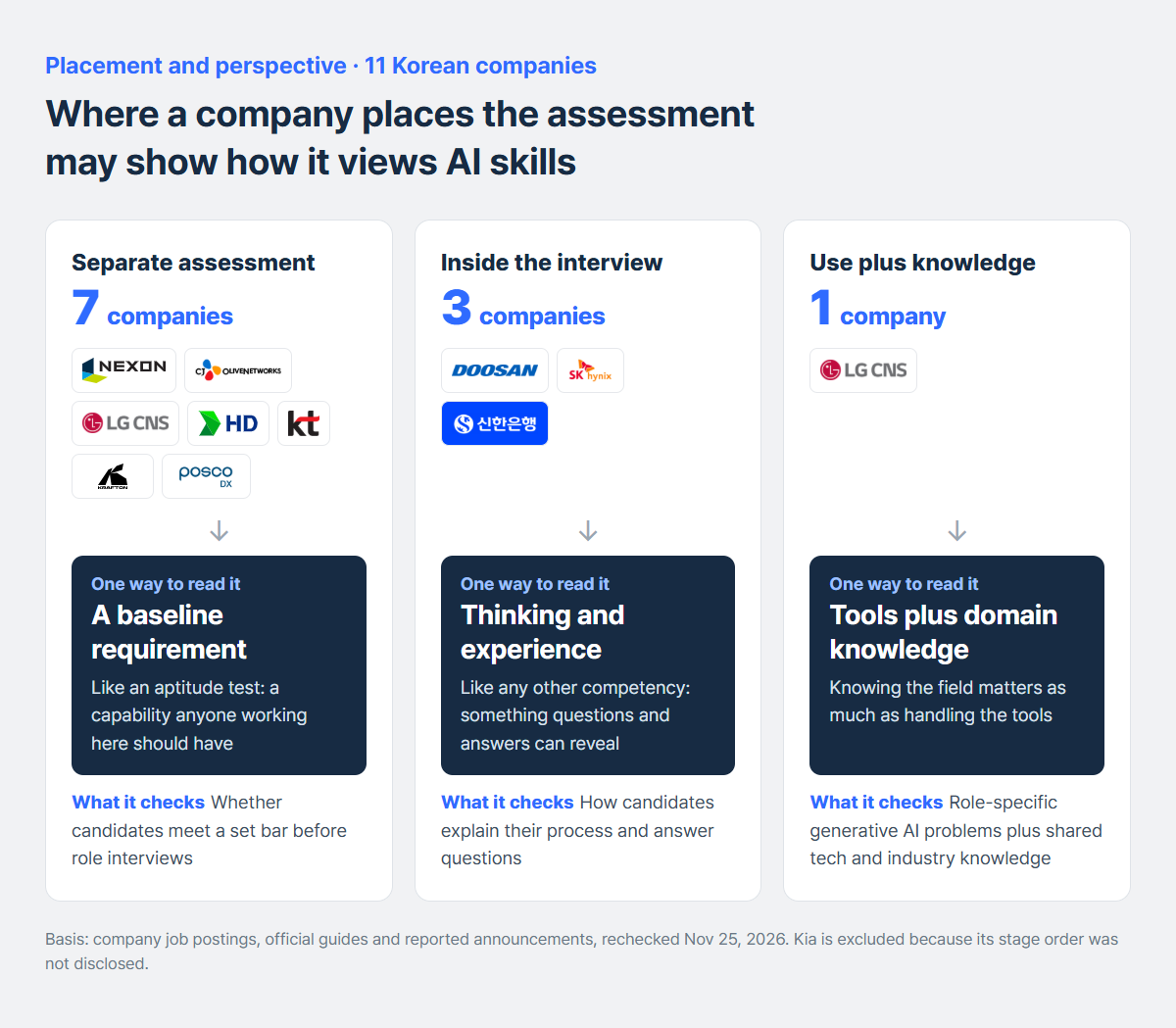
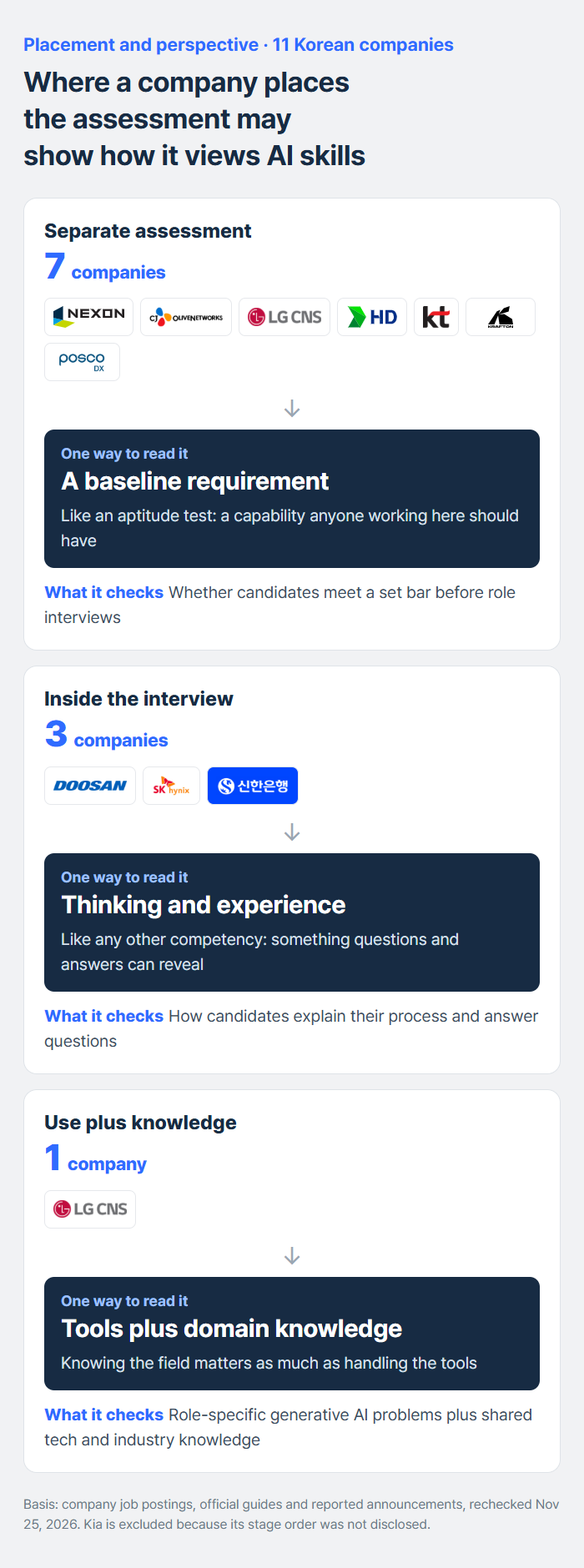
All 11 assess AI skills, but some do it separately from the interview while others build it into the interview itself. The postings don’t say why. Read together, though, the placement of the assessment and the shape of the task suggest that each company may interpret AI skills a little differently.
- If it tests knowledge alongside use — The view may be that using AI well depends as much on knowing your field as on handling the tool. Domain knowledge is what lets you decide what to ask AI and judge whether its answer is right. Working with the same AI, someone who understands the business asks better questions and catches wrong answers sooner. LG CNS asks every candidate about technology and industry knowledge alongside its generative AI problems. That reads as a design meant to check AI skills together with the knowledge that supports them, rather than in isolation.
- If it is a separate assessment outside the interview — This may mean the company treats AI use as a baseline requirement for working there, much like an aptitude test. It works as a gate: candidates must show a set level before they reach role interviews. The setup lets a company compare large numbers of candidates on the same task and the same criteria, and frees interviewers to spend their time on the job competencies of those who pass. The message to candidates is clear, too: whatever the role, knowing how to use AI is now a basic condition of getting hired. CJ OliveNetworks’ move to introduce an AI competency assessment for every role, development or not, can be read the same way.
- If it sits inside the interview — The view may be that AI skills, like any other competency, can be checked through questions and answers. Rather than measuring technical proficiency on its own, this approach looks for a candidate’s underlying thinking and experience in how they explain their process and respond to questions. Even when two outputs look alike, asking why a candidate made a call brings out the difference. SK hynix, which follows the task with a presentation and Q&A, is the clearest example.
Hiring Assessments Can Be a Fast Way to Raise an Organization’s AI Proficiency
Assessing AI skills at the hiring stage could be one of the fastest ways to raise an organization’s average level of AI use. Changing the bar for new hires is sometimes simpler than training and developing the people already on the team.
That said, the design of the assessment, and its results, can differ depending on what it is meant to achieve. An assessment that confirms a baseline requirement and one that looks at how candidates get the job done ask different questions from the start.
Building AI Skills Into Your Own Hiring
If AI skills matter to your organization, there are a few things to decide before building them into hiring. Telta drew these from the 11 cases.
- Purpose: Decide whether you want to confirm a baseline every new hire needs, or see how candidates get the job done.
- Placement: Based on that purpose, decide whether to run a separate assessment outside the interview or build a task into the interview. Designing the placement, the task and the follow-up questions together changes what you can learn.
- Task: Choose work that new hires will do often, or where mistakes are costly. For sales or planning roles, you might have candidates check whether figures produced by AI match the source data; for development roles, under what conditions code written by AI fails.
- Evaluation: Look beyond the final output at what candidates questioned and what evidence led them to change their decisions. Following up in the interview makes their judgment clearer.
In Telta’s AI Literacy Assessment, candidates likewise complete work tasks using an AI tool built into the assessment screen. Telta AI analyzes each candidate’s conversation with the AI and final answer against the assessment criteria, summarizing what they asked the AI for and how they reviewed and revised its responses as a level with supporting evidence. The assessment is used by major Korean enterprises and mid-sized companies for hiring and employee development.
Sources
- Nextorial · Recruitment guide, process and FAQ (in Korean)
- Doosan · Entry-level hiring process guide (in Korean)
- CJ Newsroom · CJ OliveNetworks H2 2026 recruitment (in Korean)
- LG press release · LG CNS recruitment (in Korean)
- LG CNS · Hiring process (in Korean)
- Yonhap News · SK hynix overhauls its hiring (in Korean) · Jul 30, 2026
- Newsis · Coverage of SK hynix’s recruitment info session (in Korean) · Sep 12, 2026
- Shinhan Bank · General entry-level banker job posting (reposted by the Korea Financial Investment Association) (in Korean)
- Asia Business Daily · Interview with Shinhan Bank officials (in Korean)
- HD Hyundai · H2 2026 college-graduate entry-level recruitment (in Korean)
- KT · 2026 college-graduate entry-level job posting (reposted) (in Korean)
- Yonhap News · KT’s AX job competency assessment (in Korean) · Aug 25, 2026
- Krafton · Internship with a path to full-time hire, recruitment and FAQ (in Korean)
- Chosun Biz · Report on Krafton’s announcement (in Korean)
- POSCO DX · H2 2026 entry-level job posting (reposted on Linkareer) (in Korean)
- Hyundai Motor Group Newsroom · Kia H2 2026 recruitment (in Korean)
Related Articles