Reading Korea’s Top 15 Groups’ New Year’s Addresses Through an HR Lens


Your first-half AI training ran on plan. The budget was spent, and completion rates beat the target. But when you sit down to plan the second half, you hit a wall. You can’t tell whether this year’s training actually worked, or what the next round should be built on to move you closer to AI transformation (AX). That’s because no one ever decided what to measure in the first place.
To find that starting point, we reread this year’s New Year’s addresses from Korea’s 15 largest business groups, the annual messages in which leadership sets the direction for the year, through an HR lens.
How Leadership’s AX Message Changed in a Single Year
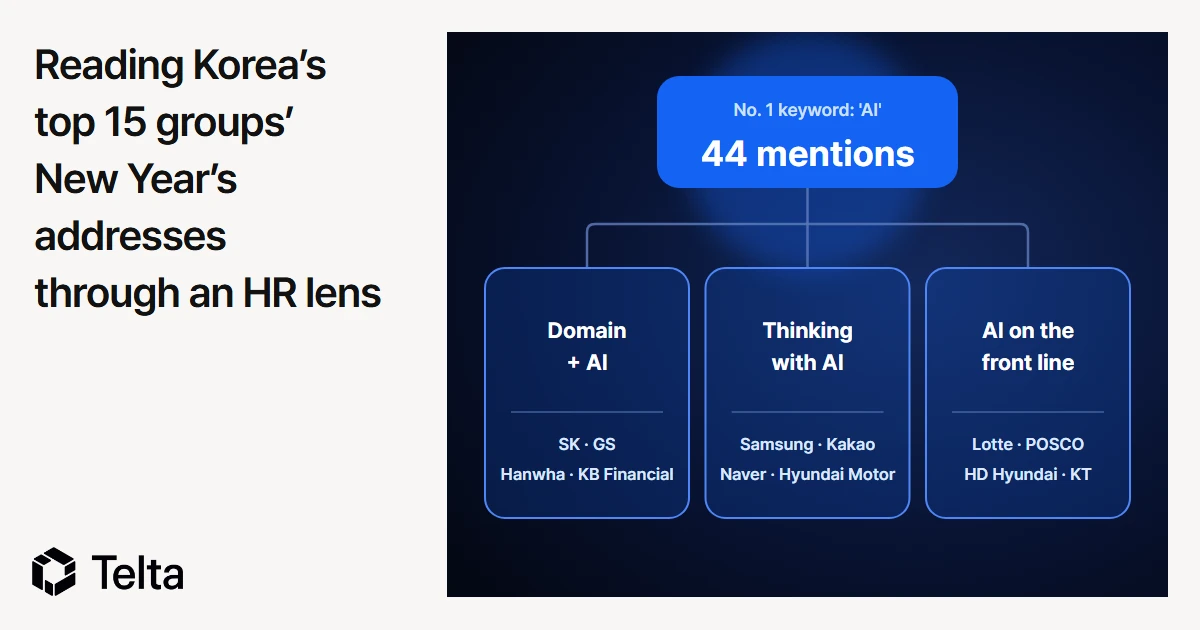
In 2026, the word that came up most often in the New Year’s addresses of Korea’s 15 largest groups was, by a wide margin, “AI.” It appeared 44 times in total, jumping nine places from 10th the year before to 1st. SK mentioned it most, at 15 times, followed by Samsung at 10 and GS at 5.
The context is more interesting than the count. The top keyword in the 2025 addresses (in Korean) was “competition,” and that was the first year AI broke into the top 10. In just one year, the way executives talk about AI has changed. Last year the message was “We will adopt AI.” This year, the declarations got specific:
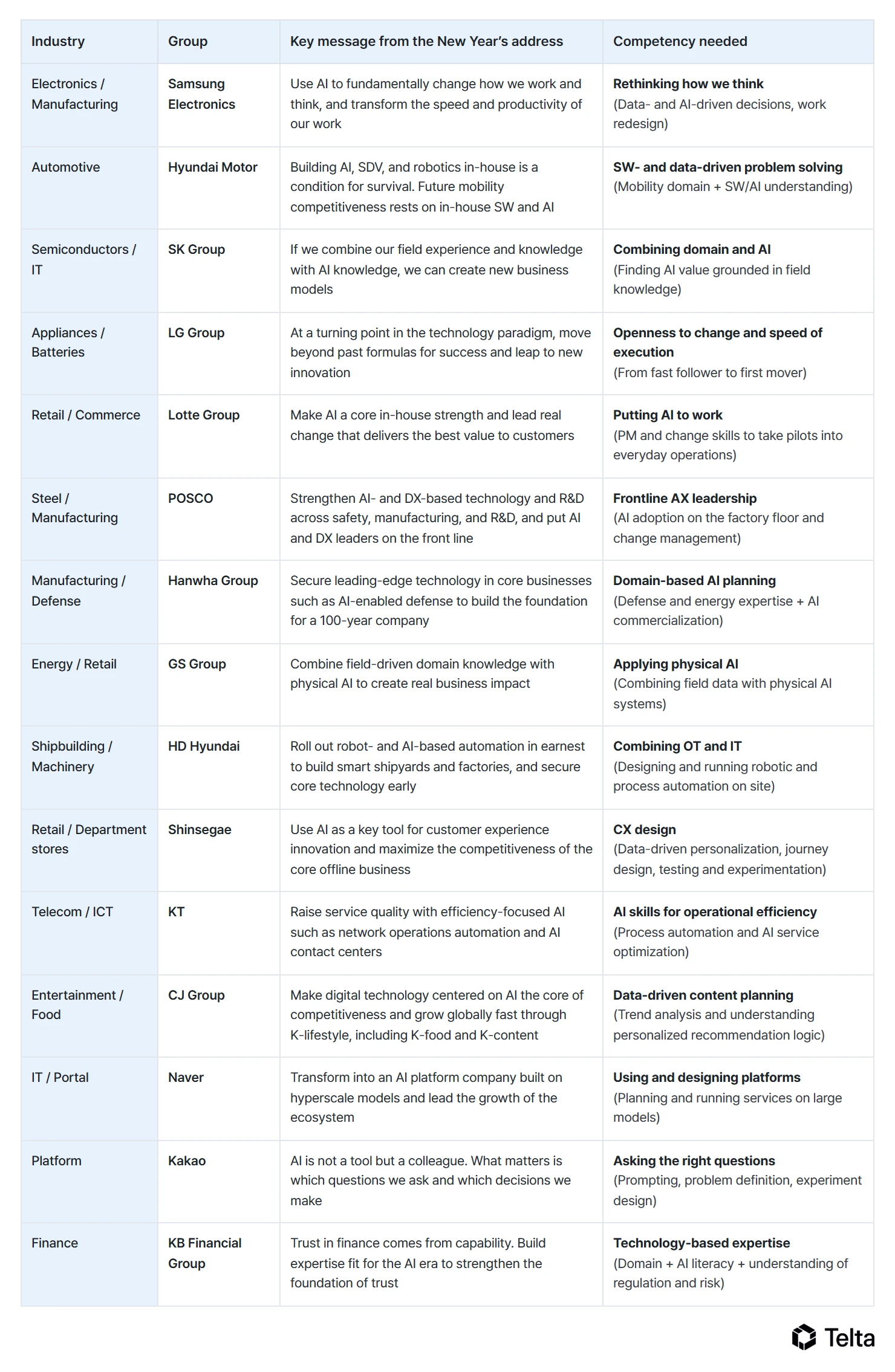
- Samsung Electronics: “We must use AI to fundamentally change the way we work and the way we think.”
- SK: “If we combine our field experience and knowledge with AI, we can create new business models.”
- Kakao: “AI is not a tool but a colleague. What matters is which questions we ask and which decisions we make.”
No one is talking about adopting AI or starting an AI transformation anymore. What leaders are asking for now is not AI adoption but a change in how employees think and how they work. And that demand ultimately lands on HR’s desk.
So how should HR respond? I think the answer is closer to home than it seems: handle it the same way the company has always executed any other strategic direction.
Take my experience working with the memory business unit of a semiconductor company. The unit’s strategic direction at the time was “Strengthen our customer-response capabilities to raise the order conversion rate.” Nobody can execute a sentence like that as written. So we first broke it down by major organization. For each one, we assessed where in the customer-response process the bottlenecks occurred, redrew roles and responsibilities between organizations, and defined the system rollouts and improvements that were needed. Then we cascaded those initiatives into KPIs for sub-teams and individuals, such as “lead time for responding to customer requests,” metrics with a causal link to the end goal of order conversion. Strategy only turns into action on the ground when there is a clear chain from strategic message to organizational initiative to individual KPI.
AI is no different. “Change the way you work and think” is also a strategic message. It has to be broken down into initiatives and KPIs under the company’s strategic direction. In practice, though, AI transformation often moves forward with that chain broken. The performance metrics become how many hours of company-wide AI training people completed and how many tool licenses were handed out. Metrics like these only confirm inputs. They say nothing about which work changed with AI, how it changed, or whether that change showed up in business results. In memory-unit terms, it’s like managing an order-conversion target by tracking hours of sales training.
That’s why the question HR should be asking is not “How much AI training have we delivered?” It’s “Under our company’s strategic direction, which work should each organization redesign with AI, and which metrics will show us that the change happened?” When AI is treated like any other strategic initiative rather than a standalone “change event,” leadership’s declarations finally make their way into how people actually work.
An AX Mission With Direction but No Standards
There’s a direction (“Develop AI-native talent,” “Change the way we work”), and there’s a training budget. That’s exactly where the problem starts. We are designing training before defining what competencies an AI-native person in our organization actually needs, or how to measure them. We’re jumping to execution while skipping the step that breaks leadership’s declarations down into units people can act on.
Can training launched without concrete standards really build the competencies our organization needs?
Three AX Competencies in the Top 15 Groups’ New Year’s Addresses
We reread and analyzed each group’s New Year’s message from an HR perspective, asking one question: what is it asking of employees? At first glance, each industry seems to be saying something different. In the end, though, the messages converge on three broad directions.
1. Connecting Domain Expertise With AI
This is the direction shared by SK, GS, Hanwha, and KB Financial Group. SK said, “If we combine our field experience and knowledge with AI knowledge, we can create new business models.” GS called on its people to “combine field-driven domain knowledge with physical AI to show business impact.” KB Financial stressed that domain expertise remains the foundation of competency even in the AI era, saying, “Trust in finance comes from capability.”
What these companies have in common is that they operate in industries where field expertise is the core of competitiveness. In sectors like energy, finance, and manufacturing, the deeper the domain knowledge, the more value there is in combining it with AI.
2. Thinking, Judging, and Designing With AI
This is the direction emphasized by Samsung, Kakao, Naver, and Hyundai Motor. Samsung defined AX as “not just a tool, but a process that fundamentally changes how we think and how we work.” Kakao said, “AI tools are copilots. What matters is which questions we ask and which decisions we make.” Naver emphasized the ability to plan and run services on top of its hyperscale AI models, and Hyundai Motor called for building SW and AI capabilities in-house and solving problems with data.
None of the four is asking for skill with AI tools. They are asking for a shift in how people think, question, and design, with AI as a given. They want people who think with AI, not just people who use it.
3. Embedding AI in Frontline Operations
This is the direction set by Lotte, POSCO, HD Hyundai, and KT. Lotte asked its people to “lead change by embedding AI as a core competitive advantage,” making AI an internal core capability rather than something outsourced or treated as a tool. POSCO spelled out how it would put AI to work across manufacturing, R&D, and safety by “placing AI and DX leaders on the front line.”
These companies share one thing: they are in industries where AI only matters if it works on the shop floor, not just in the office. They don’t want people who come up with AI ideas. They want people who win over resistance on the ground, work through the exceptions, and see the job through to the end.
Your Company’s AX Direction Only Moves When HR Translates It
“Get ready for AI transformation” is a direction. No one else will define what competencies that direction means for your organization or where to start. That’s HR’s job. So what happens if you design training while the direction is still unclear?
If you have no way to judge your first-half training other than completion rates, the problem isn’t your measurement tools. It’s that what you were trying to build was never clear in the first place. Once you define the competencies you need, what to measure follows. The starting point isn’t training. It’s understanding where you are today.
Related Reading
- Why Completion Rates Can’t Measure the Impact of Corporate AI Training
- AI Competency and Literacy Assessment: What to Measure Across Depth and Breadth
Related Articles