.svg)
Leadership Assessment Methods: 360 Feedback, Interviews, and Simulations
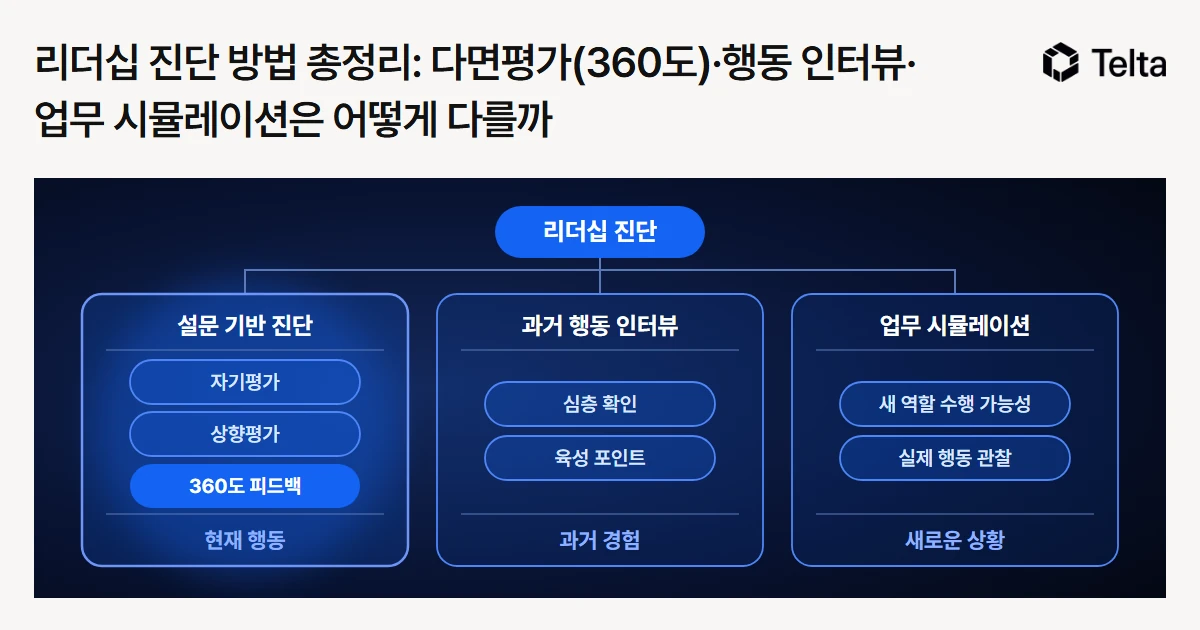


Leadership assessment isn’t about boiling “Is this a good leader?” down to a single score. You can ask the people around a leader about their current behavior, explore past experiences through in-depth interviews, or have the leader work through situations that resemble a new role. The right method depends on what you want to know.
360-degree feedback isn’t a tool separate from surveys. It’s one way to design a survey-based assessment. Pick your method based on whom you want to ask and which situations you want to observe.
Shows how leaders and the people around them experience their current behavior.
Takes real difficult situations the leader has faced, one at a time, and probes what they noticed, how they judged it, and what they did.
- In-depth review of promotion and selection candidates
- Pinpointing behaviors to develop
Presents complex situations the leader hasn’t faced yet and directly observes how they prioritize, judge, communicate, and solve problems.
- Readiness to perform in a new role
- Behavior observed in near-real work
When you prepare a leadership assessment for the first time, it’s tempting to start with the tools. “Should we just run a 360?” “Is a survey enough?” “Do we need behavioral interviews or simulations as well?” But the real starting point is less about tools and more about what you will use the results for. First, be clear whether this is for development, for promotion, or for gauging leadership across the whole organization.
A pattern Telta has seen again and again in client projects
Teams often agree that “we should assess our leaders” without deciding what they want to learn or how they will use the results. Picking a tool at that point easily leads to a project that measured plenty but answered nothing.
Why Leadership Assessment Matters More Now
In a July 2024 Gartner survey of 805 HR leaders, 75% said managers are overwhelmed by their growing responsibilities, and 69% said leaders and managers are not well equipped to lead change. In the same survey, leader and manager development ranked as HR’s top priority for 2025, holding the No. 1 spot for the third year running.
These figures come from separate studies by Gartner and DDI, so each study is shown on its own.
HR leaders who say managers are overwhelmed by growing responsibilities
HR leaders who say leaders and managers aren’t ready to lead change
Leaders who say they receive high-quality leadership assessment
DDI’s Global Leadership Forecast 2025 shows a similar gap: only 20% of leaders report receiving high-quality leadership assessments. So before asking “Should we run leadership training?”, the bigger question is how to build the evidence for deciding who needs to develop what.
What Surveys, Behavioral Interviews, and Work Simulations Each Reveal
An important distinction: 360-degree feedback is not a tool separate from surveys. It is survey-based leadership assessment with the rater pool widened to include the leader, their manager, peers, and direct reports. Past-behavior interviews and work simulations, by contrast, are not surveys at all. They take a deeper look at real experiences or at how people actually perform.
| Approach | Design | Question It Answers Best | Typical Use |
|---|---|---|---|
| Survey-based assessment | Self-assessment | How does the leader view their own leadership behavior? | Self-awareness, starting point for development |
| Upward feedback | How do team members experience this leader’s feedback, delegation, and communication? | Team leader development, manager effectiveness | |
| 360-degree feedback | Where do the views of the leader, their manager, peers, and reports align, and where do they differ? | Leadership development, post-promotion development goals | |
| Organization-level roll-up | Which leadership issues recur in particular units or job levels? | Leadership culture, organizational development priorities | |
| Past-behavior interviews | In-depth questions about real experiences | In similar situations, what did they actually notice and do? | In-depth review for promotion and selection, development points |
| Work simulations | Working through new situations firsthand | Facing a complex situation for the first time, what do they prioritize and how do they decide? | Readiness for a new role, observing real behavior |
What the research says: In Smither, London & Reilly’s (2005) meta-analysis of 24 longitudinal studies, the average improvement in ratings after multisource feedback was generally small. In other words, receiving feedback does not automatically produce change. Meanwhile, in Arthur et al.’s (2003) meta-analysis of assessment centers, scores on six dimensions observed in simulation exercises (consideration of others, communication, drive, influencing others, organizing and planning, and problem solving) correlated with job performance at roughly .25 to .39. Different methods surface different information.
Is One Method Enough?
It can be. With a single purpose, one method is often the more efficient choice. If you want to know how your team leaders are experienced by their teams, for example, a 360 or a survey may be all you need. If you want to know whether a promotion candidate can handle the complex role they’re about to take on, an observation-based simulation is more direct.
Problems arise when you try to answer several questions with one tool. In Telta’s projects, too, combining surveys with behavior-based assessment sometimes surfaced different kinds of information that complemented each other. That doesn’t mean using both always makes results more accurate. It means that when you need different information, you need different methods. We cover how behavior-based assessment filled in what 360-degree feedback couldn’t show in What 360-Degree Feedback Misses About Team Leaders, and How to Fill the Gap.
Planning Your First Leadership Assessment? Start in This Order
1. State in One Sentence Why You’re Assessing Leadership
The first thing to decide isn’t the type of test. It’s the purpose of the assessment. “We want to understand each new team leader’s strengths and development areas before training” and “We want to identify which executive promotion candidates are ready for the next role” are completely different projects. Different purposes call for different questions, participants, and assessment methods.
If this is your first time, start by answering these questions:
- Who are you assessing? New team leaders, current team leaders, executives, promotion candidates, or others
- What will you decide based on the results? Training, coaching, promotion, placement, organization-wide improvements, or something else
- Who will actually use the results? The leaders themselves, HR, senior leaders, executives, or others
2. Decide What You Need to Find Out for That Purpose
This is where it often gets confusing, because “assessing leadership” is too broad on its own. Separate out what you want to see: the leader behaviors the people around them already experience, how they handled difficult people or organizational problems in the past, or whether they can make sound judgments in new situations they haven’t faced yet.
If the goal is developing new team leaders, for example, it may matter most to check current behaviors such as “How do they give feedback to team members?” and “How clearly do they explain priorities?” For executive promotion candidates, though, you may also need to see what judgments they make when the interests of multiple stakeholders collide.
3. Choose Your Method Only After You Know What to Check
Now is the time to compare options like 360s, surveys, past-behavior interviews, and simulations. If you want to see behavior others have actually experienced, a 360 or a leadership survey is the natural fit. If you want to dig into specific past behavior, past-behavior interviews or structured interviews are the right choice. If you want to see judgment and performance in a bigger role someone hasn’t held yet, a role-play simulation or an in-basket exercise (a prioritization simulation in which participants work through a backlog of emails and reports under a time limit) is more direct.
More methods aren’t automatically better. What matters more is choosing the smallest combination that gets you the information your purpose truly requires.
4. Decide What Happens After the Assessment Before You Start
If the results arrive and everyone asks “So now what?”, the report is likely to sit on a shelf. Before you begin, it’s worth agreeing roughly on what follow-up you’ll take once the results are in.
If the goal is development, for example, you can link each person’s strengths and development areas to training and coaching topics. If the goal is promotion, you can weigh the results alongside other evaluation data in the decision. If you’re looking at leadership culture across the organization, focus less on average scores for individual items and more on where the gaps between units are largest, then use that to set follow-up workshops or leader communication tasks.
Telta Starts With the Purpose, Not the Tool
Telta doesn’t lock leadership assessment into a single format. We first define what you want to find out, then design team member surveys and real-situation assessments as needed. Rather than producing a single score, we focus on leaving you with evidence for the next decision, whether that’s training, placement, or promotion.
Related Reading
- Suddenly Managing Eight People? What to Assess in a New Team Leader
- Culture and Leadership Assessments: What to Do After the Results Arrive
- Will Your Star Performer Make a Good Team Leader? AI-Era Leadership Assessment
- Large IT Company Case: Competency Framework and Assessment for Promotions
References
- Gartner, 2025 HR Priorities — Survey of 805 HR leaders conducted in July 2024. 75% pointed to managers’ growing burden of responsibilities, and 69% to a lack of readiness to lead change. Source
- DDI, Assessments for Development / Global Leadership Forecast 2025 — Global benchmarks on leadership assessment experience and development. Source
- Smither, London & Reilly (2005) — Meta-analysis of 24 longitudinal studies on multisource (360-degree) feedback. Source
- Arthur, Day, McNelly & Edens (2003) — Meta-analysis of the relationship between six assessment center dimensions and job performance (Personnel Psychology, 56, 125–154). Source
Note: Figures and findings are based on the original materials published by each organization.
Related Articles