.svg)
What 360-Degree Feedback Misses About Team Leaders, and How to Fill the Gap


On May 20, Telta hosted a webinar with Offpiste on the theme “New Team Leader Leadership: What to Look At, and How to Connect It to Training.” More than 100 HR and HRD professionals joined us.
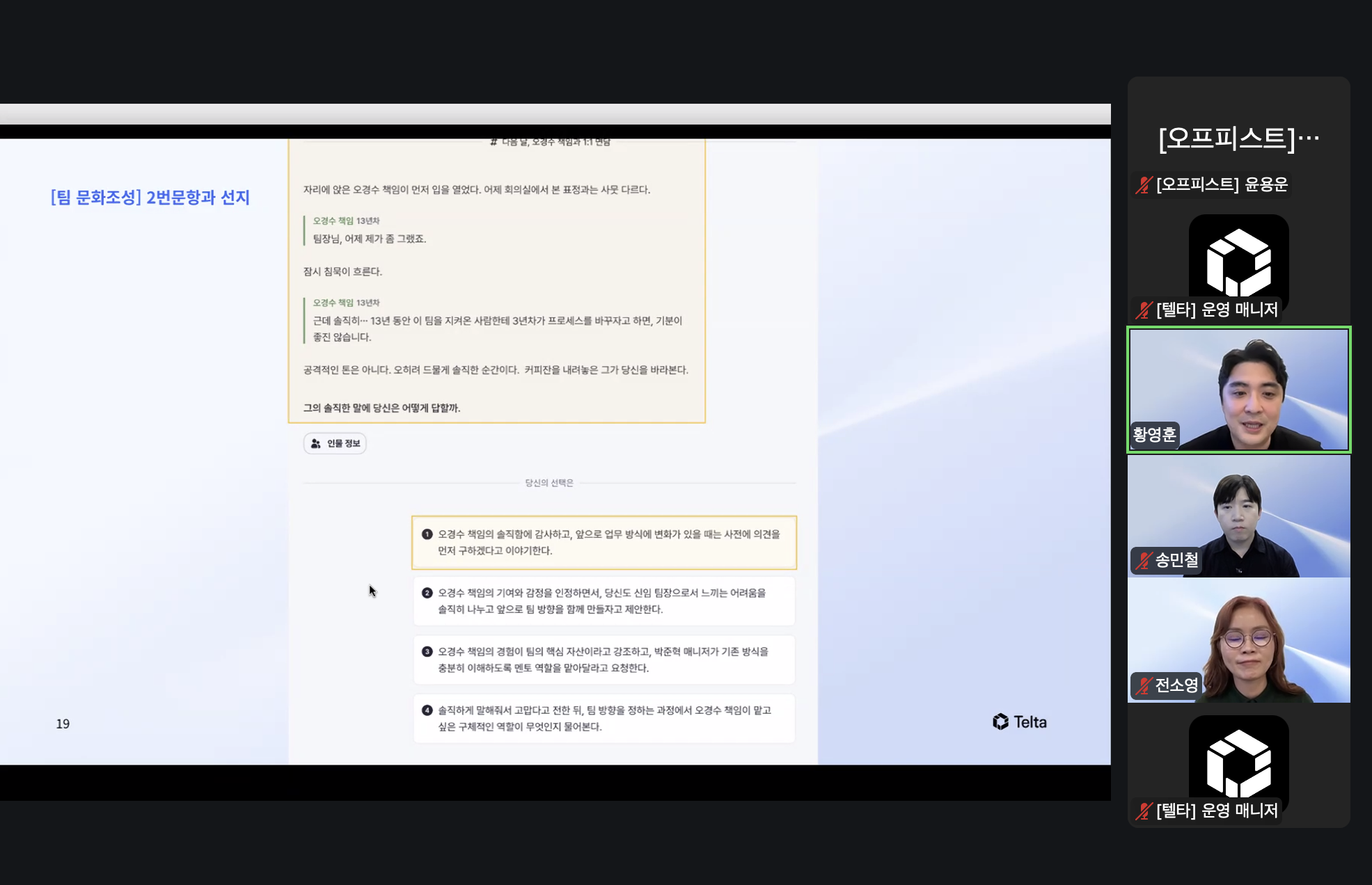
This time, the panel featured Dr. Younghoon Hwang, Professional Services Lead at Telta, and Dr. Mincheol Song, an HRD manager at an affiliate of a major Korean conglomerate.
For those who couldn’t attend, here is a recap of the four threads of conversation from that hour.
Session 1: Does 360-Degree Feedback Have Limits in Telling Leaders Apart?
The reasons self-assessment and 360-degree feedback are hard to rely on are clear. With self-assessment, self-bias naturally creeps in because the results feed into HR, evaluation, and training decisions. 360-degree feedback takes significant time and money, yet its results are heavily shaped by organizational context. Sometimes a team leader who scored well on leadership one year suddenly drops the next. Look closer, and in most cases the organization has just been restructured or the business is going through a tough stretch.
%20%E1%84%90%E1%85%A6%E1%86%AF%E1%84%90%E1%85%A1%205%E1%84%8B%E1%85%AF%E1%86%AF%20%E1%84%8B%E1%85%B0%E1%84%87%E1%85%B5%E1%84%82%E1%85%A1.pptx.png)
When You Have Scores but Don’t Know What They Measured
As one example, we shared an analysis a business group had commissioned from Telta. We ran a factor analysis on the 360-degree feedback indicators for all of its team leaders, and even when we analyzed each affiliate separately, the indicators showed almost no discriminant validity. The group had put real effort into collecting scores, but the competencies those scores were supposed to represent could not be told apart.
That doesn’t mean 360-degree feedback is the wrong tool. But assessment results fail to flow naturally into training because they rely on a single source of measurement.
Session 2: Three Lenses on Leadership: The Mirror, the Telescope, and the Situation
There are three broad ways to measure leadership. Self-assessment is like looking in a mirror. 360-degree feedback is like observing someone through a telescope from the side. And simulation-based behavioral assessment lets the situation reveal the person. Even when all three look at the same leadership, they draw on different sources of measurement, so the results are different in nature.
360-Degree Feedback Speaks the Language of Evaluation; Behavioral Assessment Speaks the Language of Development
The difference becomes clearer when you frame it by how each one is used.
- Self-assessment serves as a supporting language for self-development. It’s a starting point for reflecting on yourself.
- 360-degree feedback, thanks to the stability of accumulated ratings, is closer to the language of HRM: evaluation, compensation, and promotion.
- Behavioral assessment looks directly at the behavior a person shows in a specific situation, so it speaks the language of HRD: assessment, development, and training.
No tool is perfect. Our conclusion at Telta is that you need a combination: keep 360-degree feedback as the foundation and add a layer of behavioral assessment on top.
Session 3: 15 Minutes as a New Team Leader: Inside the Telta Simulation
In the second half of the webinar, we showed how Telta’s New Team Leader Leadership Simulation actually works.

The scenario opens with a star performer of 10 years being suddenly appointed team leader. Four team members appear, each with their own personality: Junhyung Park, Gyeongsu Oh, Seoyeon Kim, and Naeun Yu. Each one has a detailed career history and character. Gyeongsu Oh, for example, is a 12-year veteran who was passed over for the team leader role.
Participants work through 15 questions in 15 minutes, three for each of five core responsibilities: performance management, work management, people management, stakeholder management, and building team culture. The questions are multiple choice, but not simple multiple choice. It is a responsive assessment in which the next question changes depending on the option you chose before, designed so that there can be more than 120 possible outcomes.
Session 4: What It Takes to Turn Assessment into Development
Before the webinar, Dr. Mincheol Song tried Telta’s New Team Leader Leadership Simulation himself. He told us that although he tried hard to approach it critically, he found himself naturally asking, “What would I do in this situation?”
Behavioral Assessment Works Best Alongside Other Assessments
Self-assessment shows how I see myself. 360-degree feedback shows how others see me. Behavioral assessment shows what I actually choose to do in a real situation. Put the three together, and you get a three-dimensional picture of the same leader’s leadership.
One combination is especially revealing. When a leader rates high on both self-perception and others’ perception but behaves differently in the simulation, you can see in advance that they may perform well day to day yet falter under outside pressure or stress.
Telta’s team leader simulation also has an operational advantage. 360-degree feedback is only possible at least six months after someone takes the role, but Telta’s simulation can be run from day one. Because the same person can try different choices each time they retake it, it also works well as an onboarding tool for new team leaders. Once parallel test forms are ready, you can even answer the question of training ROI with data, based on score changes before and after training.
Whether leadership is treated in the language of evaluation or carried into the language of development ultimately comes down to what you look at and measure. Build on the stability that 360-degree feedback has accumulated, and add one more layer: the behavior that real situations reveal.
That was the core message of the hour we spent together at Telta’s May webinar.
Webinar Q&A: 7 Questions
Q1. Our leadership assessments rarely lead to real management or development. How can we fix that?
The reality is that debriefs and workshops built on conventional leadership assessments struggle to deliver consistent results. Telta’s New Team Leader Leadership Simulation is designed with a Development Center (DC) orientation. As new team leaders work through some 120 scenarios they are bound to face, they receive feedback tailored to the actions they chose. That is why we designed it so that, even within a leadership assessment, participants can pinpoint for themselves what they should do differently next time.
Q2. Some leaders don’t welcome leadership assessments. How should we encourage them?
It’s hard for people already in leadership roles to embrace a leadership assessment, largely because most leadership assessments have historically been tied to HR decisions. The most effective approach is to position the assessment not as a performance review tool but as a tool for improving their own leadership. The clearer you make it that the results lead to development rather than evaluation, the more readily leaders accept it.
Q3. Does behavioral assessment work for small companies too?
In some ways, it works even better. In a small company, teams are small enough that people can often guess who gave which response in a 360-degree review. The very structure that makes rater anonymity hard to guarantee undermines the credibility of 360-degree feedback. Behavioral assessment, by contrast, is completed by the leader alone, so it can be introduced regardless of organization size. The smaller the organization, the more clearly its strengths show.
Q4. Every company has its own ideal talent profile. Can the simulation be customized to fit ours?
Yes. We can keep the general framework of the team leader leadership assessment while building your company’s own talent profile into the scenarios and evaluation criteria. It can be extended beyond a DC to an Assessment Center (AC) format, and we can also connect it to a review of development potential based on your talent profile.
Q5. Can it be used for an Assessment Center (AC)? Do the quantitative scores differentiate well enough?
The current New Team Leader Simulation is designed primarily as a DC, meaning for development. Its first goal is to reduce the trial and error new team leaders go through and help them quickly adapt to their core responsibilities. If you want to use it for AC purposes, we recommend combining it with 360-degree feedback rather than using the simulation on its own. Used together, the two assessments deliver far more stable quantitative differentiation.
Q6. Can we use just one module, such as performance management?
The current package has three questions for each of five core responsibilities, so there aren’t enough questions to use the performance management module on its own. However, if you plan to run separate performance management training, we can expand that module to 15 questions and customize it into an in-depth assessment. Because the assessment and the training are designed around the same behavioral units, you can also use it for pre- and post-training comparisons.
Q7. How is it different from a situational judgment test (SJT)? What is the simulation’s main goal?
A situational judgment test stops at producing a score. Telta’s New Team Leader Leadership Simulation also explains which behaviors that score came from. In the report, participants can see what they chose in each situation, what followed as a result, and what they could do better next time. The biggest difference is that, while it is an assessment, it also works as a learning intervention. Giving new team leaders indirect experience that helps them settle into the role is the simulation’s main goal.
Related Reading
- Will Your Star Performer Make a Good Team Leader? AI-Era Leadership Assessment
- Why a Leader’s Warm Smile Can’t Create Psychological Safety in the AI Era
Related Articles
.webp)

