.svg)
Culture Survey Results: Why “Communication Is the Problem” Changes Nothing
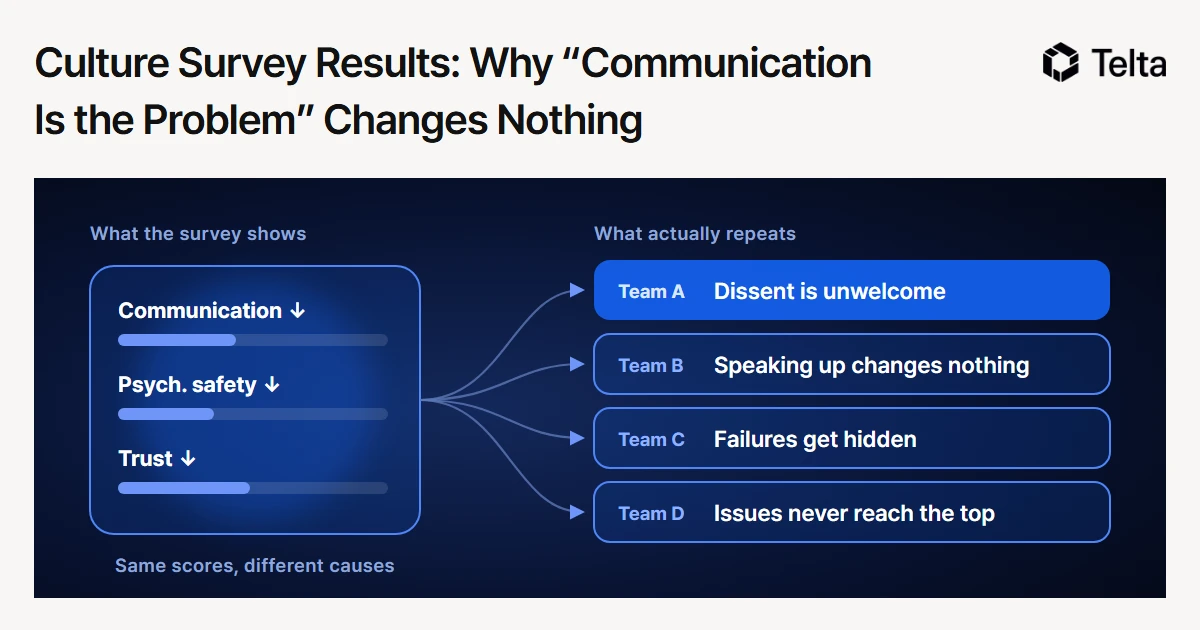

“Communication is low.” “Psychological safety is low.” These phrases only name the problem. The real work of a culture assessment starts with finding which behaviors keep repeating behind those scores.
At a company-wide meeting of a large corporation, the CEO shared the results of a recent employee survey, including this item:
More than half of respondents disagreed or strongly disagreed. It is a real case described in HBR.
Disagreed or strongly disagreed with “I feel safe speaking up at work”
But that phrase alone doesn’t tell you what to change.
An employee survey case at a large company, described in HBR. A low score matters, but it isn’t yet a cause.
The problem seems obvious: “Our psychological safety is low.” The hard question comes next. So what should we change?
Source: HBR, “Building a Culture Where Employees Feel Free to Speak Up”
The Short Answer
Culture scores are observations, not causes. Reading them as Measure → Pattern → Context → Cause → Action turns vague goals like “improve communication” into real change.
Low Psychological Safety Is Not a Cause
Culture assessments often measure communication, trust, collaboration, psychological safety, and openness to change. But most of these are names for problems, not explanations of what causes them.
In meetings, the manager reacts openly and negatively to dissent.
Suggestions are ignored so often that people stop offering them.
People believe raising problems will hurt their performance reviews.
Long reporting lines keep concerns from reaching decision-makers.
The same low culture scores can come from different behavioral norms and different causes.
In their research at a high-tech company, Detert and Amy Edmondson observed employees who worried that passing customer feedback along to a director would put their careers at risk. A far more specific behavioral rule was at work than “communication is lacking.”
Culture lives not only in what people say their company is like, but in the rules they’ve learned about how to behave safely in real situations.
Source: Detert & Edmondson, HBR (2007)
The Manager Blamed the Computers. The Real Problem Was Desks
A real employee survey case described by Gallup shows what happens when you connect a score to a cause too quickly.
When the item “I have the materials and equipment I need to do my work right” came back low, a manager assumed the cause was a delayed rollout of a new computer system. But when employees were asked, the real problem turned out to be a shortage of workspace and desks.
The visible IT issue was tied directly to the low score.
Space was so tight that people had to find a new seat after stepping away.
Adapted from a case described by Gallup. A classic example of misreading culture and employee survey results.
The manager didn’t ignore the data. In fact, they tried to act on it. They simply linked the measured result to a cause too quickly.
Source: Gallup, “What to Do With Employee Survey Results”
A Culture Survey Isn’t a Security Camera, Either
HBR’s The New Analytics of Culture notes that employee surveys and questionnaires are important tools for measuring culture but have limits. The values people say matter can differ from how they actually behave, and a survey is a snapshot of an organization that keeps moving.
The perceptions and values people express in surveys.
Behavioral rules learned in real situations.
Survey responses and actual behavior are not the same thing. The gap between them can itself be worth interpreting.
Source: HBR, “The New Analytics of Culture”
Four Things to Check Before the Average Score
If you only look at averages when you open a culture report, it’s easy to miss important patterns. At a minimum, look at these four together.
Identify areas where the score itself is low.
Check whether hotspots by team, job family, or level are hidden by the average.
Find areas that worsened or improved quickly since the last survey.
See whether indicators like communication, trust, and psychological safety move in tandem.
External Benchmarks or Internal Trends: Which Matters More?
This asks about relative position against external norms or comparison groups. It gives context for your current level, but whether you’re improving or slipping is a separate question.
This asks about change over time. It’s sensitive to internal shifts, while benchmarks help show whether you’re already at a very low absolute level.
Benchmarks and trends aren’t competing views. They are data that answer different questions.
How Big a Gap Counts as Meaningful?
You can’t apply a universal rule like “anything above 0.2 points is meaningful” to every culture survey. The same gap can mean different things depending on the scale, number of respondents, group size, response distribution, item reliability, and confidence intervals.
So rather than reacting to a one-off gap in a small group, it’s safer to check whether the same direction repeats across items and survey cycles, and whether a consistent pattern appears in particular parts of the organization.
Where Things Break Down Most Often Is After the Survey
Data from the Qualtrics XM Institute makes the gap between measurement and change easy to see. 84% of HR leaders said their executives use employee feedback effectively, but only 43% of employees said they saw positive change after past surveys.
Qualtrics XM Institute: compares data from 911 senior HR leaders and 16,163 employees.
From HR’s side, it can feel like the job is done: the survey ran, the report was shared, the action items were drafted. Employees ask a simpler question: “So what actually changed?”
Source: Qualtrics XM Institute (2025 page; source studies 2023)
Research Points to Follow-Up as the Most Neglected Step
A 2021 systematic review in Frontiers in Psychology concludes that the employee survey follow-up process often gets too little attention in practice. Some organizations treat the survey as finished once the data is collected, and the authors suggest that giving managers sufficient resources and support is essential.
In other words, the bottleneck in a culture assessment isn’t only getting the data. What matters is whether the people who receive it can work out what it actually means and turn it into action planning.
Source: Huebner & Zacher (2021), Frontiers in Psychology
So How Should You Set Improvement Priorities?
Rather than sorting by lowest score, it’s more useful in practice to weigh these questions together.
- Severity: How weak is the current state, really?
- Scope: Is it company-wide, or a hotspot in specific teams?
- Direction: Has it been getting worse quickly?
- Business impact: Is it tied to real decision-making, collaboration, attrition, or performance?
These four aren’t a statistical formula. They are practical questions for discussing priorities. Because every assessment has its own purpose and metrics, judge them in organizational context rather than converting them into a single score.
A Better Way to Read Culture Survey Results
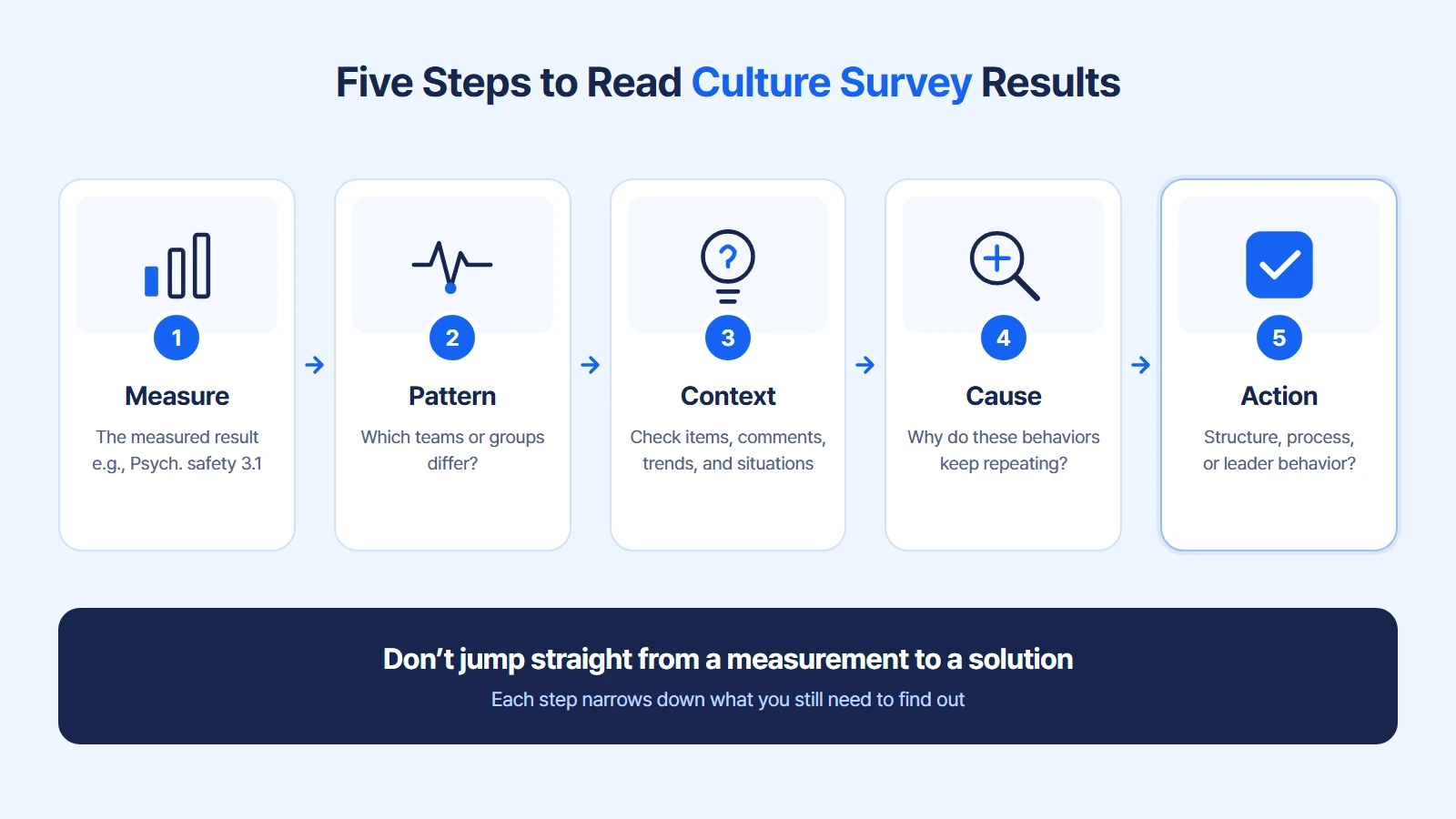
A good culture assessment doesn’t stop at “communication is low.” It helps you ask why people stopped speaking up.
Telta Looks Beyond Producing the Report to the Interpretation Gap After It
In culture assessments, the more employees and subgroups you have, the longer the report gets, and the more effort it takes to find and explain results.
That’s why Telta pairs report automation with Report Assistant for culture assessments. The goal is to make it easier to ask questions of results you’ve already collected, find what you need, and narrow down what to check next.
Cuts the effort of producing repetitive deliverables.
Find results in the report again by asking questions.
Narrows down what to check instead of jumping to a cause.
We don’t claim AI can automatically determine the real cause of an organizational problem. Assessment data must be read together with organizational context.
FAQ: Interpreting Culture Survey Results
1. Should We Fix the Lowest-Scoring Item First?
Not necessarily. Patterns that repeat in specific teams or job families, indicators that move together, and actual behavior and written comments give you a more accurate basis for priorities than the item with the lowest average.
2. Does Low Communication Mean We Need More Conversations?
No. Slow information flow, unexplained decisions, low safety to speak up, and reporting structures are different causes that can all show up as the same low communication score. Confirm the cause before you intervene.
3. Can a Culture Survey Alone Reveal the Real Cause?
A survey is an important window, but it isn’t a security camera that shows the whole organizational reality. Look at group patterns, written comments, past trends, real work context, and follow-up conversations together.
4. What Should We Look at Besides the Average Score?
Look at absolute scores along with differences by team and job family, year-over-year change, and patterns that move with other indicators. Averages can hide hotspots inside the organization.
5. Which Matters More: External Benchmarks or Year-Over-Year Trends?
They answer different questions. Benchmarks show where you stand against external groups or norms; trends show which direction your organization is moving. Don’t set improvement priorities on either one alone.
6. Is a 0.2- or 0.5-Point Difference Meaningful?
There is no universal threshold. It depends on the scale, sample size, distribution, reliability, and confidence intervals, so check for repeated patterns across groups and over time.
7. Can We Trust the Results if the Response Rate Is Low?
Response rate alone can’t determine whether results are reliable. Along with the overall rate, check whether certain teams or levels are underrepresented, the potential for nonresponse bias, and anonymity and the response environment.
8. Why Does Follow-Up After a Culture Survey Matter?
Sharing, interpreting, and turning results into action plans matters more for organizational change than the survey itself. Research also identifies employee survey follow-up as a step that often isn’t carried out well enough.
References
- Timothy R. Clark, HBR (2023)
- Detert & Edmondson, HBR (2007)
- Gallup, Employee Survey Results
- Corritore, Goldberg & Srivastava, HBR (2020)
- Qualtrics XM Institute
- Huebner & Zacher, Frontiers in Psychology (2021)
Related Reading
- Leadership Assessment Results: Why Low Scores Aren’t Your Action Plan
- Why a Leader’s Warm Smile Can’t Create Psychological Safety in the AI Era
Related Articles
.webp)
.png)

