.svg)
Large IT Company Case: Competency Framework and Assessment for Promotions


1. The Client’s Challenges and Goals
Company B, a large Korean IT company, wanted to establish new standards for systematically assessing individual competencies and factoring them into decisions, in order to make its promotion system more objective and fair. But building an objective competency framework and assessing an entire workforce of hundreds or thousands of employees came with several challenges.
(1) No Objective, Competitive Standards for Competency Assessment
Company B needed standards for evaluating employees’ competency levels objectively and fairly. Some roles had internal evaluation criteria, but for most roles the criteria had to be built from scratch. The new standards were also part of a strategy to gain an edge in a fiercely competitive market. That made it urgent to understand and internalize the competency frameworks of peers in the industry and of leading companies.
(2) The Burden of Building Competency Models and Assessment Processes
Building competency frameworks for the company’s many roles, along with an assessment solution that would actually work in the promotion process, was not realistic using only internal subject-matter experts (SMEs) and the HR team.
2. How Telta Worked with Company B
Telta was selected as a key partner for Company B’s HR system overhaul and handled the entire process, from building competency frameworks for every role to applying the assessment solution used in actual promotion decisions.
(1) Building Competency Models Accepted Across Every Role
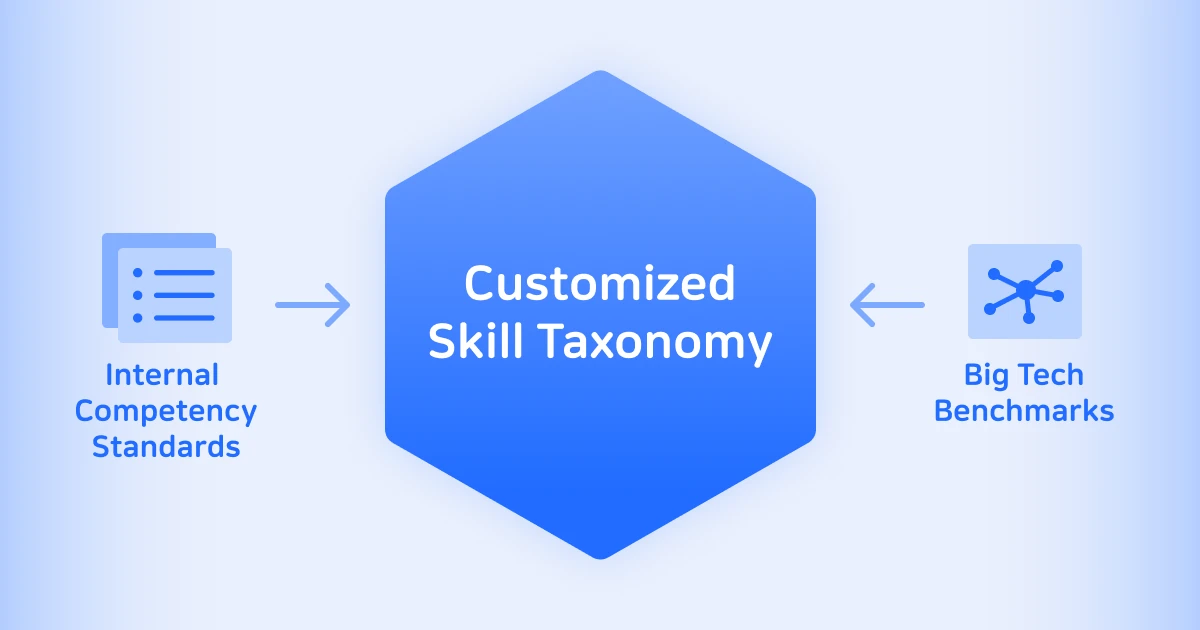
Company B ran competency modeling for every role in the company, from core development job families such as service planning and software engineering to design, marketing, and sales. The core goal was to build a model tailored to the whole company that reflected the specifics of each role in an organization of thousands, and that employees would accept. Starting from its own global benchmark data, Telta collected and analyzed additional data from the leading companies Company B wanted to benchmark against, and derived a competency set for each role.
For some of Company B’s core roles, the internal standards already in use had to be aligned with global benchmarks. Telta embraced the internal standards while drawing on external data where useful, refining and upgrading them into a form that could actually be assessed. The result was a set of differentiated competency models that took each job family’s characteristics into account. Because the models were widely accepted, they earned the trust of practitioners and became the foundation for objective competency assessment.
(2) Developing and Running Rigorous Assessments for Competency Review and Promotion
The hardest part of the Company B project was designing an evaluation process with standards people would accept, in an area as sensitive as promotion.
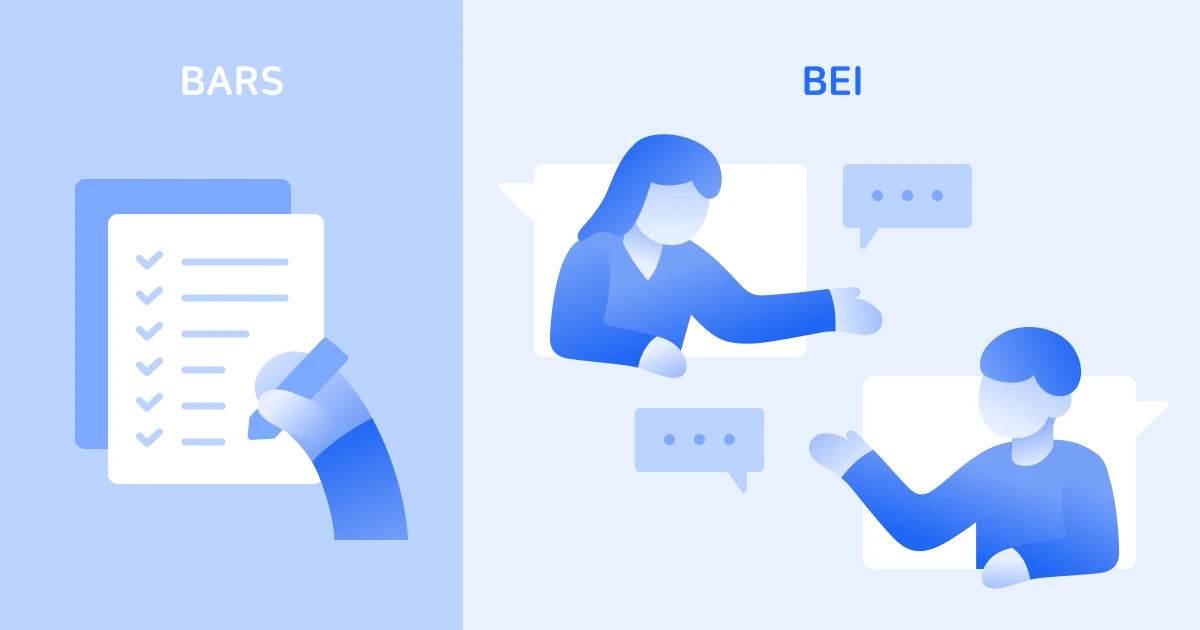
Telta designed a two-track process to meet both goals: a company-wide competency assessment and the review of promotion candidates. First, for the company-wide competency assessment, Telta developed scalable situation-based survey items using BARS (Behaviorally Anchored Rating Scales). This was designed to overcome the practical limits of assessing thousands of employees.
At the same time, Telta designed a separate structured interview process (BEI, behavioral event interview) for in-depth evaluation of key promotion candidates. Given the stakes of promotion decisions, Telta reviewed the interview scenarios and evaluation criteria in detail and provided fine-grained feedback. When the assessments ran, AI-based objective scoring, free of the interviewer’s subjectivity, also confirmed a high level of acceptance of the results.
Why Do Telta’s BEI Evaluations Earn Greater Acceptance?
In the assessment process Telta designed, the interviewer is not the evaluator. Their role is to draw out answers using predesigned questions. The answers of the employee being assessed are captured with high-accuracy speech-to-text (STT) and then evaluated by AI. Because people aren’t doing the scoring, the evaluation is highly consistent.
The AI evaluates against a scoring rubric developed alongside the assessment questions, so the results reflect input from internal experts at every step, from building the competency model to writing the questions. Results are delivered as a report of 10 or more pages with detailed reasoning for each rating, which is why employees accept them so readily.
3. Key Results and Client Feedback
Building on the competency framework and assessment tools it developed, Telta successfully completed the high-stakes overhaul of Company B’s promotion system. Across a competency framework covering roles company-wide for thousands of employees, buy-in from practitioners, and a more rigorous promotion system, the key results were:
- Competency models and assessment question sets completed for dozens of key roles
- A core assessment system established to evaluate each year’s promotion candidates
- Assessment questions, processes, and tailored reports that reflect the characteristics of each role
In the end, Telta demonstrated the expertise and execution needed to meet the HR requirements of a large IT company and deliver a project as sensitive as a promotion system overhaul. Company B’s HR planning team said Telta’s expertise was decisive in easing the burden on internal resources and bringing an objective perspective.
Building a Competitive Competency Framework
“What we valued most was being able to see the competency and skill frameworks of external competitors through Telta’s database and AI technology. Before, we were limited to building our framework from internal SMEs’ standards and the HR team’s judgment, with no objective benchmark. Thanks to Telta, we completed a competency framework that is uniquely ours, combining our internal standards with global data.”
Establishing a Widely Accepted Promotion Assessment Process
“Building an assessment process tied to promotions is sensitive, difficult work. Telta kept the burden on our SMEs to a minimum while showing the expertise to write assessment questions that reflected the specifics and context of dozens of roles. As a result, we were able to build a fair, widely accepted assessment process in a short time.”
Related Reading
- Why Your 15-Page Competency Assessment Report Ends Up in a Drawer
- Three Details That Make Telta’s Talent Assessment Report Credible to Employees
Related Articles
.webp)

