.svg)
Three Details That Make Telta’s Talent Assessment Report Credible to Employees


Why do competency assessment reports that cost tens of millions of won end up sitting in an HR manager’s drawer? We traced the root cause to two things: employees don’t trust the results, and the results are too vague to use on the job.
The Problems with Traditional Assessment Methods
1. No consistency: Even with clear criteria in place, raters’ subjectivity creeps in and undermines consistency.
2. No behavioral prescription: The focus on measurement and verdicts fails to drive concrete behavior changes people can act on right away.
3. No strategic scalability: Assessments concentrated on a small group of key talent can’t deliver what strategic talent management is really about, which is systematically aligning and advancing capabilities across the whole organization.
🔗 Read the full article: Why Your 15-Page Competency Assessment Report Ends Up in a Drawer
If assessments so far have been about ranking who performed better, assessments from here on need to produce data that proves who can do which work. But traditional methods have shown clear limits: raters’ subjectivity creeps in, or only the score survives while the context disappears. Results people can’t accept breed distrust, and ultimately turn HR data into a black box no one can rely on.
Telta solves these structural limits with explainable AI and a Human-in-the-Loop process. Here are the specific details of how a transparent system wins employees’ acceptance.
* Human-in-the-Loop (HITL): A process in which experts take part at every stage, from designing the criteria to validating the results, so that AI never makes judgments on its own.
Three Details in Telta’s Assessment Reports That Turn Doubt into Confidence
(1) Bias-Free Evaluation Standards Built with Human-in-the-Loop
Credible evaluation comes from consistency. But no matter how detailed the guidelines, if the same competency is interpreted differently depending on a rater’s fatigue or tendencies, the data loses its value. There is also a concern that handing the whole evaluation process to AI won’t properly reflect your organization’s unique context.

Telta uses a Human-in-the-Loop process to balance the objectivity of AI with human insight. Rather than handing data processing entirely to AI, we run a process in which experts lead both design and validation.
- Experts design the evaluation criteria: Telta’s PhD-level HR experts analyze the client’s role definitions and business context and personally design the scoring rubric that serves as the core guideline for AI evaluation.
- AI analysis based on expert logic: AI doesn’t make judgments on its own. Its job is to apply the designed evaluation logic rigorously across large volumes of data. This removes individual rater bias and ensures every employee is assessed against the same standard.
- Experts conduct the final review: The AI’s first-pass results are reviewed once more by experts to validate them.
In other words, a Telta report is not a list of scores AI produced at its own discretion. It is a transparent implementation of evaluation logic that HR experts have thoroughly validated.
(2) Behavioral Evidence That Explains the Result, Not Just a Score
Employees distrust assessment results because they can’t see what’s behind the score. A number like 3.5 doesn’t tell you what’s lacking, what’s strong, or how the score was calculated.
Telta’s reports go beyond delivering a score: they show, as is, the behavioral evidence that surfaced during the actual task.
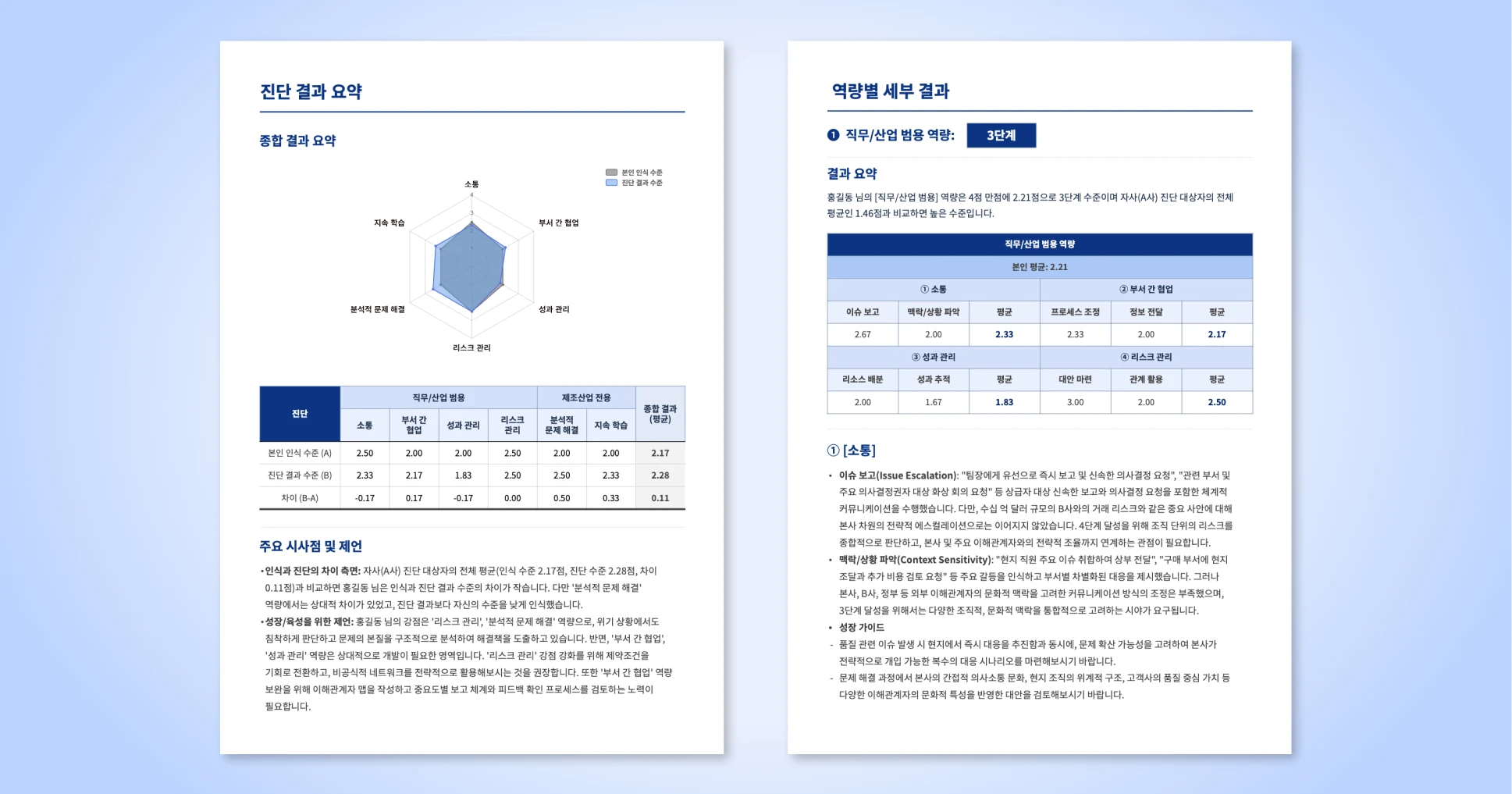
[Global Talent Assessment Results Report] Sample Detailed Results by Competency
- Process Coordination: The response included cross-department coordination and alternatives, such as “a meeting between practitioners and key decision-makers from both the quality and production departments” and “back up production at the Vietnam plant, temporarily halt Line B, and analyze the root cause and prepare countermeasures.” However, it lacked an integrated workflow spanning three or more departments and any quantitative measure of the process improvement’s impact. Reaching Level 4 requires systematic process innovation, such as setting up parallel workstreams and building feedback loops between departments.
- Information Flow Management: The response shows awareness of basic reporting requirements, such as “report needed before end of business today, Thailand time (before 6 p.m.)” and “prepare quality-issue response materials for headquarters (HQ).” However, there was no tailored communication strategy for each stakeholder and no way to confirm understanding after information was shared. Reaching Level 3 requires a systematic approach that identifies the information needs of each stakeholder, such as the Japanese HQ, Toyota, and the Thai government, and shares information with the necessary background.
With explainable AI, Telta makes transparent the detailed evaluation criteria that have long been treated as a black box. From the answers employees write or the tasks they complete, Telta extracts, sentence by sentence, the decisive behaviors behind each score and presents them directly.
When employees see objective feedback in which their own behavior is proven with data, they can trust that the assessment is valid. And that trust becomes the most practical driver of growth.
(3) Individual Reports That Add Up to Organization-Wide Skills Data
.webp)
If the report each employee receives is a milestone for their growth, the data that builds up as those reports accumulate becomes a strategic map that lets HR see and manage the whole organization.
Traditional competency and leadership assessments often stop at individual results, so even after assessing large numbers of people, organizations struggled to gain big-picture insight. To solve this data fragmentation, Telta aggregates the data from individual reports and provides a dashboard that shows, at a glance, the skills the organization holds and how competencies are distributed across it.
Through Telta’s dashboard, HR gains integrated data in which every employee’s competencies are assessed against the same standard. And once you hold skills data for the entire workforce, you can practice data-driven HR that spans staffing, hiring strategy, and real measurement of training impact.
The Real Changes Data-Driven HR Brings to an Organization
What concrete changes happen in HR once skills data starts flowing through the organization?
- You can design targeted training based on data.
Instead of generic company-wide training, you can run precisely targeted, data-driven programs. By pinpointing the departments, job levels, or employees that fall short of the required level for a given competency, you can design efficient programs that concentrate budget on the people who truly need training. - You can find and place talent using objective metrics.
When forming a task force for a new project, you no longer have to rely on reputation or word-of-mouth recommendations. You can instantly pull from the dashboard the employees who have both data analysis skills (Level 4) and project management skills (Level 2), and put hands-on talent that was hidden behind job titles or tenure exactly where it’s needed. - You can prove the quantitative impact of training programs.
You can prove training impact with clear numbers. Instead of metrics like training satisfaction or completion rates, you can demonstrate HR’s real contribution through changes in concrete competency metrics, such as “the company-wide average AI literacy score rose 28% over last year.”
In an organization with skills data, HR no longer stays a support function. Instead of relying on gut feel and reputation, it becomes a strategic business partner that proves its case with numbers and makes proposals backed by data.
Author’s Comment
Whether employees accept their assessment results depends less on how high or low the score is than on whether they can see which of their own behaviors produced it. That’s why our reports include the evidence sentences along with the behaviors needed to reach the next level. Experts should design the scoring criteria to fit each client’s context, and AI should focus on applying those criteria consistently.
Dr. Younghoon Hwang
Co-founder & Head of Assessment and Consulting, Telta
Ph.D. in HR, Seoul National University
Former, National Human Resources Development Institute (Ministry of Personnel Management)
Former, HL Group Learning & Development Institute
He has designed competency frameworks, assessments, and culture surveys. At Telta, he leads the design of competency frameworks, rubrics, and scoring criteria, and oversees assessment quality.
Related Reading
- Korean Manufacturer Case: Assessing Overseas Sales Staff and Future Leaders
- Auto Parts Manufacturer Case: Assessing and Developing Expatriate Managers
Telta: The HR Partner That Answers with Data, Not Gut Feel
Telta is where this change begins. With objective evaluation that doesn’t depend on individual raters’ memories, evidence-based reports, and data that becomes a lasting asset, you can finally solve HR’s long-standing challenges.
Telta is built for HR teams that answer with data, not gut feel. Curious how our competency assessment reports work in practice? Get the details in our service overview.
Related Articles
.webp)

