.svg)
Auto Parts Manufacturer Case: Assessing and Developing Expatriate Managers


Is the best manager at home also the best manager at an overseas subsidiary? That was the question facing Company G, a large auto parts manufacturer that has expanded its overseas production subsidiaries to follow automakers’ manufacturing bases. As overseas sites multiplied and more managers had to be sent abroad, the question grew heavier. Yet the only evidence the company had to answer it was language test scores and domestic performance.
Are Language Scores Enough to Select Expatriate Managers?
Production manager at an overseas subsidiary is a role many companies treat as a key-talent position. These managers lead the local organization on headquarters’ behalf, and one person’s decisions translate directly into the subsidiary’s results. The long-standing criteria of language scores and domestic performance had their logic: without the language, collaboration is hard, and you can’t send someone abroad who hasn’t proven themselves at home. But relying on these criteria alone had three clear limits.
(1) Overseas Assignments Demand Different Competencies Than Work at Home
A day at an overseas production subsidiary unfolds differently from a day at a domestic plant.
- When a line stops, losses pile up by the minute, and the manager has to find the cause while reporting to headquarters at the same time.
- When negotiating delivery dates and quality with a customer’s plant, intentions drift a little with every pass through an interpreter.
- Headquarters meetings are scheduled for the early hours of the morning, local time.
- When hard-won local staff leave, the know-how they built up leaves with them.
In this environment, what separates strong performers isn’t just equipment or process knowledge. Managers also need to coordinate organizations with different time zones and rules, switch between direct and indirect communication styles depending on the culture, and pass their know-how on to local staff. Domestic performance data alone can’t predict these competencies.
(2) Company G Needed a Way to Tell Strong Candidates Apart
Candidates for expatriate roles are high performers who have already proven themselves inside the company. As a result, they all scored similarly high on typical assessments, which gave little clear guidance on whom to send and how to prepare them.
(3) Building a Global Competency Framework from Scratch Takes Too Long
Building a framework from the ground up was a burden too. Just agreeing on what “global competency” means is hard, and by the time you define it, design the questions, and validate them, months have gone by. Overseas business moves too fast to wait that long.
Selecting Overseas Production Managers with a Global Competency Assessment
Company G solved this challenge with Telta’s Global Competency Assessment, working alongside a partner specializing in global competency training. Instead of starting from a blank page, it began with an established framework and checked whether it fit the company’s situation.
(1) Grounded in What Leading Global Companies Actually Require
Telta’s Global Competency Assessment draws on an analysis of more than 600,000 job records from global companies. It organizes the competencies that companies leading the world market actually require of their people into a ready-made skills framework. The manager skill set used in this project defines 27 skills across five categories at the level of observable behavior.
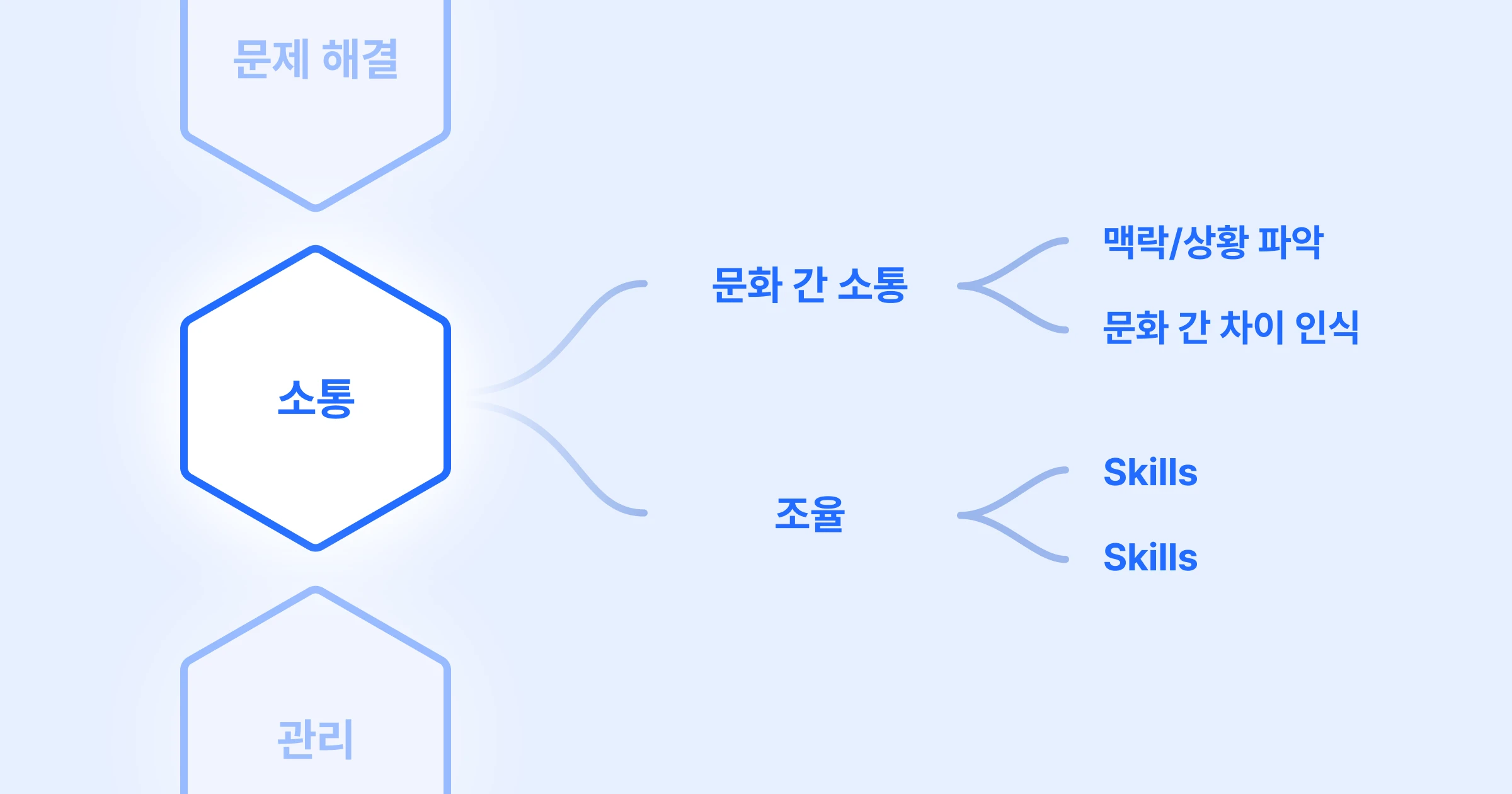
Defining skills as behaviors is what matters. In the Communication category, for example, “Awareness of Cultural Differences” is defined as “the ability to understand and respect differences in how countries approach work, decision-making, and time.” It is measured through concrete behaviors: whether someone embraces other cultures’ ways of working, stays open to cultural differences, and treats diversity as a chance to learn. A vague impression that someone “has a global mindset” becomes behavior you can actually observe.
The framework also captures differences in level. Take “Process Coordination”: it measures separately the level of organizing work procedures that span several departments and proposing improvements, and the level of reconciling interests across departments to build consensus and create new ways of collaborating. This is an essential competency for overseas production managers, who must constantly manage relationships between headquarters and the local organization.
(2) Covering Both Roles: Frontline Leader and Business Manager
The assessment targeted “overseas subsidiary production managers.” These managers lead the manufacturing floor while also carrying part of the responsibility for running the subsidiary as a business. Because the skill set layers role-specific competencies on top of the competencies every employee needs, it could cover both roles at once.
- Frontline leader: the ability to handle tight schedules and crises, and to pass accumulated know-how on to local staff
- Subsidiary manager: the business sense to reflect on oneself as a leader, read market shifts, and manage profitability
The skill definitions and questions went through thorough review by the business during the project and were refined to match the language used on Company G’s overseas production floors.
(3) Predicting Judgment and Response with Detailed Simulations
The assessment used written-response simulations. Participants were given tough situations they could realistically face at an overseas production subsidiary and, instead of choosing a right answer, wrote out how they would judge and respond.
Difficulty was the key. Because every candidate was already a proven performer, easier questions would have bunched scores at the top and made it harder to tell people apart. Differences in judgment only emerge when people face hard, complex problems.
Telta’s AI scored the written answers against consistent criteria, turning narrative responses into scores. Results don’t shift depending on who does the evaluating, and the final results were delivered as personalized reports summarizing each person’s scores by competency, strengths, and areas to develop.
Connecting Assessment Results to Global Competency Training
What Was Measured Fed Directly into Development
The project didn’t stop at assigning scores. The individual development areas identified by the assessment flowed into training from the global competency training partner, linking measurement and development into one process. The more critical the talent, the more development should start not from hearsay that someone is “doing well” but from concrete data showing where they are strong and what they need to build.
Data-Driven Reporting to Executives Became Possible
Instead of listing language scores and career histories, HR can now report with data on current levels and gaps in each competency needed for global collaboration. Assessment results also explain why training investment is directed at particular areas. And by reassessing against the same standard after training, the company can see how much people have improved by the size of the change.
You Can Start Telta’s Competency Assessment Without Your Own Competency Framework
Even organizations like Company G that had no global competency model of their own can start assessing with Telta’s predefined competency framework. Once a business review confirms it fits your organization, you can connect everything from assessment to training in a single pipeline. If you need roles unique to your organization or particular local conditions reflected, the framework can be extended through custom design.
If you’re preparing for the next stage of your overseas business, start by finding out whether there’s a competency assessment that fits your team.
Related Reading
- To Improve Job Training Outcomes, Assess Competencies Before Training Starts
- Korean Manufacturer Case: Assessing Overseas Sales Staff and Future Leaders
Related Articles
.webp)

