.svg)
A Practical Guide to Using AI in Hiring: What Works and What to Watch


Nearly nine in ten large Korean companies already use AI in HR work. In the 2025 Corporate Hiring Trends Survey by Korea’s Ministry of Employment and Labor and the Korea Employment Information Service (in Korean), which covered the country’s 500 largest companies by revenue, 86.7% of the 396 responding companies said so. And 74.5% said they plan to adopt AI in hiring or expand how they use it there.
Yet only 21.7% said they currently use AI in hiring itself. That’s one in five. If AI has become routine in HR work, why are companies so hesitant to bring it into hiring? Because hiring mixes two kinds of work: quickly organizing documents and carefully judging people. Below, we walk through each stage of hiring to show which tasks recruiting teams can hand to AI and where a person needs to step in and check.
💡 Key Takeaways
- 86.7% of companies use AI in HR work, but only 21.7% use it in hiring. Hiring includes evaluation work that can’t be judged on efficiency alone.
- Before using AI, protect candidates’ personal data and define the scope of AI’s work. AI handles research, first drafts, and note-taking support; people make the hiring decisions.
- Using AI for writing job descriptions, screening applications, and recording interviews cuts repetitive work. But the person responsible should still verify the final wording, job fit, and evaluation conclusions against the source material and context.
Why Is AI Hiring Hard to Adopt? Hiring Mixes “Organizing” and “Judging”
List out every hiring task, and they fall into two groups.
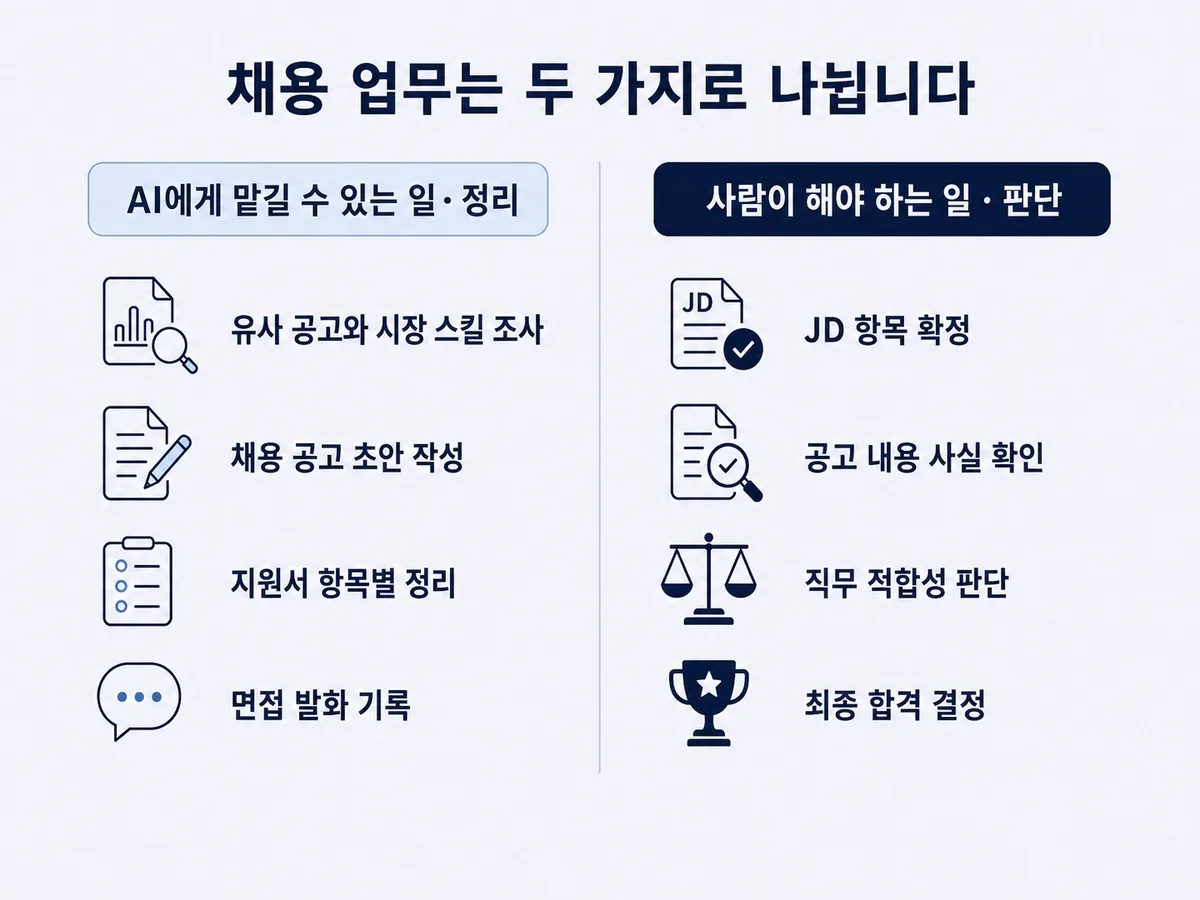
The first is gathering material and putting it into shape: looking up postings for similar roles, drafting a job description (JD), and pulling each applicant’s years of experience and projects out of their application, item by item. The steps are set and repeat in much the same way every time, which makes this work a good fit for AI.
The second is deciding between people: whether this candidate’s experience fits the role, and whether their interview answers show enough of the competencies you need. Because the outcome determines whether someone gets the job, you have to be able to explain why you decided the way you did, and that explanation has to come from a person.
That is why, when you bring AI into hiring, you first need to draw a line between these two kinds of work in your own process. Without that line, whatever AI organizes can flow straight into the hiring evaluation. With a clear line, AI can do its proper job as an assistant that takes work off people’s plates.
Before Using AI in Hiring: Protect Candidates’ Personal Data
Whatever stage you use AI in, one thing comes first: applications and interview records are full of candidates’ personal information.
So when you use AI tools, take care not to expose personal details such as candidates’ names, contact information, photos, or family relationships. The basics, and the essentials, are to leave out anything not needed for the evaluation and to check everything AI generates or summarizes against the original job posting, application, and interview record.
💡 What should recruiters check before adopting AI hiring tools? Find out more in AI Hiring That Earns Candidate Trust Without Sacrificing HR Efficiency.
How Should HR Use AI? Three Uses Across the Hiring Process
When you use AI in hiring, start by defining the scope of its work. The same AI will produce different results depending on what material you give it and the criteria you ask it to organize by. For each stage, here is how AI can cut repetitive work and where the person responsible needs to check.
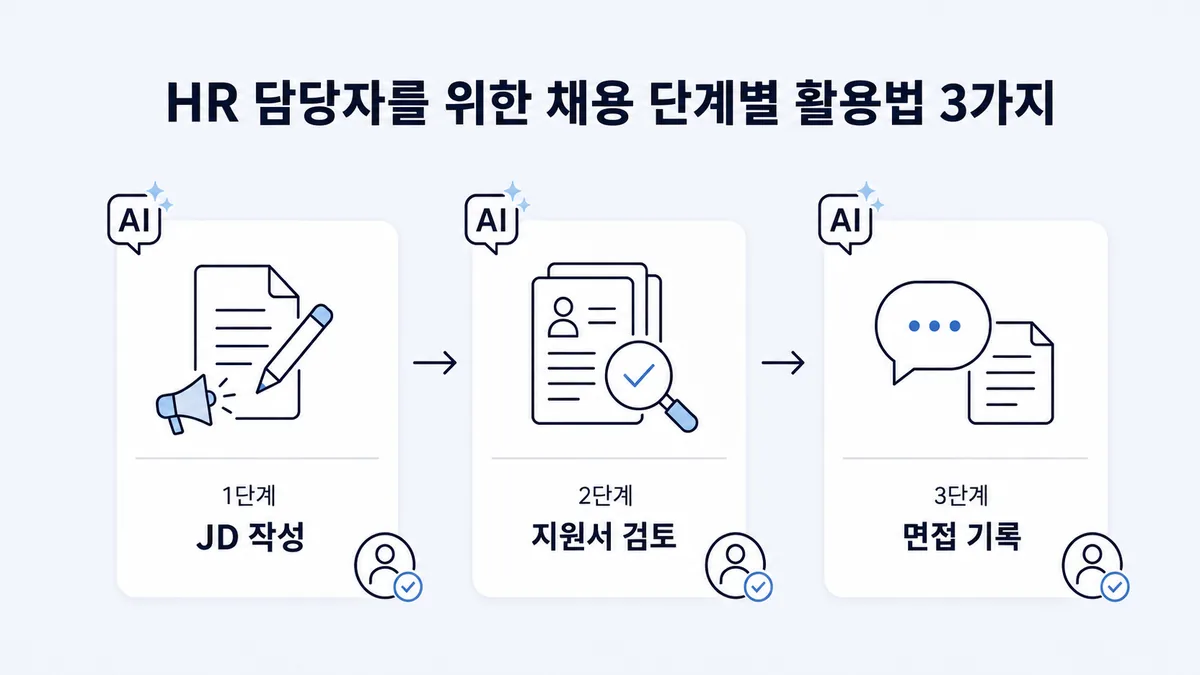
1. Writing the JD: Gather Research and Draft the Posting Quickly
The first place most people get stuck before writing a JD is the question, “What competencies does this role actually require these days?” This is where AI can help, by quickly gathering and organizing postings for similar roles, the role descriptions common in your industry, and the competencies expected at each career level. Recruiters spend less time jumping between pages looking for material and can put together a first draft to discuss with the hiring team.
But a broad question gets a broad answer. Ask, “Write a JD for a backend developer,” and you’ll get language you could find anywhere. You get a draft that fits your organization only when you include the role, the experience level, and your team’s scope, for example: “We’re hiring a backend developer with five years of experience at a Korean B2B SaaS company. Our team owns payments, permissions, and data processing. List the responsibilities, required competencies, and preferred competencies.”
An AI-generated JD draft is a document for review, not a finished product. The hiring team should check that it matches the work the person will actually do, that it doesn’t set the bar unreasonably high, and that it doesn’t mention working conditions or benefits the company doesn’t offer. A job posting is what candidates use to decide whether to apply, and it is the first promise a company makes to them. So go through the information that can change a candidate’s decision, such as responsibilities, qualifications, work arrangement, and hiring process, line by line.
2. Screening Applications: Organize Scattered Information Against the Same Criteria
When hundreds of applications come in, things quickly get jumbled. Some applicants list their experience by year; others group it by project. Before you can compare them on the same criteria, you have to get them into the same format. AI can turn the information scattered across applications into a table organized by predefined fields.
Set the fields in advance, for example total years of experience, size of the most recent organization, projects, roles, and tools used, and you can review every application in the same frame. Be sure to include instructions such as “Mark anything not in the application as ‘not stated,’” “Don’t infer; copy only wording that appears in the original,” and “Don’t write any evaluative comments.” That reduces the chances of AI filling gaps with guesses or scoring candidates.
At this stage, AI’s job is to organize information, not to evaluate applicants. The moment you ask it to score or rank them, you hand over the judgment. Put the organized table side by side with the original applications and check for anything missing or misread. Depth of experience, relevance to the role, and organizational fit are for HR and the hiring team to judge together.
3. Recording Interviews: Capture the Conversation and Find Leads for Follow-Up Questions
Once you move from applications to interviews, a new problem appears. Interviewers have to ask questions and take notes at the same time. Along the way, they miss the points in an answer they should have probed further, and after the interview it’s easy to write the evaluation from whatever impression stuck.
A K-beauty company hiring for positions across several brands at once ran into exactly this problem. Each interviewer looked at different competencies first, and the moment for a follow-up question slipped by while they were taking notes. Above all, a short conversation made it hard to tell whether the impressive numbers a candidate cited came from their own judgment or from favorable market conditions.
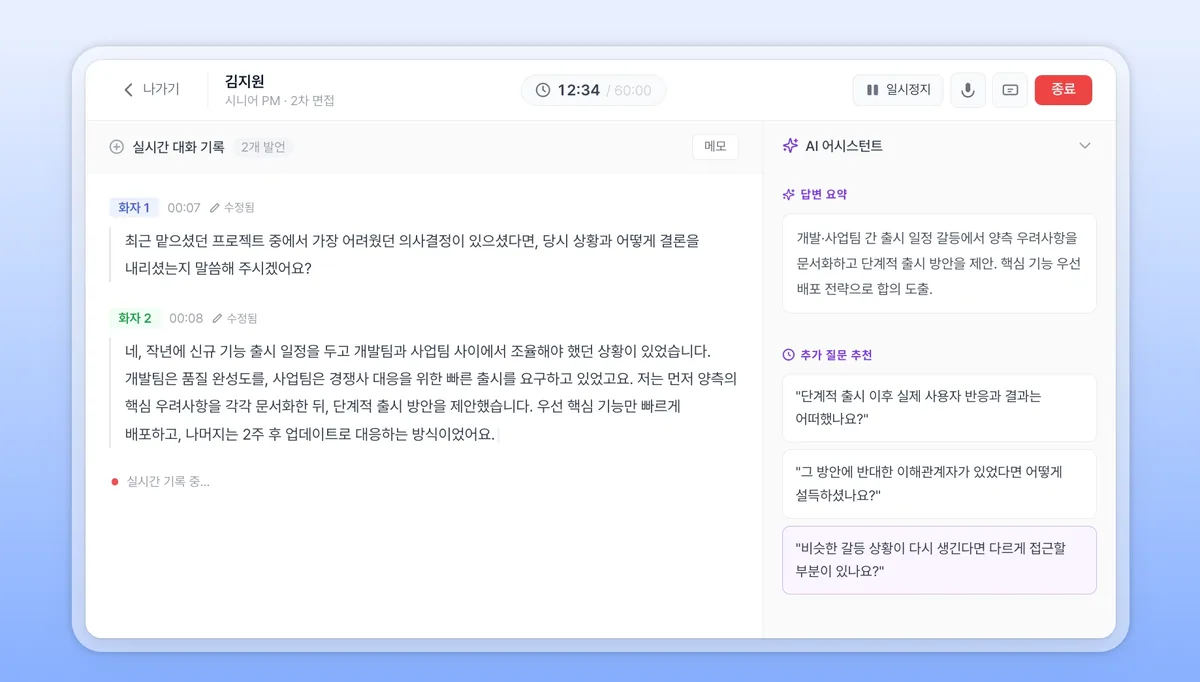
So the company brought an AI hiring solution, Telta Interview Pro, into its interviews. The moment a performance marketing candidate says, “I doubled our ROAS,” the AI tags that statement as a competency signal, flags it as something to verify, and suggests a follow-up question. Interviewers could pick up that thread and dig into, “What did you personally design or change to get that improvement, and how did you know that was what made the difference?” AI didn’t decide the answer for them; it gave interviewers a chance to ask one more question.
When an interview ends, Telta Interview Pro immediately provides a summary of the questions and answers and a cleaned-up transcript. You can also request, candidate by candidate, a report with scores for each competency and the reasoning behind them, based on what the candidate actually said.
Still, the report is evidence for a hiring decision, not the conclusion. Whether a low score on an item reflects a real gap in competency or a poorly delivered question is something you can only tell by going back to the record. The final evaluation belongs to the recruiter and the hiring manager, who review what was said in context.
Related Reading
- What Is a Structured Interview? How to Reduce Rating Gaps Between Interviewers
- AI Interview Tools: Three Things to Check Before You Adopt One
Not Sure Where to Start with AI Hiring? Start with Interview Records in Telta Interview Pro
If you try to change your entire hiring process at once, it’s hard to take even the first step. If you pick just one starting point, make it interview records. Recording interviews doesn’t automate evaluation, yet it reduces interviewers’ note-taking burden and the variation in their ratings.
Telta Interview Pro provides a real-time transcript, answer summaries, competency signals, and suggested follow-up questions. Interviewers take part in the interview with their ears instead of their hands, and evaluations are written on the basis of what candidates said, not on impressions.
The goal of AI hiring isn’t to automate judgments about candidates. It’s to take repetitive work off your plate and leave evidence that people can examine. If it’s time to take a fresh look at your hiring process, start with interview records, using the five free interviews included every month.
Related Articles
.webp)
.png)