.svg)
AI Hiring That Earns Candidate Trust Without Sacrificing HR Efficiency


As AI moves into the mainstream, more companies are using it to hire. In the 2025 Corporate Hiring Trends Survey (in Korean), which Korea’s Ministry of Employment and Labor and the Korea Employment Information Service ran among the country’s 500 largest companies by revenue, 21.7% of the 396 responding companies said they formally use AI in their hiring process. Another 74.5% said they plan to adopt AI or expand how they use it.
AI hiring means applying AI across the hiring process, from application screening and competency tests to recording and analyzing interviews. It lets companies cut repetitive work and pull together the information they need to evaluate candidates faster.
HR teams are moving quickly to bring AI into hiring, but how do candidates feel about it? This article looks at how to define AI’s role so it makes HR more efficient while protecting candidate trust.
💡 At a Glance
- Candidate distrust runs deep: in one UK survey, 30% said they had dropped out of a hiring process because it included an AI interview.
- To earn candidates’ trust, position AI as an evaluation assistant rather than an interviewer, ask for consent up front, and design a process in which a person makes the final decision.
- Telta Interview Pro is an AI hiring solution that uses AI to assist with recording and analysis, not to make decisions, so it lightens HR’s workload while building candidate trust.
Why Candidates Distrust AI Hiring
Without Advance Notice, 3 in 10 Candidates Drop Out of AI Interviews
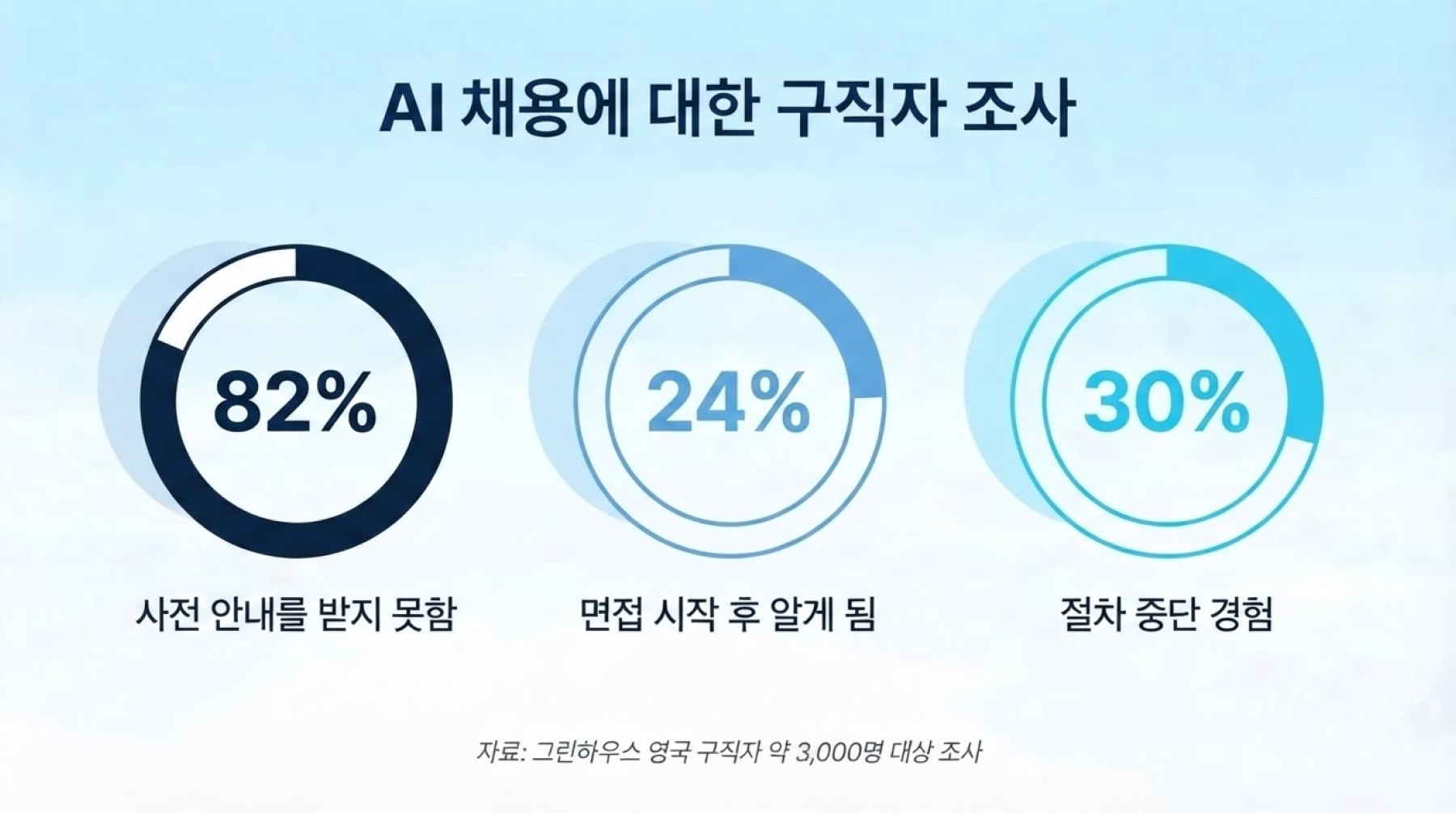
In a survey of about 3,000 UK job seekers by global hiring software company Greenhouse (in Korean), 82% said they had not been clearly told in advance that AI would be evaluating them. And 24% found out AI was involved only after the interview had started.
Running into AI without warning led to real drop-off. 30% of respondents said they had abandoned a hiring process after learning late that it included an AI interview.
When AI Use Isn’t Clearly Explained, Candidates Distrust the Whole Process
If candidates receive only a result, with no clear explanation of how AI was used or what criteria applied, the hiring process will inevitably feel opaque. Even candidates who were told up front that AI is part of the process will struggle to accept a result that comes with no concrete reasoning.
Say a candidate asks why they were rejected and hears only, “Your AI competency test score fell below the cutoff.” They have no way of knowing which criteria they failed to meet.
To build candidate trust, position AI as an “evaluation assistant,” not an “interviewer,” and explain to candidates exactly where AI is used and what information they will receive.
Three Principles for AI Hiring That Keeps Candidate Trust
1. If You Use AI Records, Notify Candidates Before the Interview Starts
If you run interviews with an AI tool or use one to record and analyze answers, you need to tell candidates before you begin and get their consent in advance. The audio, video, and text collected in an interview are all personal data. Under Article 15 of Korea’s Personal Information Protection Act and Article 22 (both in Korean), you must disclose the purpose of collection, the items collected, how long they will be kept, and any consequences of refusing, and then obtain consent.
If AI alone decides whether a candidate passes, with no human involvement, the candidate can also reject that decision or ask for an explanation under Article 37-2 (data subjects’ rights regarding automated decisions) (in Korean). So keep a person involved in the final decision, and set up a process in advance that lets candidates request a human review.
💡 With Telta Interview Pro, Notice Alone Is Enough
Typical AI interviews store and analyze audio and video, so they require separate consent. Telta Interview Pro does not store audio; it works only with what is said, and a person makes the final decision. As a result, you can run it safely with notice alone, without a complicated consent process.
2. Use Interview Records Only as Evidence for Competency Judgments
Interview conversations naturally drift into personal details that have nothing to do with the job, such as a candidate’s age, family, or hometown. Human interviewers filter these out when they take notes, but AI captures the entire conversation, so those details can stay in the record. That is why it’s important to limit what gets recorded and evaluated to competencies. Personal information and external factors that could invite bias should be kept out of the record from the start, or at least out of the evaluation.
When only job-specific and general competency signals remain, interviewers can focus their review on what the candidate actually said, not on first impressions or subjective memory. The post-interview summary report contains only competency evidence, too. That guards against bias and unnecessary intrusions on privacy, and it makes hiring fairer.
3. A Person Makes the Final Decision After the Interview
Even when AI produces objective scores and analysis from multiple angles, the final decision on who moves forward and who doesn’t must always be made by a person. AI is an excellent assistant that analyzes candidates’ answers and surfaces useful insights. But it cannot fully judge what is said between the lines or how well someone fits the organization’s culture.
Interviewers and recruiters should therefore review the AI’s competency analysis report critically and make the final call by weighing it alongside what the candidate actually said and how they came across in the interview. When the final decision stays with people, candidates can trust an AI-assisted hiring process as a fair, reasonable way to verify competencies rather than opaque, mechanical filtering.
The Last Condition for Trusted AI Hiring Is Still a Person
However sophisticated AI becomes, the main reason candidates can trust a hiring process is that a person, the interviewer, is part of it. When AI supports the interviewer’s judgment instead of being put front and center as the evaluator, candidates can relax and show what they can really do.
Telta Interview Pro supports exactly this kind of people-centered AI hiring process. It discards candidates’ audio instead of storing it, and turns what they say into a real-time transcript that serves as evidence for competency judgments. Without accumulating data, it provides only real-time analysis and well-targeted follow-up questions, so interviewers can make rigorously competency-based, objective evaluations in the room.
Trusted AI hiring isn’t about replacing people with technology. It starts with a safe, transparent design that helps interviewers focus only on a candidate’s job competencies.
Build an AI hiring process candidates can trust with Telta Interview Pro.
Related Reading
- AI Interview Tools: Replacing the Interviewer vs. Supporting One
- What Is a Structured Interview? How to Reduce Rating Gaps Between Interviewers
Related Articles
.webp)
.png)