.svg)
How to Assess Real Ability: A Guide to AI-Free Competency Assessment


Using AI to prepare personal statements, take-home assignments, and interviews is now second nature for job applicants. Personal statements arrive polished without a single typo, and assignment submissions look more finished than ever.
That is exactly where the problem lies. It has become hard to tell whether a submission reflects the applicant’s own thinking or whether AI pulled it together for them. That is why AI-free competency assessment, which limits applicants’ use of AI during parts of the hiring process to verify how they really think, is drawing attention.
AI-free competency assessment doesn’t mean banning applicants from AI outright. It means verifying whether applicants can understand a problem, make judgments, and adapt a solution to the context without help from AI tools.
Now that AI-free assessment matters, how can companies judge what candidates are really capable of?
At a Glance
- As AI spreads across every stage of hiring, it has become hard to judge whether an applicant’s work actually matches their competencies.
- Global companies such as Anthropic and Microsoft separate the preparation stage, where AI use is allowed, from the assessment stage, where applicants must do their own thinking.
- Companies should design evaluation criteria and situation-based questions around three competencies, and Telta Competency Assessment is a solution for measuring them efficiently.
How Global Companies Assess Competency: “Don’t Use AI on This Assignment”
Today, when applicants receive a take-home assignment, many open an AI tool before they’ve given it any thought themselves. Instead of wrestling with how to define the problem and what evidence to base their judgment on, polishing and submitting an AI-generated answer has become the norm. As a result, companies receive well-crafted submissions yet can’t be sure whether they’re looking at the applicant’s thinking or the AI’s. It has become hard to see what applicants can really do.
So global companies are moving toward directly verifying whether applicants can think for themselves without leaning on AI. In its top strategic predictions for 2026, Gartner forecast that 50% of organizations worldwide will require AI-free skills assessments of candidates. Here are examples of global companies that already spell out AI-free requirements for applicants in their hiring process.
1. Anthropic: Clearly Marks AI-Free Stages, from Assignments to Interviews
Anthropic, the developer of Claude, spells out where candidates may use AI in its hiring process. It separates stages where AI use is fine, such as writing an application, from take-home assignments that must be completed without Claude unless candidates are told otherwise. It also explains that AI assistance is not available during live interviews.
Companies now want to see candidates’ own perspectives and abilities without AI’s shadow over them. Setting AI-free assessment stages, so applicants can’t use AI on assignments and in interviews, gives you a clearer view of how they define problems, what they base their judgments on, and how they handle information they don’t know.
2. Microsoft: Use AI Responsibly, but Prove Your Own Capabilities
Microsoft tells candidates they may use AI tools responsibly and ethically while preparing for the hiring process, as long as that use still reflects their own capabilities. In assessments and interviews, it explains, candidates must demonstrate their abilities without outside help unless explicitly permitted.
As Microsoft’s approach shows, rather than treating applicants’ AI use as black and white, separate the preparation process from the competency assessment process. You can allow AI during preparation. But in the assessment stage, you need to design moments where applicants make their own judgments and explain them. Only then can the hiring team see the thinking behind the work.
3. Ericsson: Warns That Improper AI Use Can Lead to Disqualification
Ericsson, the global telecommunications equipment and services company, gives even more specific guidance on how candidates should use generative AI in the hiring process and when they must not use it at all. It says candidates must not use AI to invent experience or skills on their applications and should avoid copying and pasting AI-generated answers. Researching industry trends or company information to prepare for an interview is fine, but Ericsson states that AI tools may not be used during assessments or interviews and warns that improper AI use can lead to disqualification.
As Ericsson’s example shows, now that applicants routinely use AI, recruiters need to set clear standards for how far applicants can go with AI. Only by clearly defining AI-free stages can you also define clearly which competencies your company is going to assess.
3 Competencies to Assess in AI-Free Evaluation
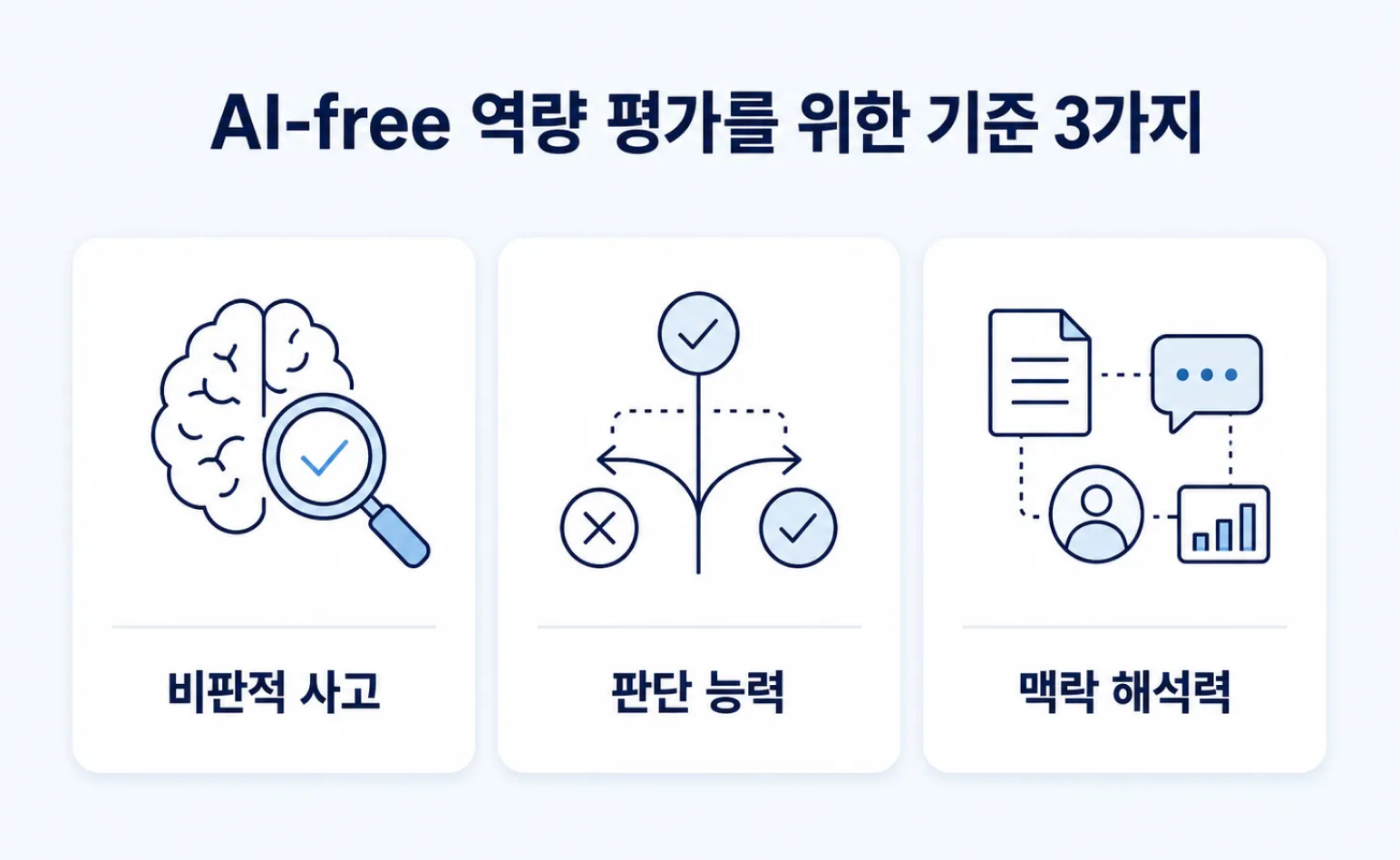
Simply writing “Do not use AI” in a job posting or assignment brief isn’t enough. For AI-free assessment to work as intended, you first need to decide which competencies, and which parts of the thinking process, you will look for and evaluate. The competencies applicants should be able to demonstrate without AI fall into three broad groups.
1. Critical Thinking
Critical thinking is the ability to question the information you’re given, separate facts from assumptions, and look at a problem afresh. AI can quickly produce plausible summaries and answers. But noticing what information is missing, which assumptions are risky, and what else needs to be asked is where an applicant’s thinking shows.
In a hiring assignment, look at how applicants break down the problem rather than how fast they reach an answer. Give an assignment such as “Analyze why this campaign underperformed,” for example, and you can see whether the applicant points out gaps in the data, separates external factors from execution issues, and suggests additional metrics to check.
2. Judgment
Judgment shows in how someone weighs the pros, cons, and risks of different options and sets priorities within real constraints. AI-suggested answers tend to drift toward safe, balanced positions. But at work, conditions rarely come neatly packaged. Time, budget, organizational realities, and stakeholder demands collide.
That’s why you can only gauge judgment by asking “Why did you make that choice?” rather than “What’s the right answer?” Give applicants three alternatives and ask them to explain the criteria they would use to pick one, for example, and the reasoning behind their judgment becomes visible. The hiring team can then look less at the choice itself and more at the consistency of the reasoning, awareness of risk, and how the applicant sets priorities.
3. Contextual Interpretation
Contextual interpretation is the ability to adapt a solution to the situation of the customer, organization, role, and stakeholders. The same answer can mean different things at a startup and a large enterprise, for an entry-level hire and a leader, or in a sales team and an engineering team. AI can quickly produce a generic answer, but interpreting a specific organization’s constraints and working context on their own is something applicants have to demonstrate.
So in your assessment questions, rather than “Describe how you would solve the problem,” it’s better to provide context, such as “With two people, a limited budget, and customer complaints all at once, in what order would you respond?” You can then see how the applicant reads priorities, whom they think needs to be persuaded first, and what criteria they use to adjust their solution.
Reviewer’s Comment
The point of AI-free assessment isn’t to block AI. It’s to build moments into the assessment where candidates have to make their own judgments and explain them. Looking only at the final work, it’s hard to tell how much AI helped. But situation-based questions that ask for the reasoning behind a decision and the alternatives considered reveal how deeply a candidate thinks. Telling candidates up front how far they can use AI at each stage also matters for the candidate experience.
Dr. Younghoon Hwang
Co-founder & Head of Assessment and Consulting, Telta
Ph.D. in HR, Seoul National University
Former, National Human Resources Development Institute (Ministry of Personnel Management)
Former, HL Group Learning & Development Institute
He has designed competency models, assessments, and organizational culture surveys. At Telta, he leads the design of competency models, rubrics, and scoring criteria and oversees assessment quality.
Related Reading
- What SK hynix and NVIDIA Look for Before Degrees and Credentials
- How to Find AI Talent: A Guide to Assessing AI Competency
Measure the Real Competencies Revealed in AI-Free Hiring with Telta
Critical thinking, judgment, and contextual interpretation all show up not in a finished product but in the process of working toward an answer. A single well-organized answer won’t reveal them; you only see them by following how the applicant broke down the problem and what they based their judgment on. So how do you measure that process in real-world hiring?
Telta Competency Assessment is designed to verify exactly this thinking process. Drawing on global job data and standard frameworks, it breaks each role’s competencies down into skills and collects written answers to questions built around real work situations. AI then analyzes the answers against the role’s standards from an evaluator’s perspective and structures each applicant’s strengths and development areas into a report.
Hiring assessment in the AI era shouldn’t stop at policing whether candidates used AI. What you really need to know is how candidates understand a problem, what they base their judgments on, and how they adapt their answers to the context. If it’s time to rebuild your organization’s competency assessment criteria, start by designing role-specific questions and a scoring report structure with Telta Competency Assessment.
Related Articles
.webp)
.png)