.svg)
What SK hynix and NVIDIA Look for Before Degrees and Credentials


SK hynix dropped all educational requirements (in Korean) from its rolling entry-level hiring as of June 17, 2026. Around the same time, NVIDIA CEO Jensen Huang appeared on the Korean talk show “You Quiz on the Block” (in Korean) and said that intelligence is now essentially a commodity. Two global companies, one direction: intelligence and credentials have become common things anyone can have, and companies have started looking past degrees and credentials to what candidates can actually do.
.png)
💡At a Glance
- SK hynix has dropped its educational requirements and will hire based on job competencies and growth potential.
- NVIDIA’s Jensen Huang said intelligence is now a commodity, and that being smart is no longer enough to set talent apart.
- Both companies are looking at competencies that can be assessed, instead of traditional credentials.
- Telta Interview Pro captures competencies that don’t show up on a résumé, such as initiative, problem-solving, and teamwork, as data backed by what candidates said in the interview.
What SK hynix and NVIDIA Look at Instead of Degrees and Credentials
Starting with this round of hiring, SK hynix has moved to a system where anyone can apply and be hired regardless of education, judged on their experience, job competencies, cultural fit, and growth potential. The company added that “in a fast-changing AI environment, the competitiveness of future talent is hard to explain with a particular degree or standardized credentials alone.”
The change also echoes the talent profile SK Group Chairman Chey Tae-won has long emphasized: a “thinking muscle” that asks its own questions and digs into the heart of a problem, an “adaptation muscle” that responds nimbly to new technology, and an “empathy muscle” that understands diversity and collaborates flexibly. In other words, SK wants people with these three capabilities more than people with a particular degree.
NVIDIA is sending the same signal. On the show, CEO Jensen Huang said that intelligence is basically a commodity: there are already so many smart people in the world, and now there is AI as well. Being smart, in other words, is no longer a scarce resource.
Recommended Reading
Why SK hynix Dropped Degree Requirements: 3 Competencies for the AI Era
Companies Now Need New Ways to Assess Abilities Beyond Credentials
What both companies are saying, in the end, is that you need to look at what candidates can actually do, not the education or credentials on their résumé. The trouble is that those competencies rarely show up on paper.
What problems a candidate faced, what criteria they used to solve them, and how they worked with their team are captured not in a résumé but in the answers they give in an interview. Keep those answers as evidence, and you can verify concretely the competencies a résumé can’t show, such as initiative, problem-solving, and teamwork.

Related Reading
- How to Assess Real Ability: A Guide to AI-Free Competency Assessment
- AI Hiring Case Study #2: 24 Criteria That Define a Strong BD Hire
Turn Candidates’ Behavior and Answers into Competency Data with Telta Interview Pro
Telta Interview Pro is an AI interview assistant that records and analyzes the interview conversation in real time and, once the interview ends, delivers a competency report and the data you need for evaluation. Interviewers can focus more on the conversation and quickly receive a report built on competency standards designed from global job data.
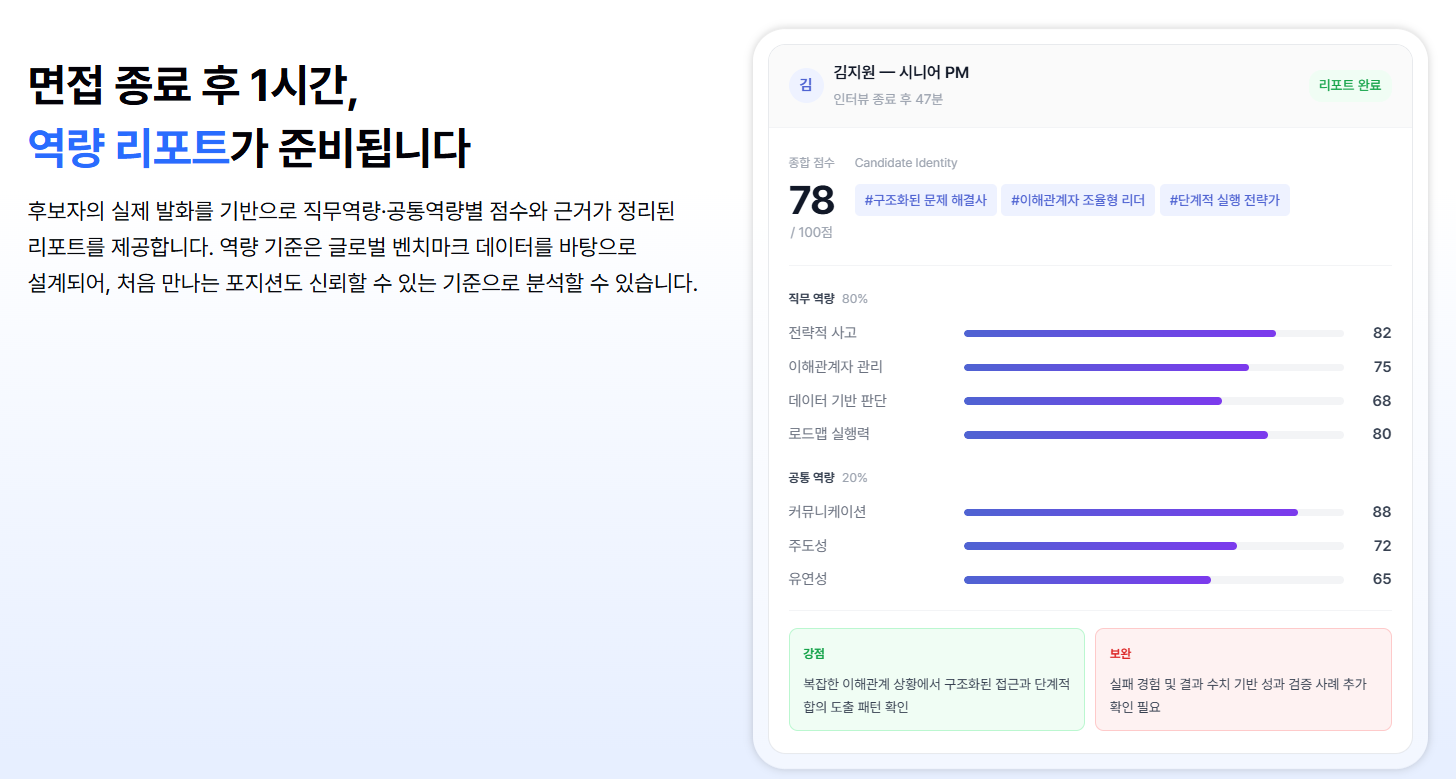
In the Telta Interview Pro competency report, you can review competencies that most companies need, such as initiative, problem-solving, teamwork, and communication, alongside the statements that support each rating. When the report captures what situation the candidate described, what criteria they acted on, and what role they played in collaborating with others, you can apply your evaluation standards more consistently.
Hiring in the AI era isn’t just a race to find smarter candidates. You need to define the competencies your organization wants and evaluate every candidate against the same standard. Telta Interview Pro helps you apply that standard right in the interview room. If you need competency assessment to find the people who will grow with your organization, start your free trial today.
Related Articles
.webp)
.png)