.svg)
AI Hiring Case Study #2: 24 Criteria That Define a Strong BD Hire

In Part 1, we explained why the Telta team launched an AI hiring experiment and the strategies we used to help interviewers stay fully engaged in the conversation. In the end, it was an effort to let people focus more closely on people.
Recording the conversation is the technical part. An equally important challenge is deciding “what criteria to use when analyzing candidates.” If the criteria are vague, it doesn’t matter how much data the AI extracts: interviewers end up falling back on gut feel.
In Part 2, we share how the Telta team turned a loosely defined business development role into data and defined it as 24 measurable skills.
📗 Curious why Telta started using AI in hiring? Start with Part 1.
What Does Business Development (BD) Do at a Startup?
The first challenge we faced in defining the role was pinning down the scope of BD. At a tech startup like Telta, BD often has to be an all-rounder, moving from strategic planning and new business discovery to sales, and sometimes even acting as a product manager who helps set the product’s direction.
As a result, every interviewer had a different idea of what a great BD hire looks like. Some put sales ability first; others prioritized strategic thinking. Unless we resolved that ambiguity, even an AI-generated interview report couldn’t serve as an objective measure.
BD Competencies Drawn from Global Job Descriptions
We decided to find the answer the way Telta does best: by making it objective with data. Rather than relying on individual interviewers’ experience and preferences, we wanted to confirm which competencies the market consistently values.
Using AI, we selected about 200 global leaders across B2B sectors and analyzed in detail the tasks and skills each of their positions required. Without leaning toward any single industry, we extracted five common BD tasks that apply in any B2B business environment. That let us go beyond “what our team needs” and build a standard, market-validated competency framework.
The tasks and skills described in this article are less detailed than Telta’s actual output, which will be offered later as a more refined service.
The Five Core Tasks of Business Development
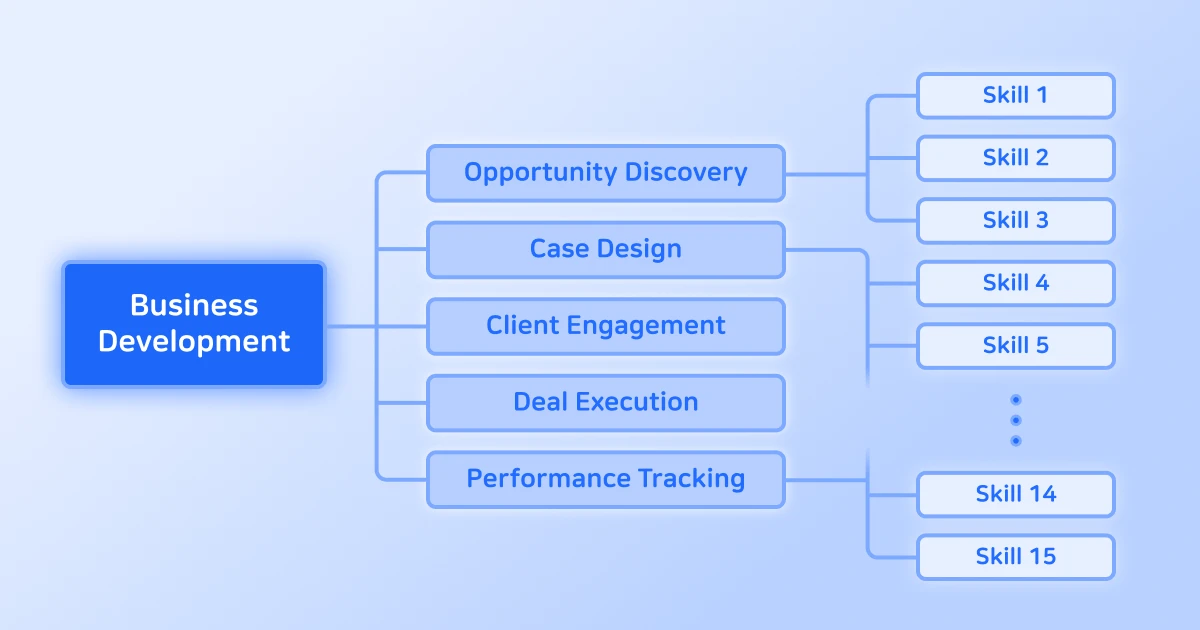
After extensive data cleansing, we identified five core tasks that run through every BD role.
- Opportunity Discovery: Identifying potential customers and partnership opportunities in the market and assessing their viability to uncover new opportunities
- Case Design: Combining customer needs with the company’s solutions to structure a business model
- Customer Engagement: Building trust with key stakeholders and leading communication with them
- Deal Execution: Managing risk through negotiation and closing real deals
- Performance Tracking: Setting business KPIs and measuring ROI to drive continuous improvement
The Core BD Skill Set That Makes Those Tasks Succeed
We then broke down the competencies needed to succeed at those five tasks into 24 specific skills.
- 15 Hard Skills: Technical competencies essential to doing the work, such as Market Analysis, Financial Modeling, Risk Assessment, and Data-Driven Decision Making
- 9 Soft Skills: Behavioral competencies that maximize performance, such as Problem Solving, Strategic Thinking, and Adaptive Execution
24 Predefined Criteria Mapped to Candidate Answers
The Telta team used these 24 skills as the data-matching criteria AI applies to sort interview answers. Instead of relying on a subjective impression that someone “speaks well,” we could see in quantitative data which specific skills each answer connected to.
Once the evaluation criteria are clear, the quality of the interview naturally changes. Because the AI sorts each answer into one of the 24 skills, interviewers no longer need to type away to keep a record.
That freed us to look candidates in the eye and focus entirely on the conversation. When an interviewer asks a question and the candidate answers, the AI reads the context of the answer and logs the data under the relevant skill. By the end of the interview, the analysis report is ready, showing at a glance how closely the candidate’s competencies match the team’s needs.
So what does all this data look like once the interview is over? In Part 3, we’ll share a concrete example of how the data on 24 skills is visualized in the actual interview report, and how it gave us confidence in the final decision.
*This article is based on Telta’s own internal hiring experience.
Reviewer’s Comment
The most common trap in defining role competencies is letting each interviewer’s own picture of “someone who’s good at the job” become the standard. When you define the tasks first and then work down to the skills needed to accomplish them, expectations that used to vary from one interviewer to the next converge into a shared language. That said, analyzing external job descriptions is only a starting point. You still need to refine the results against how your own top performers actually behave.
Dr. Younghoon Hwang
Co-founder & Head of Assessment and Consulting, Telta
Ph.D. in HR, Seoul National University
Former, National Human Resources Development Institute (Ministry of Personnel Management)
Former, HL Group Learning & Development Institute
He has designed competency models, assessments, and culture surveys. At Telta, he leads the design of competency frameworks, rubrics, and scoring criteria, and oversees assessment quality.
Related Reading
- AI Hiring Case Study #3: How a 90-Minute Interview Becomes a Report
- What Is a Structured Interview? How to Reduce Rating Gaps Between Interviewers
Related Articles
.webp)
.png)