.svg)
AI Hiring Case Study #3: How a 90-Minute Interview Becomes a Report

As we explained in Part 2, the Telta team used AI to analyze job descriptions from about 200 leading global companies and defined 24 skills for the business development role in advance. While interviewers focused entirely on the conversation with the candidate, the AI sorted what the candidate said in real time and built up data under each skill.
So what did we actually get once the interview was over? In Part 3, we look at that output, the report itself: how it is structured and how it gave us more confidence in the final decision.
An AI Hiring Report That Puts the Candidate’s Own Words Front and Center
When a team meets to share a hiring decision, you often hear comments like “Their energy was different” or “Talking with them in person, I just had a feeling it would work out.” The interviewer’s intuition isn’t wrong. But getting sign-off on that basis, and convincing future colleagues, is never easy.
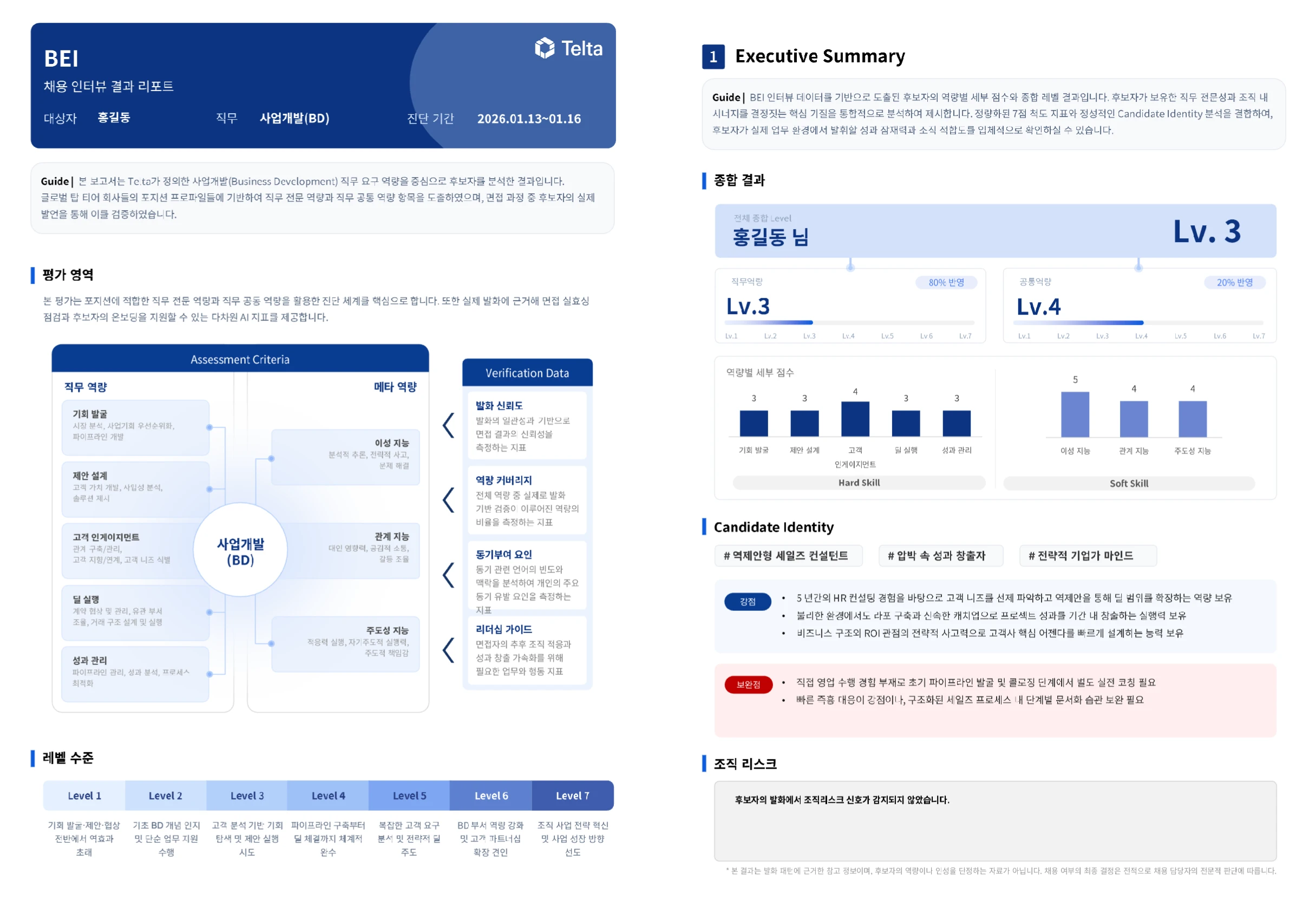
A report built on AI analysis of what the candidate said helps close that gap. The first page, the Executive Summary, shows the overall result on a seven-level scale along with three keywords that describe the candidate. For this business development candidate, they read:
#Counter-Proposal Sales Consultant · #Performer Under Pressure · #Strategic Entrepreneurial Mindset
These keywords aren’t tags the AI assigned at random. They are drawn from behavioral patterns that came up repeatedly across everything the candidate said in the interview. They are followed by an analysis of strengths, such as “Draws on five years of consulting experience to anticipate client needs and expand deal scope through counter-proposals,” and specific areas for development, such as “No direct sales experience; will need hands-on coaching in early pipeline building and closing.” Rather than a pass/fail verdict, the report shows where the candidate is strong and where support will help them deliver results faster.
How Candidate Statements Become Competency Data in Our AI Hiring Case
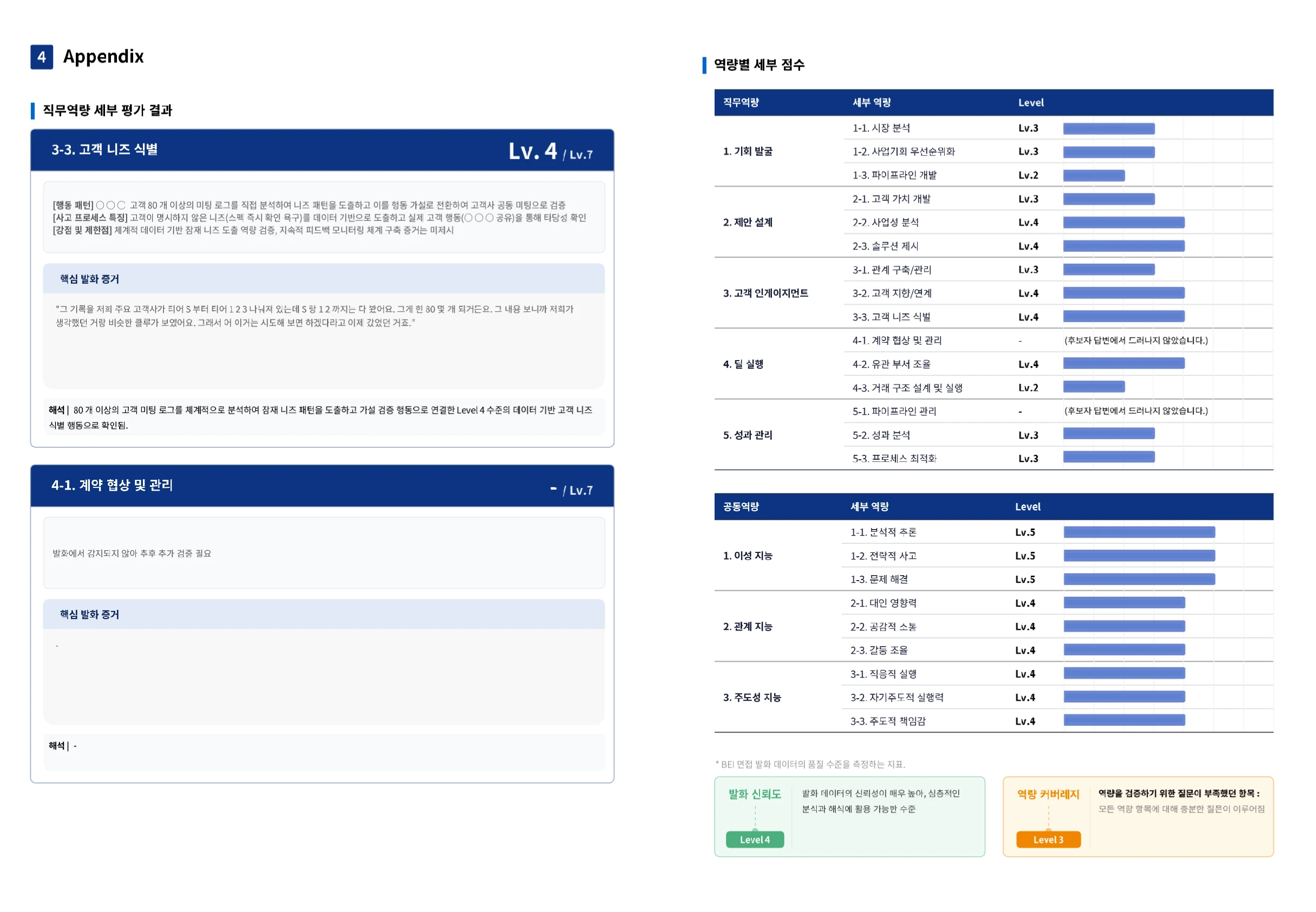
The heart of the report is how it links what the candidate said to each skill rating. Each of the 24 skills receives a level on a seven-point scale, and the Appendix at the end of the report presents the actual statements behind each score along with the AI’s interpretation.
Under “Identifying Customer Needs,” for example, the report cites the candidate saying they “personally analyzed more than 80 client meeting logs to identify patterns in customer needs and turned them into hypothesis-testing actions,” followed by the reasoning for why that behavior rates Lv.4. Instead of a fuzzy impression that the candidate “seemed to do a lot of analysis,” interviewers can revisit the specific statement and its meaning side by side.
Two Metrics That Show How Far You Can Trust the Results
Skills that never came up in the candidate’s answers are marked with a “-”. That gap can mean one of two things: either the candidate genuinely lacks that experience, or the interview never included questions that tested the skill well enough.
That’s why the report also includes two meta-metrics. Competency Coverage shows the share of all skills that were actually tested based on what the candidate said, and Response Reliability measures how consistent and specific the candidate’s statements were. Together they signal whether the interview missed anything, and they give you a basis for judging how much to trust the interview results themselves.
An AI Report That Stays Useful After the Hiring Decision
We were also struck by the fact that the report isn’t just a document for the moment of hiring.
The Leadership Guide section gives managers specific actions to help the new hire settle in quickly and start delivering. Its task roadmap, built on the AI’s analysis of what the candidate said, spells out what work to assign in months 1–2, 3–4, and 5–6 to get results quickly, and in which situations the person’s energy is likely to drop. That is information that is hard to capture in an interview. Once hiring is done, the report becomes an onboarding guide.
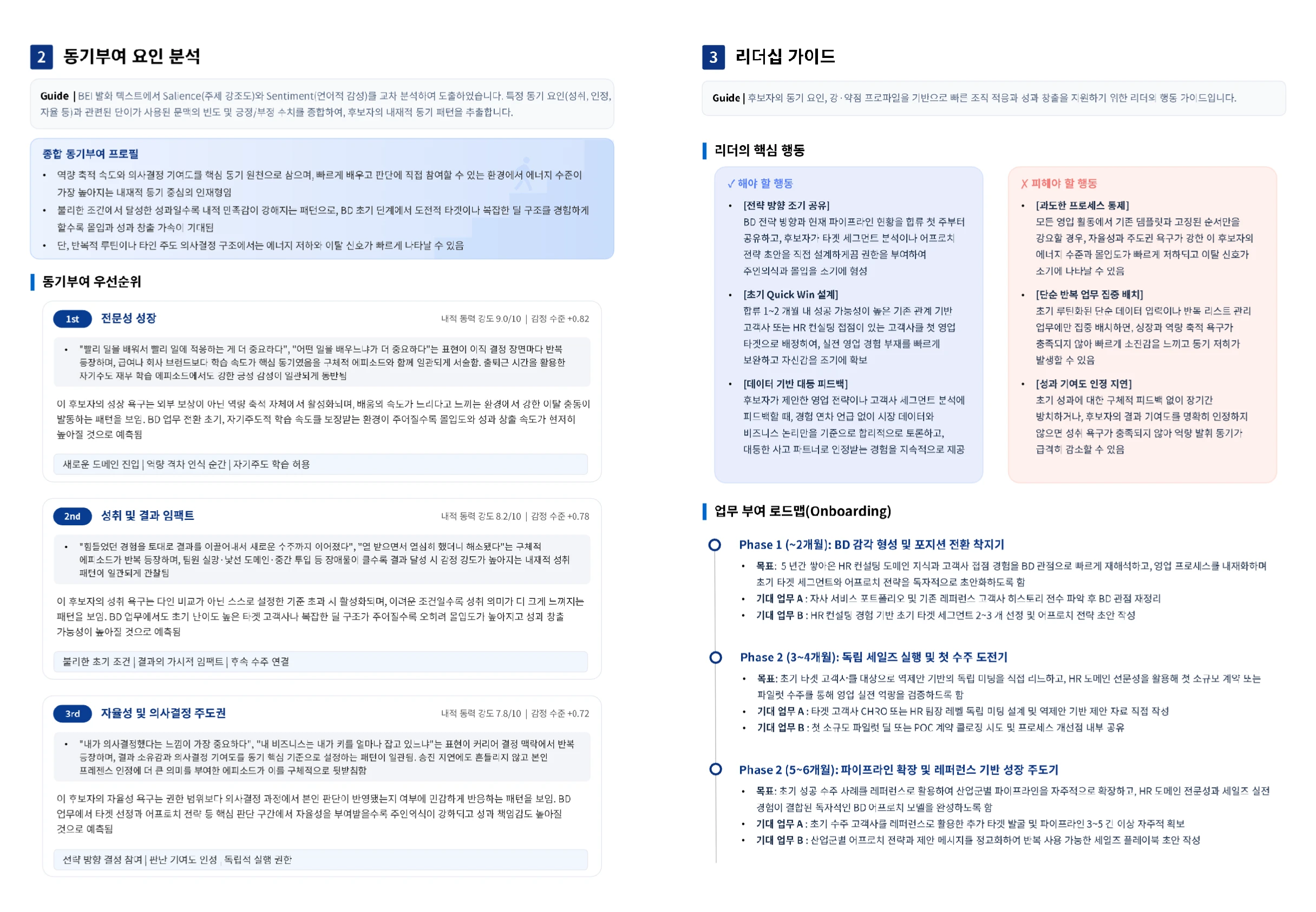
The Motivation Analysis section cross-analyzes how often the candidate used language tied to specific motivators, such as achievement, recognition, and autonomy, along with the sentiment behind it, to identify what really drives the person. This candidate’s top motivator was “professional growth,” and the report doesn’t stop at the conclusion: it also shows the actual context from the interview that supports it.
What AI Can and Can’t Do in Hiring
Every analysis in the report is performed automatically by AI. Interviewers don’t need to fill out checklists, and HR doesn’t need to listen to recordings again. AI turns the interview, as it happened, into structured insights.
From the start, however, the report makes one premise clear: the final hiring decision, and responsibility for its outcome, rests entirely with the hiring organization. The AI looks into places the interviewer couldn’t see and preserves, as data, conversational context that would otherwise slip away. It is an analyst, not a judge.
When an experiment that began in Part 1 with a single press of the record button produced output this rich, one reaction came naturally from the Telta team: “This is too good to keep to ourselves.”
What’s Next
In Part 4, we’ll hear from a Telta team member who went through this hiring process firsthand. Not the recruiter, not the person who designed the evaluation, but the candidate: a look back at the experiment from the perspective of the person it was about.
This article is based on Telta’s own internal hiring experience. All names and company names in the sample report are pseudonyms.
Related Reading
- AI Hiring Case Study #1: Turning Interviewer Gut Feel into Evidence
- What Is a Structured Interview? How to Reduce Rating Gaps Between Interviewers
Related Articles
.webp)
.png)