.svg)
Why Do Organizational Assessment Reports End Up in a Drawer?
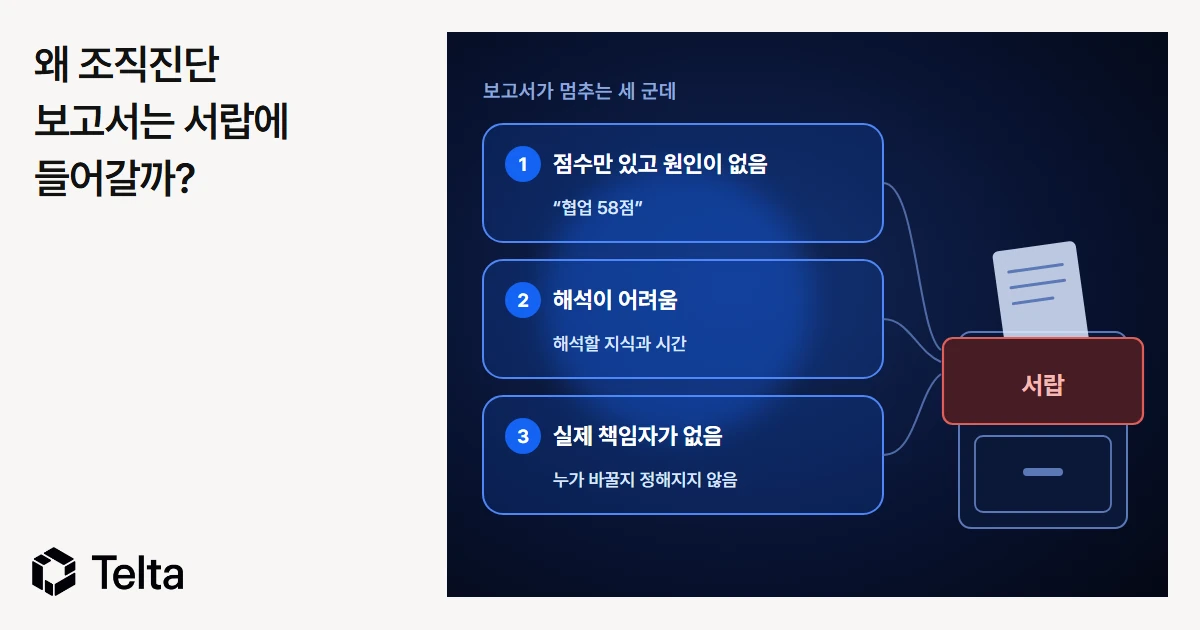


Organizational assessment reports usually end up in a drawer not because the data falls short, but because organizations lack three things: the expertise to read results in context and trace them to causes, the time for follow-up analysis, and leaders on the ground who own the actual changes.
When you have the numbers but not the causes, too few people to help interpret them, and no one assigned to make the changes, an assessment tends to end as a report.
“Collaboration: 58” alone can’t tell you whether the issue is conflicting goals, unclear roles, or leader behavior.
HR and line leaders can’t be experts on every item in the assessment. Just reading the results already takes significant time.
HR can draft the plan, but line leaders are the ones who change how their teams run meetings, give feedback, and make decisions.
The 70-page report is done, and the executive briefing is over. A few months later, no one opens it. It’s hard to explain this away as “the business just doesn’t care.” The real reason is that turning assessment results into actual decisions and actions takes time and expertise of its own.
Bottleneck #1: Scores Don’t Explain Causes
“Collaboration: 58” and “Leadership: 62” are compressed signals of what is happening. The numbers alone can’t tell you whether the cause is leader behavior, policy, workload, or conflicting goals between units. Mistake a score for a cause, and you can spend time and budget on the wrong problem.
Bottleneck #2: Neither HR Nor Leaders Are Always Expert Interpreters
Perceptyx’s 2025 State of Employee Listening surveyed 750 HR leaders. 95% had maintained or expanded their employee listening efforts over the previous year, yet only 27% were confident their programs would help deliver the business outcomes they wanted. Listening had grown, but confidence that it would lead to real change remained low.
Findings from Perceptyx’s 2025 survey of more than 750 HR decision-makers at large enterprises.
What Telta has seen in the field
Leaders and HR often lacked the knowledge and time to interpret the report. Yet assigning a consultant to every unit and leader drives costs up quickly, and follow-through tends to fizzle out.
Bottleneck #3: No One Is Assigned to Make the Change
Gallup notes that doing nothing after an engagement survey can actually increase resentment. A 2023 Gallup article reports that only 8% of employees strongly agree their organization takes action on survey results, and it stresses the importance of having owners on the front line who take action themselves.
Employee responses cited by Gallup.
The behaviors that actually change a culture happen not on an HR dashboard, but in team meetings, feedback, decisions, and priority-setting.
What Sets Apart Organizations Where Results Lead to Change
In its recent Employee Engagement offering, Qualtrics highlights manager-level action planning guidance, recommended actions, and progress tracking so HR teams don’t have to carry every follow-up themselves. It’s a sign that market attention is shifting from “building better surveys” to guiding what line leaders will actually do.
They Treat Results as Information That Needs Explaining, Not a Scorecard
They don’t stop at “Our team scored 62.” They look at which items showed the biggest gaps, how the team differed from others, and what context emerges when the scores are read alongside written comments. It matters to give the people reading the numbers guidance on how to interpret them.
They Focus on One or Two Changes at a Time
If every low-scoring item becomes an action, execution itself becomes hard. It’s more realistic to start with what you can genuinely change this quarter and what employees are most likely to notice, and leave the rest for later.
Line Leaders, Not HR, Decide the Actions
HR can explain results and ask good questions, but line leaders are the ones who actually change how their teams run meetings and give feedback. That’s why it works better to have the leader decide, in the results debrief, “what our team will change.”
They Check Months Later Whether Anything Really Changed
The action plan isn’t the finish line. Use low-burden methods such as short pulse surveys, re-measuring the relevant items, or one-on-one interviews to see whether employees feel a difference. If nothing has changed, revisit the causes and adjust the action plan.
How Far Can AI Help With Interpretation and Follow-Through?
AI shouldn’t automatically decide the answer to an organizational problem. But it can support, at low cost, the parts that used to consume expert time: explaining reports again and again, exploring how items relate to one another, suggesting questions based on similar organizations, and drafting action plans.
Mercer also names turning employee feedback into real change as a central task of modern employee listening. Only fast, visible follow-up lets employees feel that “speaking up actually changes something.”
Why Telta’s Product Covers Interpretation After the Survey
What Telta wants to shrink is the stretch after results arrive, when no one can decide on the next step and everything stalls. We’re building report automation and an interpretation assistant together, so leaders can understand their own results, create action plans, and check progress without HR having to act as an interpretation consultant for every unit.
Related Reading
- Culture and Leadership Assessments: What to Do After the Results Arrive
- Leadership Assessment Methods: 360 Feedback, Interviews, and Simulations
References
- Perceptyx, State of Employee Listening 2025: A survey of 750 HR leaders, covering the gap between listening activity and confidence in business outcomes. Read the source
- Gallup, So You Administered an Employee Engagement Survey. Now What?: Covers the share of employees who see real action after surveys and why frontline ownership of follow-up matters. Read the source
- Qualtrics, Improve Employee Engagement: Describes follow-up features such as manager-level action planning guidance, recommended actions, and progress tracking. Read the source
- Mercer, The future of employee listening: Explains why employee listening must connect to fast, visible follow-up. Read the source
Note: Figures and findings are summarized from the original sources published by each organization.
Related Articles