.svg)
What Is People Analytics? Why HR Data Matters More in the AI Era
.png)

People analytics (PA) has been one of HR’s defining topics for more than a decade, yet few companies have managed to make it stick. As we’ve noted on the Telta blog, problems with data reliability and expertise have made it hard for HR teams to even attempt data analysis.
AI is changing exactly that. As AI starts helping to organize and analyze data, people analytics is moving from a project only large enterprises with dedicated teams could take on toward something everyday HR teams can run as part of their work. And as the barrier to working with data drops, HR teams are now expected to read data in real time and put people and skills where they’re needed most.
This article explains what people analytics is, why it’s drawing renewed attention in the AI era, and what kinds of data HR teams can actually work with.
💡 Key Takeaways
- People analytics is a way of making decisions that uses HR data analysis to bring objective criteria to hiring, development, evaluation, and how the organization is run.
- By lowering the barriers to organizing and analyzing data, AI lets HR read and respond to issues such as attrition prediction and team effectiveness much faster.
- Measuring employee competency data, however, requires role-specific standards and well-designed assessment questions, and Telta’s competency assessment can be the starting point for filling that gap.
People Analytics Turns HR Data into a Basis for People Decisions
People analytics is a data-driven approach that collects and analyzes a wide range of HR data, such as employees’ competencies, performance, and experience, to support decisions across talent management.
For example, an HR team can read attrition risk by looking at tenure and compensation data together. It can compare evaluation results with training histories to see which programs are linked to changes in performance. Connect internal transfer histories, leadership assessments, and engagement surveys, and you can see more concretely not “who is good” but “under what conditions performance and growth happen.”
The goal of people analytics is to back up decisions that used to rest on gut feel and experience with objective data, sharpening the criteria for everything from hiring and development to evaluation and organizational strategy.
Three Reasons People Analytics Matters More in the AI Era
People analytics, once hard to start because of high analytical barriers, is emerging as one of HR’s most powerful tools in the AI era. Now that AI helps organize and interpret data and has lowered the bar for analysis, here are three reasons HR teams should pay attention to people analytics and put it to work.
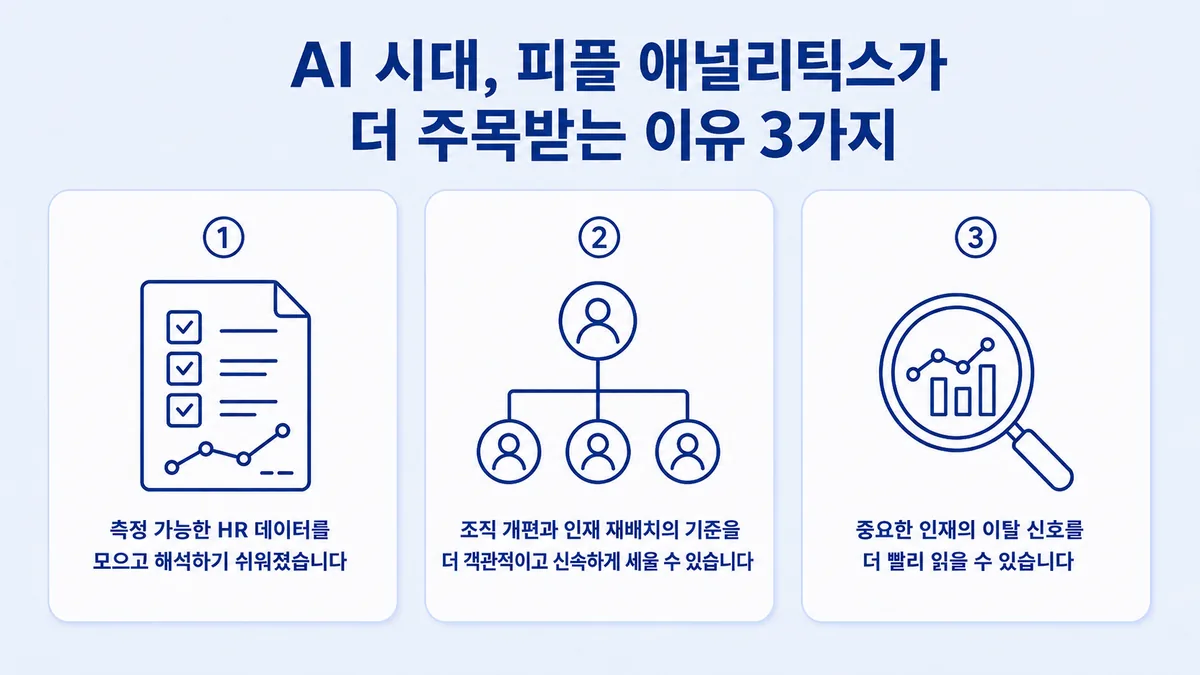
1. AI Makes Measurable HR Data Easier to Collect and Interpret
In the past, starting with people analytics meant a major project covering everything from data collection to analysis and reporting. HR data was scattered across HR systems, evaluation forms, training records, survey tools, and Excel files. Pulling it all together and analyzing it for insights took a lot of time.
AI now shortens that process. It can help classify scattered data and find recurring patterns. Summarizing data to answer a specific question or drafting a report has become much easier, too. As a result, people analytics is shifting from “something you can only do with a data analytics team” to “something HR can build into its operations step by step.”
2. You Can Make Restructuring and Redeployment Decisions Objectively and Quickly as Work Changes
As AI adoption raises productivity, some companies are considering restructuring or redeploying talent. But when decisions this important rest only on managers’ subjective judgment or unclear criteria, managers may focus only on visible results, or apply friendlier standards to people they’ve worked with for a long time.
HR needs data analysis not only for the objectivity to set standards, but also for speed and agility. According to global consulting firm Deloitte, 67% of leaders said speed and agility will be the key to competitive advantage over the next three years. To make the organization faster and more agile, HR needs to move beyond fixed workforce plans and be able to sense people data in real time and deploy people and skills in real time.
With people analytics in an environment that changes this dynamically, HR can use AI to analyze its data easily and quickly and build the evidence for decisions.
3. You Can Plan Rewards and Development for Key Talent and Predict Attrition Signals
People who use AI well and pick up new ways of working quickly are scarce in any organization. If you only notice the gap after they leave, it’s too late. HR teams now need to look not just at who might leave, but at what conditions drive people away and what environments help them grow.
On their own, HR data points such as tenure, pay levels, and promotion history are fragments. Viewed together, they become patterns. You can see whether promotions keep stalling in a particular role, whether engagement is dropping on a particular team, or whether high performers still aren’t getting new responsibilities after training.
When you read signals like these, people analytics shifts the question from “Whom should we hold on to?” to “What do we need to change so talent stays?” That question keeps HR’s work on pay, development, placement, and leadership from moving in separate directions.
Check Whether Your HR Data Is Ready to Support Decisions
A wide range of data can feed people analytics, and organizations already record much of it. But having data and being able to use it for decisions are two different things. You need to map out which question each type of data answers.
The first thing HR should ask isn’t “What more data should we collect?” It’s defining which HR problem your organization wants to solve, then identifying the data you need to collect. The data you need depends on whether you want to fix hiring criteria, redesign training investment, or identify leader candidates.
📌 Recommended HR data to collect for people analytics
The Key Metric That Shapes Your Organization’s Future:
Are You Building Up Data on Employee Competencies?
Among the HR data collected for people analytics, basic data such as job level, tenure, and overtime days has usually already piled up inside the organization. Data on employee competencies is different.
It isn’t something that gets logged or accumulated in a system automatically, like attendance records or one-off evaluation scores.
Yet if basic HR data shows the organization’s current state, competency data is the key metric that determines whether you can put the right people in the right roles and what future performance will look like. In other words, only when you turn how employees work and what they can actually do into data can you build a talent management strategy that works.
Telta’s Competency Assessment Package: Ready to Measure Without Custom Design
To capture data on employee competencies, you first have to define the competencies each role requires and then design the questions and criteria to measure them. That takes a high level of HR expertise and a significant amount of time. As a result, mostly large enterprises could do it, usually through specialist consulting firms, and competency data often remained a blank spot in other companies’ people analytics.
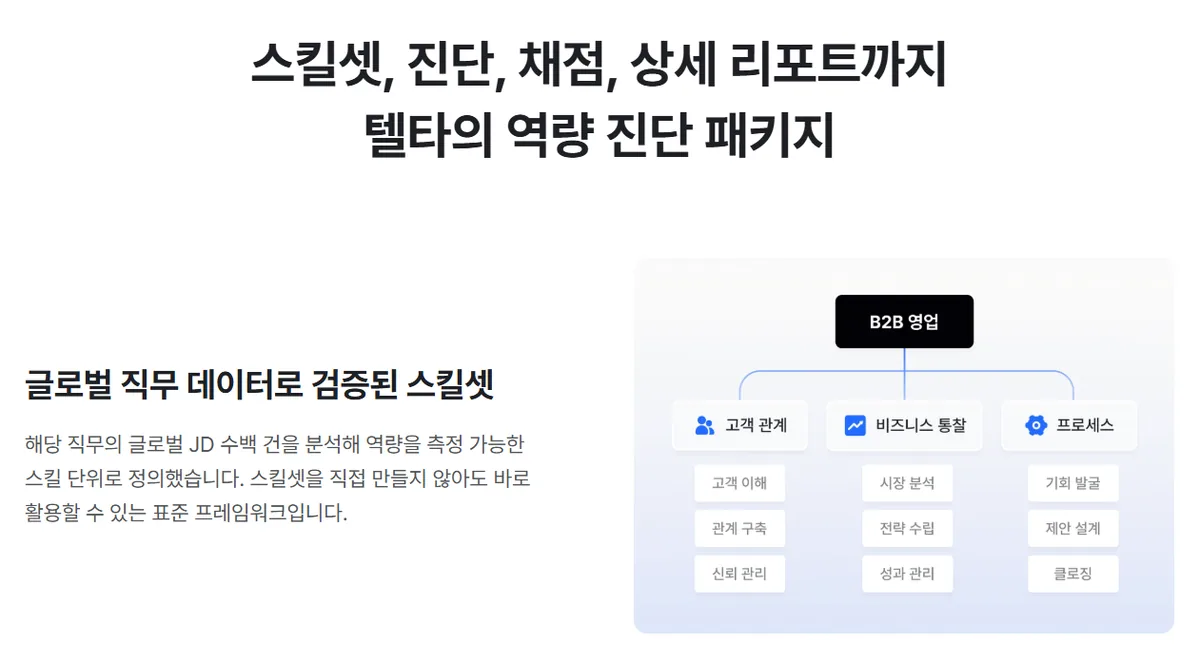
Telta’s competency assessment makes this process dramatically more efficient. As a complete assessment package with validated skill sets and assessment questions by role and position, automated AI scoring, and detailed reports, it can be rolled out immediately with no separate design period.
Even organizations without their own competency standards can receive consulting-grade assessment reports right away, built on skill sets validated with global data.
Fill in employee competencies, long the hardest piece of people analytics, with measurable data, and build growth strategies grounded in objective evidence. Telta’s competency assessment can help you get started.
Related Reading
- AI-Era Talent Strategy: Filling the Skills Data Gap in Your HCM and HRIS
- Talent Intelligence: The Center of HR Strategy in a Low-Growth 2026
Related Articles
.webp)
.png)