.svg)
The AI Jobs Shock Shows Up in Hiring Patterns Before Unemployment


Which jobs will AI replace? That is the question behind the flood of research over the past few years. Most of those studies measured theoretical potential: they estimated, from a technical standpoint, whether AI could handle the work of a given occupation. But being able to do something and actually doing it are two different things. Failing to separate the two is why most of those forecasts missed the mark.
The labor market impact report Anthropic released this March tackles that gap head-on. Using real Claude usage data, it separately tracked which tasks are being automated right now. We looked at how far its findings diverge from earlier predictions, and at the signals already emerging in Korea’s job market.
A Shift in Method: Analyzing Tasks, Not Occupations
The researchers’ approach differed in two ways.
First, they changed the unit of analysis from occupations to tasks. Earlier studies asked, occupation by occupation, “Is this job at risk from AI?” But no job consists of a single kind of work. Teaching, for example, includes tasks as different as “writing lesson plans” and “guiding students’ behavior.” AI can handle the first but not the second. Look at the occupation as a whole and that difference disappears; break it down into tasks and you start to see which work is actually shifting to AI.
Second, they measured theoretical potential and actual automation separately. What AI could handle in theory and what it is actually handling are not the same. Using real Claude usage data, the researchers separately tracked which tasks are currently being automated. Only by looking at both metrics together did a picture emerge that earlier research had missed.
AI Exposure, Roles, and Skill Level
The More Skilled the Knowledge Worker, the Higher the AI Exposure
The occupations with the highest actual AI exposure were computer programmers (75%), customer service representatives (67%), and data entry workers (67%). Workers in these high-exposure occupations earn 47% more on average than those in low-exposure occupations, and are about four times as likely to hold a graduate degree.
.png)
Because LLMs are tools for text-based cognitive work, tasks outside the digital environment score low on exposure even in theory. So occupations that demand considerable skill but take place in a physical setting, such as motorcycle mechanics and bartenders, showed very low AI exposure. This is where it is important to be precise about how skill level relates to AI exposure. Contrary to popular belief, AI is heading first not for low-skill work, but for high-skill cognitive work done in front of a screen.
AI Automation: Theory vs. Reality
In computer and math occupations, AI could theoretically handle 94% of tasks, yet actual coverage is only 33%, a substantial gap between theory and reality. At the same time, the report adds that when compared with employment growth projections from the BLS (US Bureau of Labor Statistics), a correlation is already visible: for every 10-percentage-point increase in exposure, an occupation’s projected employment growth falls by 0.6 percentage points. So while AI has not yet fully replaced work or put entire occupations in crisis, it is important to stay alert to the early signals the report points out.
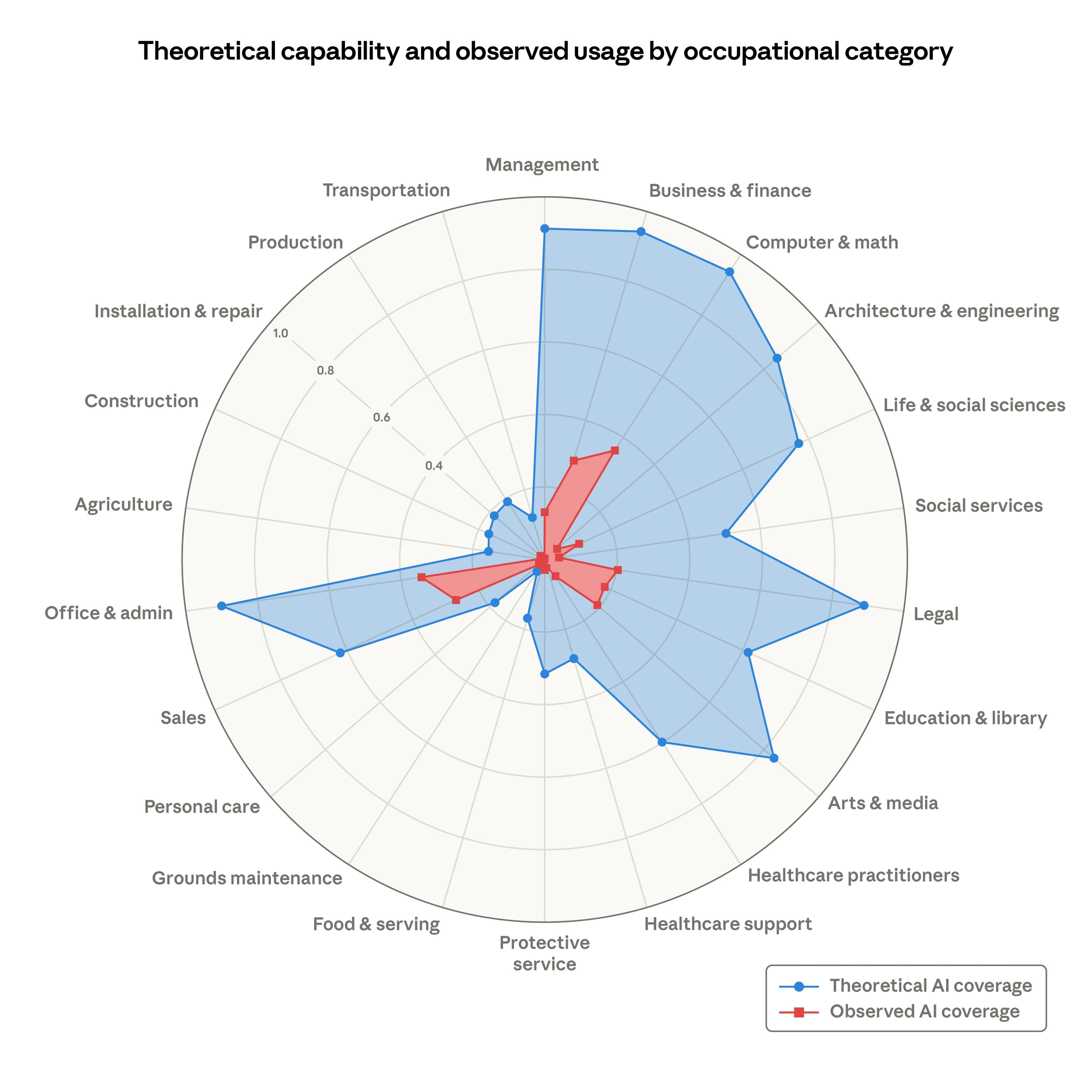
How Far AI Exposure Actually Reaches into Entry-Level Hiring
So far, AI has produced no statistically significant change in the overall unemployment rate. But in high-exposure occupations, new hiring of 22- to 25-year-olds was down about 14%. To separate this signal from ordinary business-cycle swings, the researchers strengthened the analysis by comparing roles with different exposure levels within the same company. The results were consistent. The more of junior employees’ tasks AI could cover (that is, the higher the AI exposure), the more organizations chose to have existing staff use AI more instead of hiring new people.
AI’s Impact Is Even Clearer in Korea’s Job Market
In terms of direction, the trend is actually clearer in Korea than in the US. Because layoffs are more restricted in Korea than in the US, AI’s impact tends to concentrate on reduced new hiring rather than cuts to the existing workforce.
A report released this February by the National Assembly Budget Office (in Korean) analyzed the period from November 2022 through the first half of 2025. It found no evidence that youth employment in high-exposure occupations had fallen in a statistically significant way during that period. But the analyst who wrote the report left this note at the end:
“In January this year, employment in professional, scientific, and technical services, an industry with a high share of AI-exposed occupations, fell unusually sharply, but this report only covers data through last year.”
Indeed, Korea’s January 2026 employment trends data (in Korean) showed employment in that sector plunging by 98,000 year over year, the largest drop since 2013. Korea’s job market is reacting faster than Anthropic’s report anticipated.
According to a Bank of Korea survey (in Korean), this trend is accelerating. 63.5% of Korean workers use generative AI, and 51.8% use it for work alone, about twice the US rate. Yet in another report (in Korean), the Bank of Korea finds that AI adoption is working in a seniority-biased way. The gains from AI are concentrating among experienced workers, while the very path by which newcomers build skills on the job is narrowing. AI tools have spread in Korea at a world-leading rate, but because they take over juniors’ entry-level tasks first, the bottom rung of the career ladder is disappearing. As of January 2026, the youth employment rate stood at 43.6% after 21 consecutive months of decline, and the number of young people who say they are “just resting” (neither working nor looking for work) is at a record high.
What Anthropic’s Report Means for HR in Korea
Anthropic’s report and the other data point to a single message: AI’s impact shows up first, and more clearly, in hiring patterns rather than in overall employment statistics. Specifically, junior hiring is the first to shrink in occupations with high AI exposure. That is why a still-steady unemployment rate is no reason to relax.
What HR can do now is read these signals. Use data to identify which of your roles have high AI exposure and how the balance between new hiring and making better use of existing staff is shifting in those job families. Then go one step further: for each role, distinguish the tasks AI covers from the tasks people need to own. In the reality we face, you can’t design training, hiring criteria, or career paths without that distinction. Setting this standard first, before launching broad AI training programs, is HR’s real task right now.
Telta brings data to the work of setting that standard. By combining global job data with each organization’s real context, we assess, role by role, which tasks are being taken over by AI and which remain fundamentally unchanged. Our AI Literacy Assessment likewise isn’t a knowledge test; it measures how people actually use AI in a real work environment.
We encourage you to take stock of where your organization stands in its readiness for the AI era.
Related Reading
- What SK hynix and NVIDIA Look for Before Degrees and Credentials
- Are Engineers Disappearing? Claude Code’s Creator on 5 New Role Types
Related Articles
.webp)
.png)