.svg)
Are Engineers Disappearing? Claude Code’s Creator on 5 New Role Types
.webp)

In June, a post by Boris Cherny, the creator of Anthropic’s Claude Code, went viral with more than 3 million views.
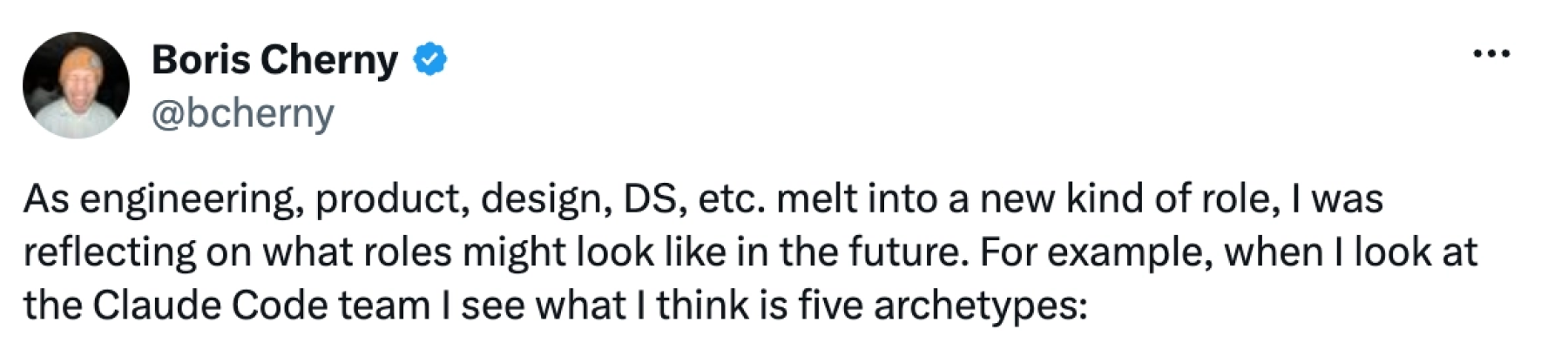
“As engineering, product, design, DS, etc. melt into a new kind of role, I was reflecting on what roles might look like in the future,” he wrote, before laying out five archetypes he sees on his own team. The post has been shared more than 20,000 times and struck a chord with many readers.
So what are the new role archetypes that the head of Claude Code at Anthropic, one of the world’s leading AI companies, sees taking shape?
💡 Key Takeaways
- In the AI era, one person moves across several roles, so a fixed job title alone can no longer define what someone does.
- As Boris Cherny’s five archetypes show, organizations now need to assess talent based on what people can actually do, not on their résumés.
- With Telta’s validated assessment system, you can adopt skills-based talent management right away, without designing skill standards from scratch.
The 5 Archetypes Boris Cherny Sees on the Claude Code Team
Boris Cherny describes five roles he has observed among his team members. Many people on the team play two, and sometimes three, of these roles at once.
- Prototyper
- Comes up with entirely new ideas. Prototypers generate lots of ideas quickly, though many never ship as actual products.
- Builder
- Quickly turns prototypes and ideas into production-ready products or infrastructure.
- Sweeper
- Polishes the UI, simplifies code and systems, strips out unnecessary features, and optimizes performance.
- Grower
- Keeps improving an existing product to strengthen product-market fit.
- Maintainer
- Owns mature systems and keeps them secure, reliable, fast, and efficient as they scale.
- Owns mature systems and keeps them secure, reliable, fast, and efficient as they scale.
What makes this interesting is that none of the five roles is tied to a particular job. One designer may be closer to a prototyper, while another is more of a builder or sweeper. The same goes for engineers, PMs, and data scientists.
According to Boris Cherny, a healthy team has the right mix of each archetype for the product’s stage. He also raises a question: will product development in the future be organized around archetypes rather than around specialist disciplines, as it is today?
Why Job Titles Like Engineer, PM, and Designer No Longer Describe Talent
As Boris Cherny suggests, in the AI era a job title only shows a narrow slice of the work. It cannot capture how the tasks people perform have changed, or the level of capability those tasks now demand. With AI taking over repetitive work, one person can now handle what used to be split across several people, from planning to development to design. That is why people who move across multiple roles have emerged.
When a job title no longer explains everything a person does, what should organizations look at instead?
Not Experience or Tenure, but “What Can You Do?”
Organizations now need to evaluate talent based on which skills people actually have and how well they can apply them, rather than on job titles or years of experience. Two engineers may differ in their ability to turn new ideas into working products quickly and their ability to run stable systems. Two PMs may differ in their ability to explore a market and their ability to grow a product, and those should be treated as different skills.
In the end, organizations need to move beyond evaluating fixed roles by job, define the specific skills the work requires, such as problem definition, prototyping, productization, optimization, growth, and operations, and understand each person’s proficiency in them.
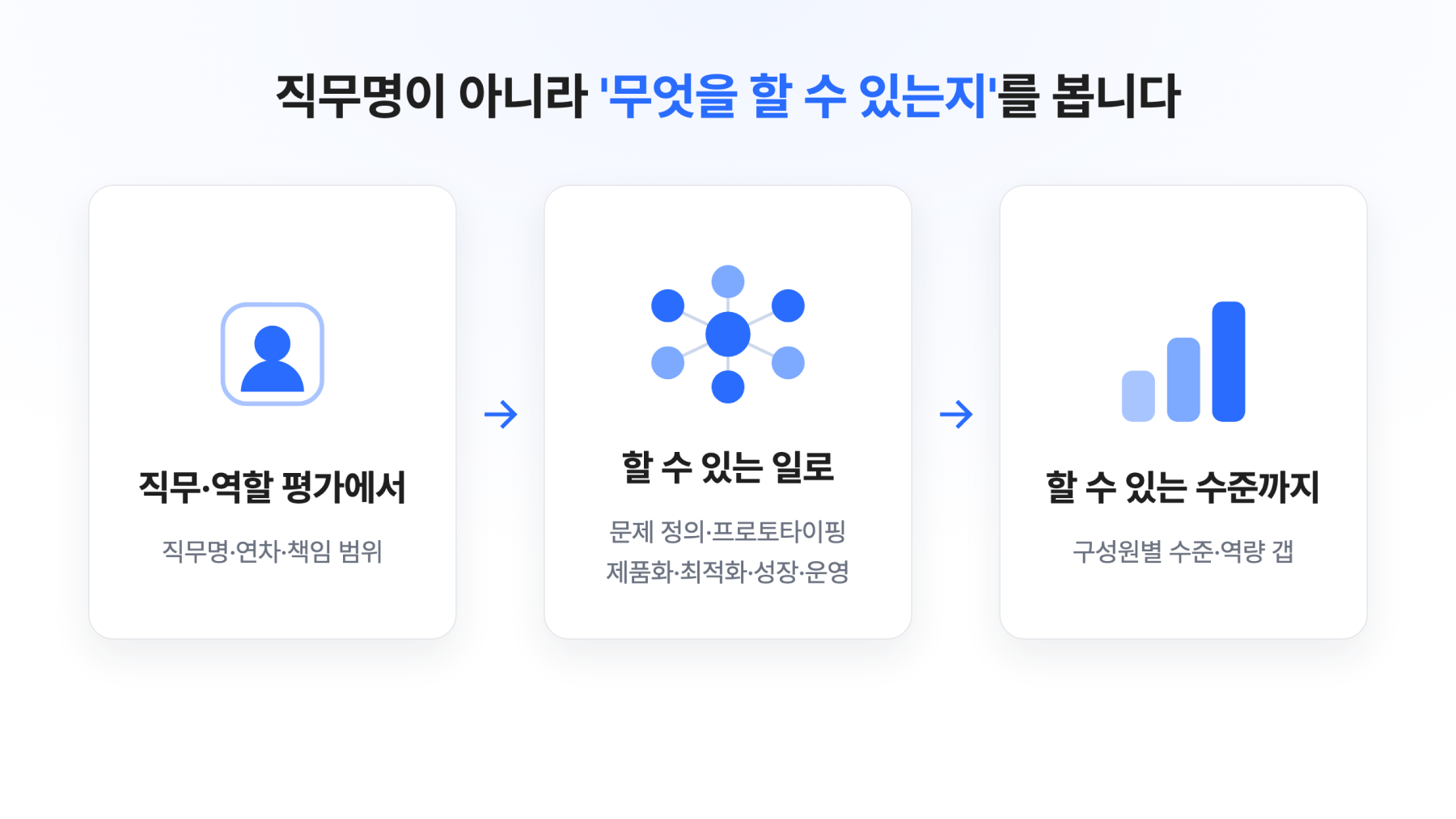
Only then can you flexibly match people with the right skill sets to changing projects and tasks, instead of locking them into fixed jobs. That, in turn, lays the groundwork for developing each person’s capability gaps with precision and for evaluating multi-skilled people who work across several roles fairly.
When Skills Become Visible, Job Boundaries Disappear
To find these new kinds of talent and support their growth, you first need an objective picture of which skills each person uses and at what level, based on what they can do rather than on their job title. You also need to check which new skills have become necessary as your business and market change.
Defining skill standards for dozens of roles tailored to your organization and designing validated assessment criteria, however, takes months and a substantial amount of HR resources.
Telta’s competency assessment does not lock people into fixed grades. Instead, it brings what people can actually do, often hidden behind their job titles, to the surface as data, so you can match people flexibly to changing projects. Get started with Telta today, no complex design work required.
Related Reading
- The AI Jobs Shock Shows Up in Hiring Patterns Before Unemployment
- 6 Core B2B Sales Competencies AI Can’t Replace
Related Articles
.webp)
.png)