.svg)
AI Competency Assessment Tools Compared: 4 Solutions, 3 Criteria


The previous three articles in this series looked at how AI competency should be measured: some questions can’t be answered by post-training completion rates, AI competency has to be viewed along two axes (depth and breadth), and getting a full picture of one person’s AI competency means looking at knowledge, applied skill, and everyday use together.
So how well do the AI competency assessment solutions on the market meet those standards? This article lays out three criteria for organizations that need to assess AI competency, then compares four providers against them.
Three Criteria for Comparing AI Competency Assessment Solutions
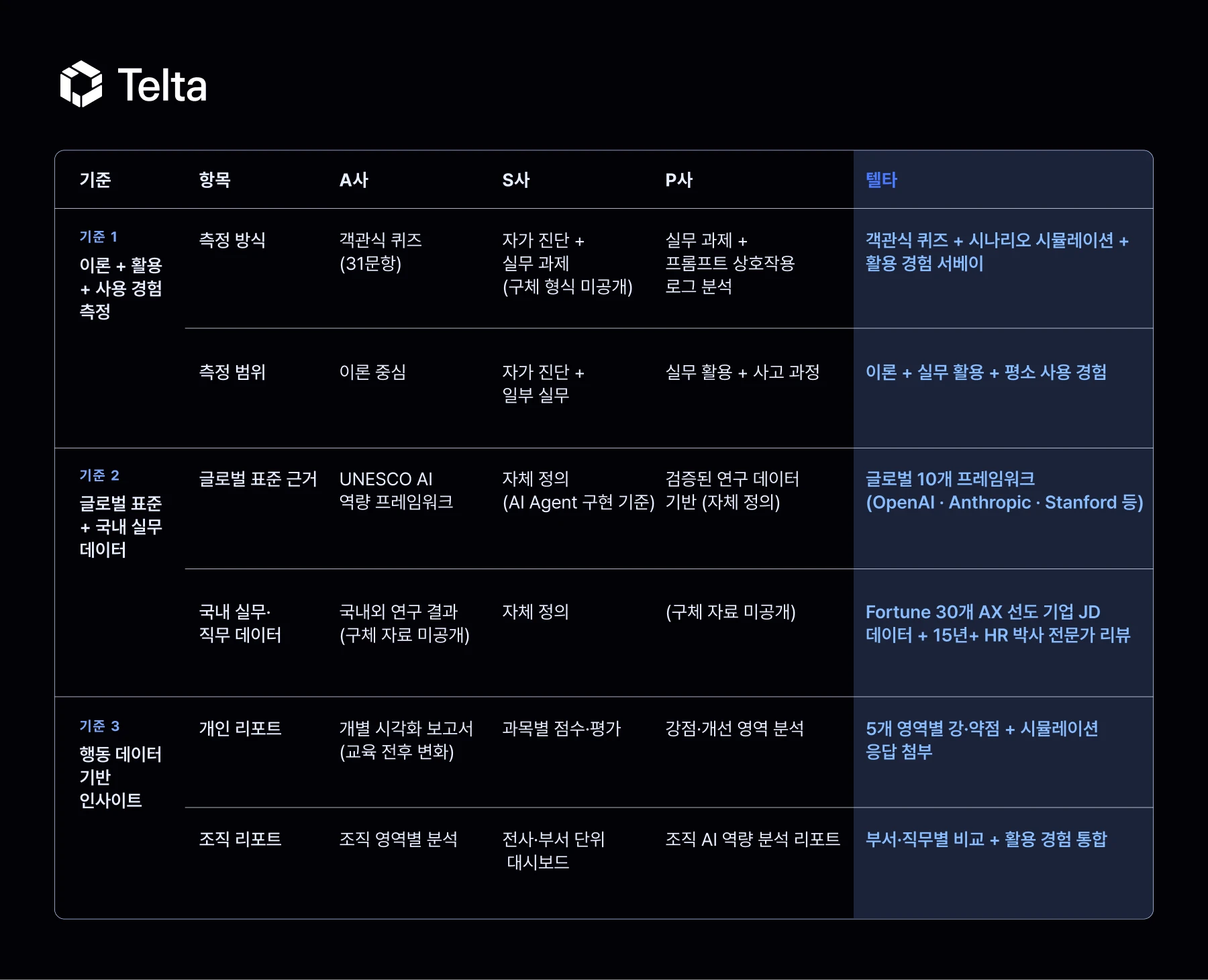
1. Does It Measure Applied Skill and Everyday Use, Not Just Knowledge?
Knowing about AI and actually working with it are different things. A multiple-choice quiz can confirm knowledge that has a right answer, but it can’t show how someone handles AI in real work situations, where there is no single right answer.
You need both a scenario-based simulation and a survey on how often people use AI day to day. Only then can you see the gap between what people are able to do and what they actually do.
2. Does the Competency Framework Reflect Both Global Standards and Local Job Data?
Assessment results are only persuasive when they rest on a credible standard. That standard should draw on global frameworks from organizations such as OpenAI and Stanford, as well as on real business practice and job data from Korean companies.
Rely on global standards alone, and the results drift away from how work actually gets done on the ground. Rely on a vendor’s own framework alone, and the results lose credibility. Only a framework that reflects both can support an assessment people can act on.
3. Does the Report Include Behavioral Insights You Can Use to Make Decisions?
A report that only gives you a score is hard to act on. If it can’t explain why someone got that score, you won’t know what to do differently next quarter either.
The report needs to capture behavioral data on how each participant actually worked with AI. That is what lets you pinpoint where an individual should improve, and once the same data is rolled up by department and role, it can inform decisions at the organizational level.
Compare four leading assessment solutions in Korea against these three criteria, and they differ sharply in how many of them they actually meet.
AI Competency Assessment Solutions: A Side-by-Side Comparison
The table below compares the four solutions against the same three criteria, so you can see how far each one goes in measuring AI competency.
Related Reading
- Even KBS Reporters Took the Test: Companies Now Verify AI Skills Directly
- Logistics Case: Assessing AI Literacy in a Global Firm’s Key Talent
Telta: AI Competency Assessment That Drives Your AI Transformation
Companies assess AI competency so they can use the data as a basis for decisions. To pick up speed in AI transformation (AX), you need to be able to answer questions like where to put next quarter’s training budget first, or how to add a more discriminating signal to hiring decisions, using data on the AI competency of your people and your organization. An AI competency assessment solution that genuinely delivers has to meet all three criteria: how it measures, the competency framework behind it, and how usable its reports are. Only when all three are in place do assessment results go beyond meaningless numbers and feed into next quarter’s decisions.
If you need assessments that support AI transformation across training, hiring, and beyond, request the Telta AI Literacy Assessment overview today.
In the end, assessing AI competency comes down to how much of a person’s behavior you can capture as data.
More in This Series
🔗 Part 1: Why Training Certificates Can’t Prove AI Competency
🔗 Part 2: What Should You Measure in AI Competency?
🔗 Part 3: Knowing AI vs. Using It: How Telta Measures the Difference
Related Articles
.webp)
.png)