.svg)
Even KBS Reporters Took the Test: Companies Now Verify AI Skills Directly


Are Your Best Performers Also Your Best AI Users?
“Are the people who do great work also great at using AI?” That was the question KBS 9 O’Clock News (in Korean) asked in a recent segment. To find out, two reporters took an “AI proficiency test” themselves.
The results were telling. Both worked in the same field and used AI in their day-to-day work. The reporter who said “I figured I’d do well” got a B, and the one who “expected an S” got an A. Their own predictions didn’t match their actual results.
That gap is exactly what companies are now paying attention to. Saying “I’m good with AI” is one thing; what someone actually produces when you hand them a task and an AI tool is another. As more organizations look for hard evidence of that difference, a new category of AI tests and AI competency assessments has emerged.
These tests aren’t only used in hiring. Some companies factor the scores into promotions and performance reviews; others use them before and after training to see whether employees’ skills actually improved. What they share is simple: instead of taking people’s self-assessments at face value, they’ve started measuring directly.
So what exactly do these AI tests measure, and how?
AI Tests Measure Whether You Can Use AI, Not What You Know About It
Look at the screen from the AI test the KBS reporters took (in Korean): a work task on the left, a generative AI chat window on the right. Test takers pick one of about 50 tasks to begin. The reporters chose “Write a New Year’s address” and “AI ethics,” and each had 30 minutes to finish using nothing but generative AI. Scoring is done by AI, and results come out on a five-grade scale from S to D.
What matters here is the yardstick. The test doesn’t look at how much you know about AI; it looks at how you use it. Do you give the AI a specific role? Do you explain the context and why the task matters? Do you set the scope of the answer and spell out what’s off-limits? You don’t need to know how to code. What counts is how well you structure the problem and work through it step by step.
A knowledge test is something you can cram for. This one reveals how you actually work. That’s why grades diverge even among people in the same field, or among people who “use AI a fair amount.”
Telta’s AI Competency Assessment Works on the Same Principle
Telta’s AI Literacy Assessment works in much the same way. Here’s what the actual assessment screen looks like.
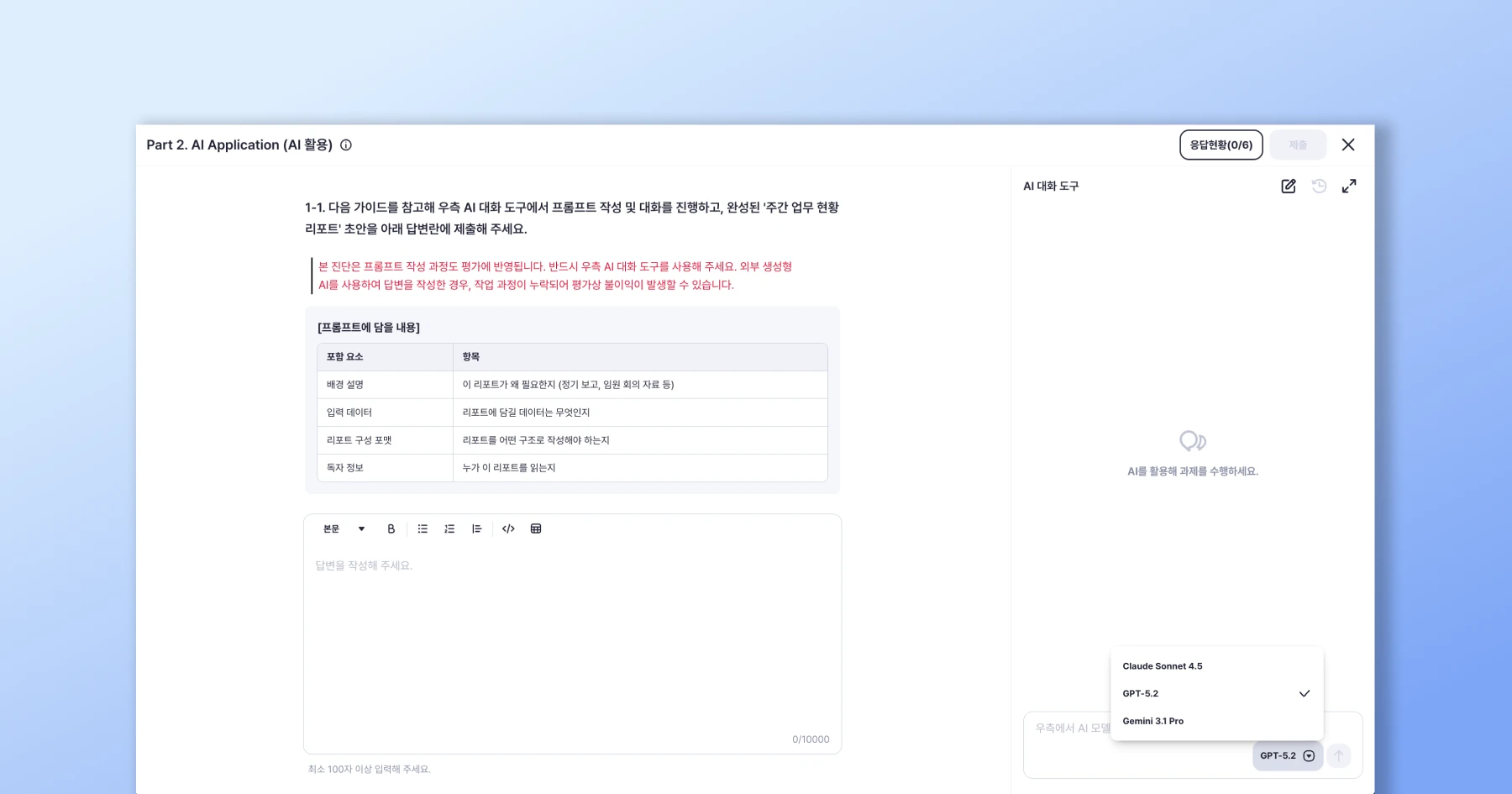
The left side of the screen presents a realistic work situation, such as “Write a weekly status report for the XX team,” along with a table of work data to draw on. The right side has a built-in AI chat tool, which participants use to write their own prompts, complete the report, and submit it.
The key is how Telta scores it. Telta doesn’t grade the finished output alone. It also evaluates the process: how participants structure and refine their prompts as they work through the task. That’s also why outside AI tools are restricted during the assessment. An answer produced elsewhere leaves out the very thing being measured: how the person used AI to get there. In other words, Telta looks not just at the answer, but at the path to the answer.
When Telta ran the same assessment with four reporters from Maeil Business Newspaper, the results echoed the KBS story. The reporter who answered the most AI knowledge questions correctly placed only third on application, while a reporter with a comparatively lower knowledge score came first overall. The results confirmed that knowing a lot about AI and using it well are clearly different competencies.
Want to see how Telta separates knowing AI from using it? Read more in the article below.
🔗 Knowing AI vs. Using It: How Telta Measures AI Competency
The Real Value of an AI Assessment Shows Up After It’s Done
For HR, though, the question that really matters is a different one: where do our people stand right now, and what do they still need to build? You can’t answer that from a score or a grade alone.
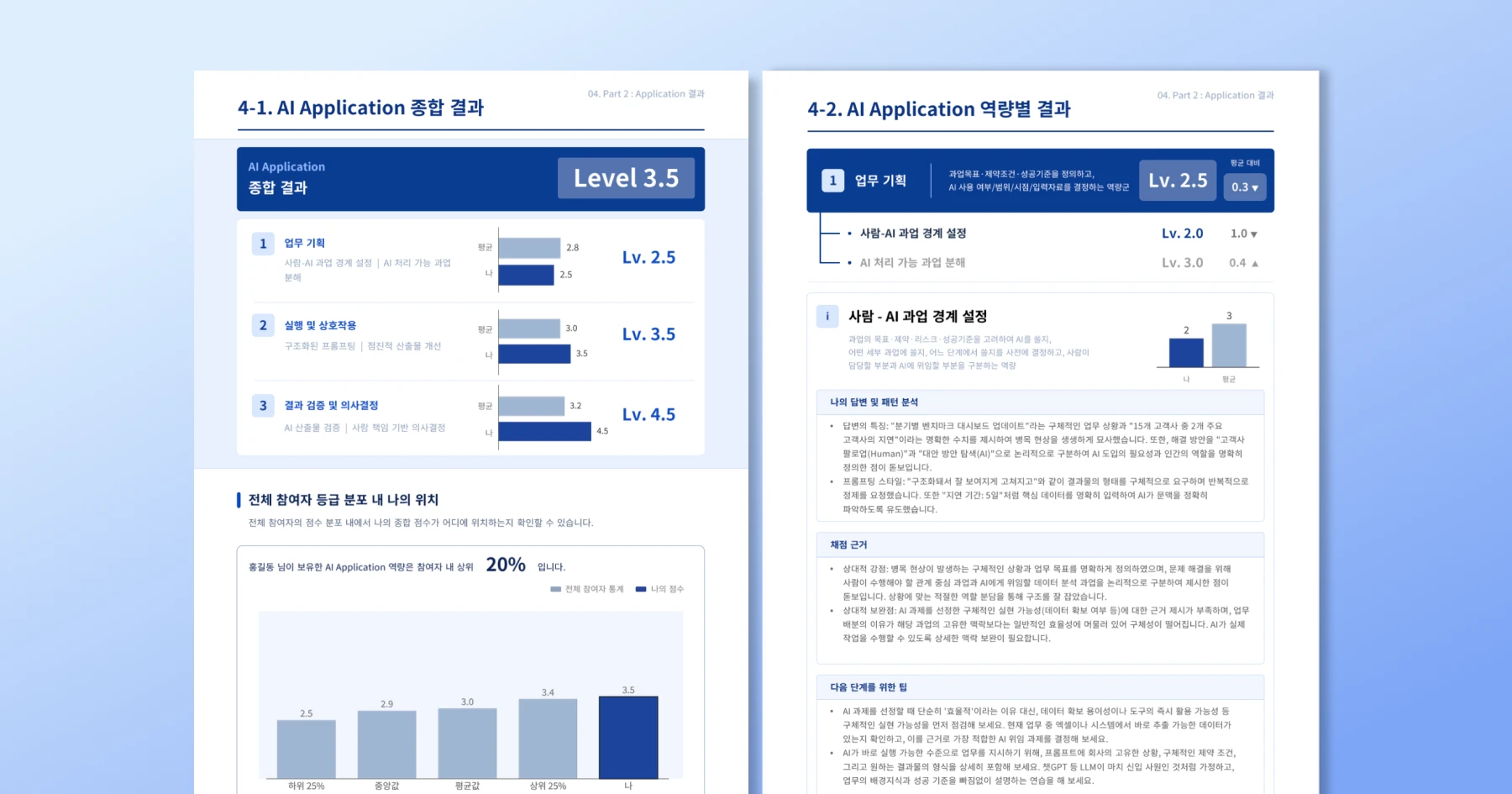
The results report from Telta’s AI Literacy Assessment is built to answer exactly that question for HR and L&D teams. It shows understanding of AI and practical application as separate levels, and it includes the evidence, pointing to the specific responses behind each judgment. That lets you make data-driven decisions about who needs which training, and whether next quarter’s AI literacy program actually moved the needle.
Where Does Your Workforce’s AI Literacy Stand Today?
The gap between people who use AI well and those who don’t now shows up clearly in their work. In the US, job postings that list AI skills as a plus have grown sevenfold over the past two years. The question is no longer “Do you use AI?” It’s “Who gets better results with AI?” Companies are already asking it.
What’s left is your organization’s answer.
How much, and how well, are your people really working with AI?
Related Reading
- Knowing AI vs. Using It: How Telta Measures AI Competency
- AI Competency Assessment Tools Compared: 4 Solutions, 3 Criteria
Related Articles
.webp)
.png)