.svg)
Skills-Based HR: A New Paradigm for Business and HR


Skills-based HR is fast becoming a must-have strategy for business survival and growth. As advances in AI and digital technology lower the barriers to adoption and amplify the payoff, many global companies have already embraced it.
The result: it is gaining attention as the surest way to secure future competitiveness, delivering positive change for both organizations and their people. This article explains what sits at the heart of this new HR paradigm and why companies should pay attention to it.
What Skills-Based HR Is and Why It Matters
What Is Skills-Based HR?
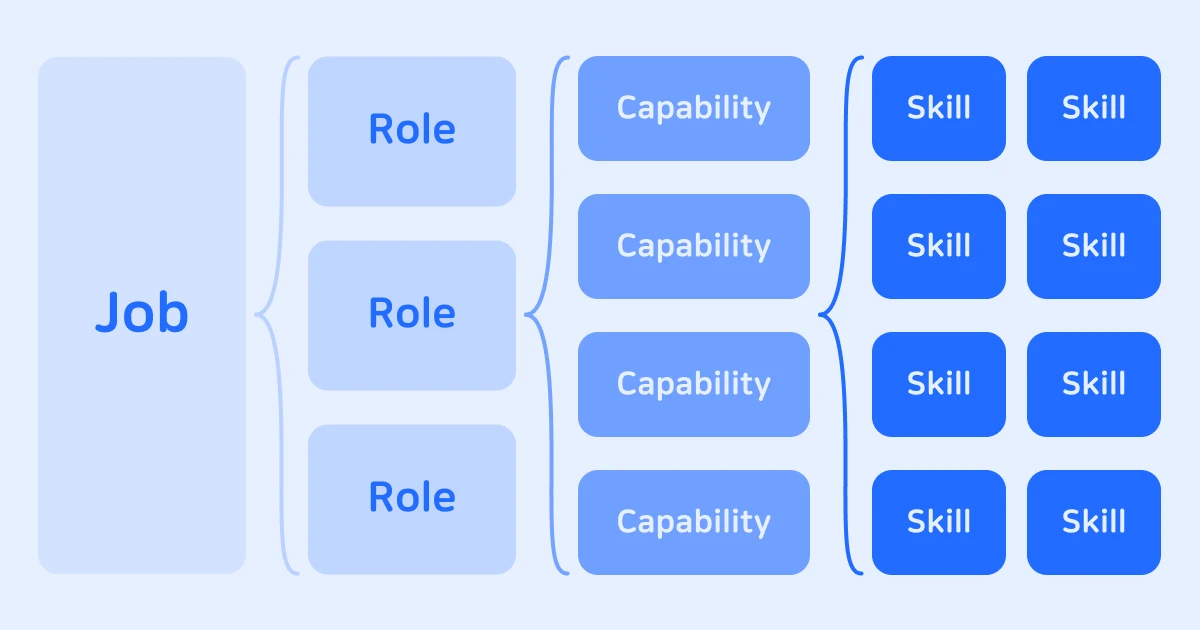
Skills-based HR is an approach that breaks down an employee’s ability to perform specific tasks into manageable units and uses those units as the basis for HR decisions. Compared with traditional competencies, which are qualitative and bundle in “knowledge” and “attitude,” skills are emerging as a more structured and measurable unit of management.
Why Skills-Based HR Is Gaining Ground
- Rapid shifts in technology and the business environment: Two-thirds of today’s jobs are exposed to AI-driven automation, and an estimated 300 million jobs could be replaced by it.
- Greater efficiency in HR work: Advances in AI have sharply reduced the time and effort required to adopt skills-based HR, lowering the barrier to entry.
- Faster change in employee roles: Between 2015 and 2022, the skill sets required for jobs changed by 25%. That pace of change is expected to double by 2027.
(Source: Goldman Sachs, LinkedIn, Deloitte)
Skills-based HR shapes not only HR itself but also an organization’s strategy and direction. It builds an environment that can keep pace with rapid change and makes HR work more efficient, which in turn lifts overall productivity and efficiency across the organization.
That is why global companies are adopting skills-based HR more aggressively. According to a 2022 Deloitte survey, 98% of business executives plan to transition to a skills-based organization, and 90% of companies are already actively experimenting with skills-based approaches.
And a 2023 Mercer survey found that more than 60% of global HR leaders have applied skills to career development, talent acquisition, or performance management. In other words, skills-based HR has moved beyond ideas and discussion and is now being used to solve real problems and improve efficiency.
3 Areas of HR That Skills-Based HR Transforms
Skills-based HR can be applied across every area of HR, and it brings different changes to each. Here is what skills change in concrete terms.
1. Talent Acquisition
Skills-based hiring evaluates candidates on their actual abilities and the skills they hold rather than on degrees or work history. Instead of education, job titles, and previous experience, the traditional gatekeepers of hiring, employers can evaluate candidates on skills that reveal how well they can actually do the job. That opens hiring to a much wider talent pool.
Skills-based hiring is also five times more predictive of job performance than hiring based on education or experience. Because it also improves role fit, it supports more stable workforce management. For organizations and managers, this is arguably the area with the biggest payoff. Adoption does require an overhaul of HR policies, however, so many companies are phasing it in gradually.
2. Learning & Development
Skills-based L&D assesses employees’ current skill levels and offers tailored training to build the skills they need. Individual skill gap analysis (the gap between required and current skills) and learning path design, combined with targeted training, make learning more efficient. Personalized career development can also do a great deal for employee satisfaction.
With skills-based L&D, an organization can anticipate the skills it will need in the future and act early, becoming more responsive to market change. Because most employees readily see the need for it, the barrier to adoption is lower than for skills-based hiring, which makes it the area where the most companies have applied skills.
3. Performance Management and Total Rewards
Skills-based performance management takes a holistic view of each employee’s current skill level and progress, and can carry those results through to rewards. Using objective skill metrics, organizations can build a fair system for evaluation and assessment. Individual results raise awareness of skill gaps across the company, and differentiated incentives based on those results encourage employees to keep growing on their own initiative.
Because skills-based evaluation feeds directly into pay, however, it is a difficult area: it requires a major overhaul of HR policies and a long effort to win employees over.
Skills-Based HR Is No Longer Optional
For the organization, skills-based HR drives productivity and efficiency. For HR, it strengthens its strategic role and makes the talent pipeline easier to manage. For employees, it means more career development opportunities, fairer evaluations, and greater employment security.
Skills-based HR is a pivotal shift for your organization’s future competitiveness. Take the first step today.
Related Reading
- A 4-Step Guide to Becoming a Skills-Based Organization
- HR’s 2025 Megatrend: The Rise of Skills-Based HR
Related Articles
.webp)
.png)