.svg)
Webinar Recap: What HR Should Know Before Investing in AI


Is your organization’s AI investment heading in the right direction?
On Tuesday, April 21, Telta hosted its first webinar, “The One Thing HR Needs to Know Before Investing in AI,” with HR leaders from a range of companies.
Questions kept coming in throughout the session, a clear sign that many people are wrestling with the same issues. For those who couldn’t join live, here’s a recap of the session along with the full Q&A.
Session 1/ Why the More You Invest in AI, the Harder It Gets for HR to Show Results
You’ve run the training and rolled out the tools, yet nothing seems different on the ground. If you work in HR, you’ve probably felt this at least once.
Data Telta collected from employees at Korean companies shows that more than 85% of respondents felt AI had made them at least 10% more efficient. At the same time, concerns about security and data leaks (25.9%) and dissatisfaction with output quality (24.3%) emerged as the main bottlenecks holding back AI use. People are using AI and feel more efficient, but no one knows whether that efficiency is translating into organizational results. Without a way to measure it, you can’t tell whether your investment is on the right track.
Session 2/ The Reality, According to Korean Company Data
The most striking data point from the webinar was the relationship between how often people use AI tools and how well they use them.
More than 70% of participants used AI almost every day, yet even within that daily-use group, actual AI proficiency ranged across the full spectrum, from 3.4% to 73.4%. Using AI more often doesn’t mean using it better.
Knowing About AI and Using It Well Are Not the Same

There was also an 11-percentage-point gap between AI knowledge and actual AI application. In other words, knowing and doing turned out to be entirely different competencies.
In addition, 58% of participants lacked clear standards for recognizing AI risks, and the daily-use group was no exception. A sense for using AI safely doesn’t come from experience alone.
The data discussed in the webinar comes from Telta’s AI Literacy Report 2026, based on our assessment of 130 employees at Korean companies. To learn more about our research and assessments, explore our resources.
👉 Browse Telta Resources
Session 3/ So What Should HR Do First?
Neither AI usage frequency nor training completion rates explain where your organization really stands. You only find out by looking at how people actually use AI in their work. Telta looks at this at two levels: the individual and the organization.
AI Literacy Assessment: Measuring Individual AI Competency
It measures each employee’s real-world proficiency along two dimensions: AI Understanding and Risk Awareness (technical understanding, risk awareness, tool selection) and AI Application (Plan-Execute-Review). Alongside multiple-choice questions that test knowledge, it includes open-ended questions based on work scenarios, so we can analyze how people actually think.
AX Readiness Assessment: Pinpointing Organizational Bottlenecks
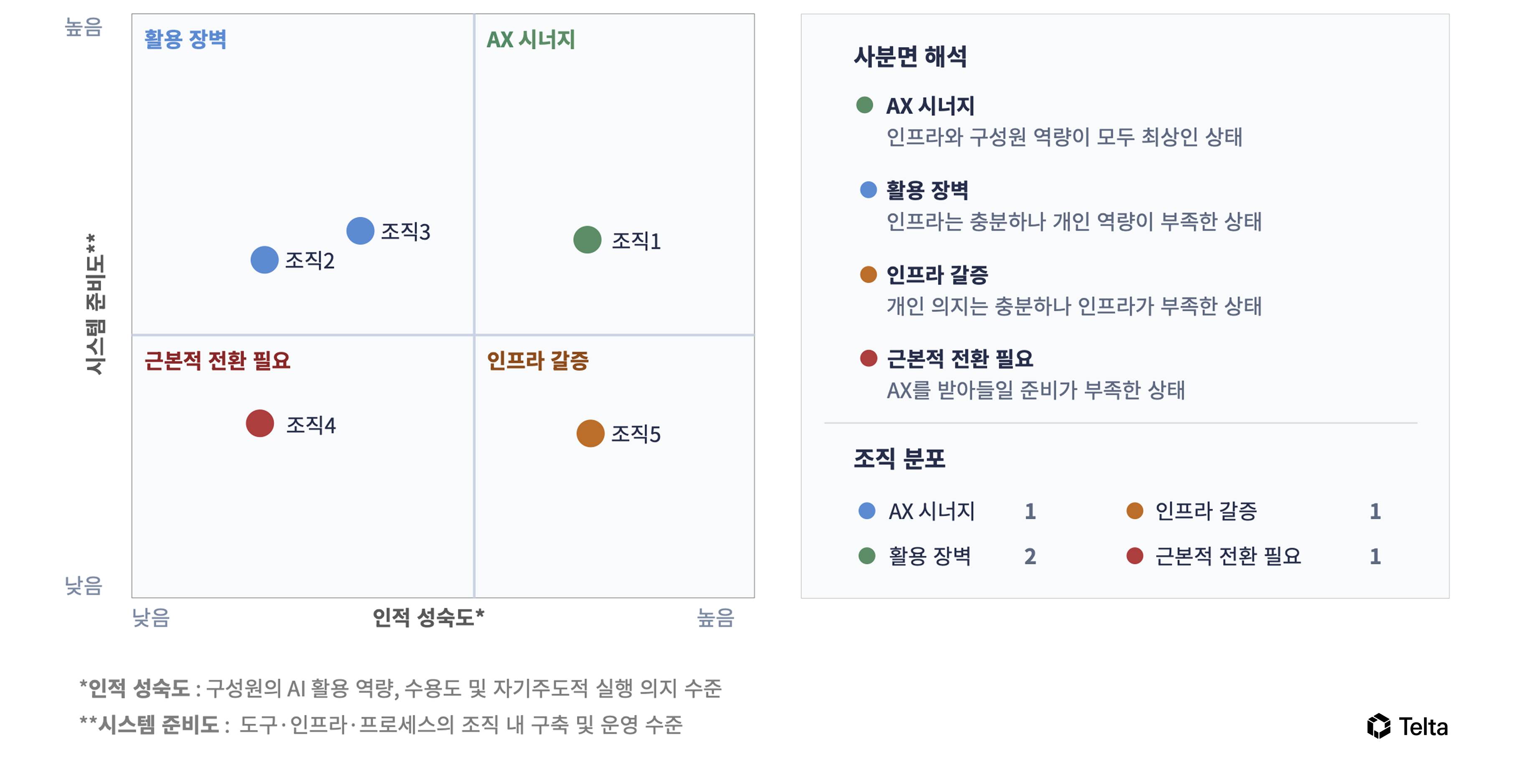
Telta’s AX Readiness Assessment measures an organization’s readiness for AI transformation across six competencies, including AI strategy execution, growth environment, and psychological safety. The accompanying report shows at a glance where each unit’s bottleneck lies: whether it has reached AX synergy, has the infrastructure but faces adoption barriers, or has willing people but lacks infrastructure.
When a well-differentiated assessment shows you where your organization really stands, HR’s next decisions can change. You can tell whether to offer more training, or whether organizational interventions such as leadership or psychological safety need to come first.
11 Questions From the Live Q&A
Q1. What goes wrong when an organization mistakes “knowing” for “doing”?
You get too many cooks in the kitchen: lots of people talking, and the project drifts off course. Plenty of people can say they know AI, but the ones who actually deliver results on the job are a different group. Just as a high TOEIC score doesn’t mean someone can run a meeting in English, conceptual understanding and practical application are different competencies.
When an organization confuses the two, it falls into the illusion that “we’re already using AI well,” and the real bottlenecks go unaddressed. The more training you pour in without assessment, the wider that gap inevitably grows.
Q2. What is Telta’s AI proficiency standard based on?
Telta took a rigorously data-driven approach. We analyzed 2024–2025 job postings from 30 global companies (based on Fortune AIQ) that have deployed AI in their business and seen it pay off financially.
Excluding AI engineering and ML roles, we extracted how AI-related requirements have changed for general roles in manufacturing, finance, retail, marketing, and more. We then mapped those findings to frameworks from credible institutions such as OpenAI, Anthropic, and Stanford to build the Telta AI Skills Taxonomy. Think of it as a practical structure that layers real market demand on top of solid theory.
Q3. We rolled out Copilot company-wide, but employees aren’t really using it. What works for employees who resist AI?
With 100 employees, there are 100 reasons for resistance, and persuading people one by one isn’t realistic. The key is to replace vague “let’s give it a try” slogans with small wins tied to each person’s actual work.
The fastest way to reduce resistance is to have people find tasks in their own work they can hand off to AI, try it, and get tailored feedback on the results. That’s why an approach rooted in each person’s work context beats one-size-fits-all training. Focus on helping each employee see what AI means for their own work, and you’ll be able to drive the change you’re after.
Q4. What exactly is AI literacy? I’m not sure whether it means tool skills, data skills, or understanding LLMs.
All three are part of AI literacy, but none of them is the whole picture. Telta defines AI literacy as the thinking and judgment needed to work with AI in a real work context. Just as you can set up and use a smartphone for your needs without reading the manual cover to cover, what matters is understanding why AI produces the results it does and what judgment calls you can make in a given situation.
Specifically, it includes recognizing AI’s limits, choosing the right tool for the right purpose, designing and delegating tasks to AI in real work, and critically reviewing the output.
Q5. How do the individual AI Literacy Assessment and the organizational AX Readiness Assessment each work? Can a survey really produce meaningful data?
The individual AI Literacy Assessment uses multiple-choice questions based on theoretical knowledge and experience, along with open-ended questions based on work scenarios, to analyze how participants think.
The organizational AX Readiness Assessment is survey-based, but it doesn’t use Likert scales. Surveys work well for gauging perceptions, but measuring real capability requires behavior-based question design. The assessment uses behaviorally anchored rating scale (BARS) items describing behaviors you can observe in real work, organized around six competencies: AI strategy execution, growth environment, psychological safety, collaboration ecosystem, leadership, and AI integration into daily work.
Q6. How can assessment results actually feed into training design?
The results show that everyone’s bottleneck is different. Some people can’t do structured, iterative refinement; some don’t know how to give feedback on AI output; others can’t plan how to delegate a task to AI in the first place. That’s why the same training works for some people and not for others.
Telta goes as far as matching people with training providers based on their individual results. When four reporters from Maeil Business Newspaper’s digital tech desk took Telta’s AI Literacy Assessment, only one of them actually needed training. It was a clear case of the group splitting into people who needed training and people whose needs could be met with a checklist or a process fix.
Q7. Can the results also be used in hiring or performance evaluation?
It depends on the goal. In hiring, an assessment based on a simulated work task can verify a candidate’s real AI proficiency. Some of Telta’s current clients use it to identify, before hiring, which candidates are likely to become bottlenecks after they join.
In evaluation, you can turn Telta’s competency framework into evaluation criteria and track growth with reassessments every six months. For development, you can design individual feedback together with matched online and offline training.
Q8. When assessing AI competency company-wide, how should we set priorities?
Start by plotting a quadrant on two axes: people maturity (employees’ AI proficiency, receptiveness, and willingness to act) and system readiness (how well tools, infrastructure, and processes are in place). You’ll see at a glance which units have reached AX synergy, which have the infrastructure but face adoption barriers, and which have willing people but lack infrastructure. The starting point for a company-wide assessment is identifying where the bottlenecks are, then designing an approach that fits each quadrant.
Q9. Specifically, how did Telta develop its AI competency standards?
We collected 2024–2025 job postings from 30 AX leaders selected by Fortune. Excluding technical roles such as AI engineering and ML, we extracted and analyzed only the AI-related requirements for general roles in manufacturing, finance, retail, banking, and more.
Rather than simply counting keywords, we used LLMs to refine the data based on meaning and context, then mapped it to global frameworks. The goal of the process was to close the gap between theoretical standards and what the market actually demands.
Q10. To connect individual productivity gains to organizational performance, what should we measure, and how?
Even if you work faster, the overall flow won’t change if the people before you or next to you are the bottleneck. A company is a place where many people create results together. When individuals boost their efficiency with AI, start by checking whether that carries through to colleagues at the same level of quality, and whether bottlenecks in the organization’s collaboration flow are disappearing. Individual assessments alone won’t show you that bigger picture. That’s why you need organization-level assessment as well.
Q11. Expectations for AI proficiency will differ by department and role. In a company-wide assessment, what criteria should we use to set priorities?
It’s true that different roles require different levels of AI proficiency. That’s why, at the company level, Telta recommends screening the whole organization using the quadrant before setting role-specific standards. Identify which units and departments fall into which quadrant, then start with the areas where bottlenecks are concentrated. Detailed role-specific standards can be sharpened in the next phase.
Related Reading
- Logistics Case: Assessing AI Literacy in a Global Firm’s Key Talent
- Even KBS Reporters Took the Test: Companies Now Verify AI Skills Directly
Related Articles
.webp)
.png)