.svg)
SK hynix Moves to Half-Day Interviews: Why Interviews Are Getting Tougher


SK hynix has introduced a new interview format for its rolling entry-level hiring. Starting in August 2026, the company announced, it will drop the personal statement (application essay) stage and the short 20- to 30-minute interview, and introduce half-day in-depth interviews (in Korean) instead.
Across the hiring market, there is growing recognition that application screening and short interviews alone can’t adequately verify a candidate’s real competencies. In response, companies are changing the interview format itself to assess competencies more precisely.
In this article, we look at why companies need to strengthen their interviews, and how to evaluate interviews so you get an accurate read on a candidate’s competencies.
Article Preview
- Application materials and short interviews alone can’t adequately verify a candidate’s real competencies. Companies are strengthening interview evaluation to make more accurate hiring decisions.
- To judge a candidate’s true competencies, set clear evaluation criteria before the interview, record what the candidate says objectively during it, and afterward organize that record into scores and evidence for each competency.
- Telta Interview Pro records the interview, suggests follow-up questions, and generates an evaluation report, helping you assess candidates’ competencies more systematically.
Like SK hynix’s Half-Day Interviews: 2 Reasons Companies Are Strengthening Interviews
Why are companies that lead in talent acquisition, like SK hynix, investing more time and money to strengthen their interviews? There are two main reasons.
1. Short Interviews Alone Can’t Fully Reveal a Candidate’s Competencies
Each candidate typically gets 30 minutes to an hour of interview time. Within that window, it’s hard to review their application, exchange questions and answers, and accurately judge their on-the-job competencies all at once.
When a decision based on limited information turns out wrong, the cost to the company grows. According to a U.S. Department of Labor report, the cost of a bad hire is at least 30% of the employee’s first-year salary. That’s why companies need stronger interview evaluation to make more accurate decisions.
2. Applications and Well-Rehearsed Answers No Longer Set Candidates Apart
As generative AI has become ubiquitous, it’s now routine to prepare personal statements, pre-interview assignments, and even answers to expected interview questions with AI. According to a survey by Novoresume, a global résumé-building platform, 42.6% of Americans used AI on their most recent résumé, and those who did were three times more likely to include false information than those who didn’t.
Now that anyone can submit polished application materials and arrive with well-crafted answers to expected questions, applications and prepared answers alone make it hard to tell candidates apart. The discriminating power of traditional hiring evaluation itself is weakening.
That’s why the interview now has to evolve from a routine step into a deeper, more rigorous stage of the process. Instead of simply listening to rehearsed answers, interviewers need to use real-time follow-up questions and specific scenarios to verify firsthand whether candidates can actually solve problems, and whether they have the role-specific competencies, AI skills, and logical thinking the job requires. Google CEO Sundar Pichai’s statement that Google will require at least one in-person interview, citing candidates’ use of AI, reflects the same thinking.
3 Stages of Interview Evaluation for Judging a Candidate’s Real Competencies
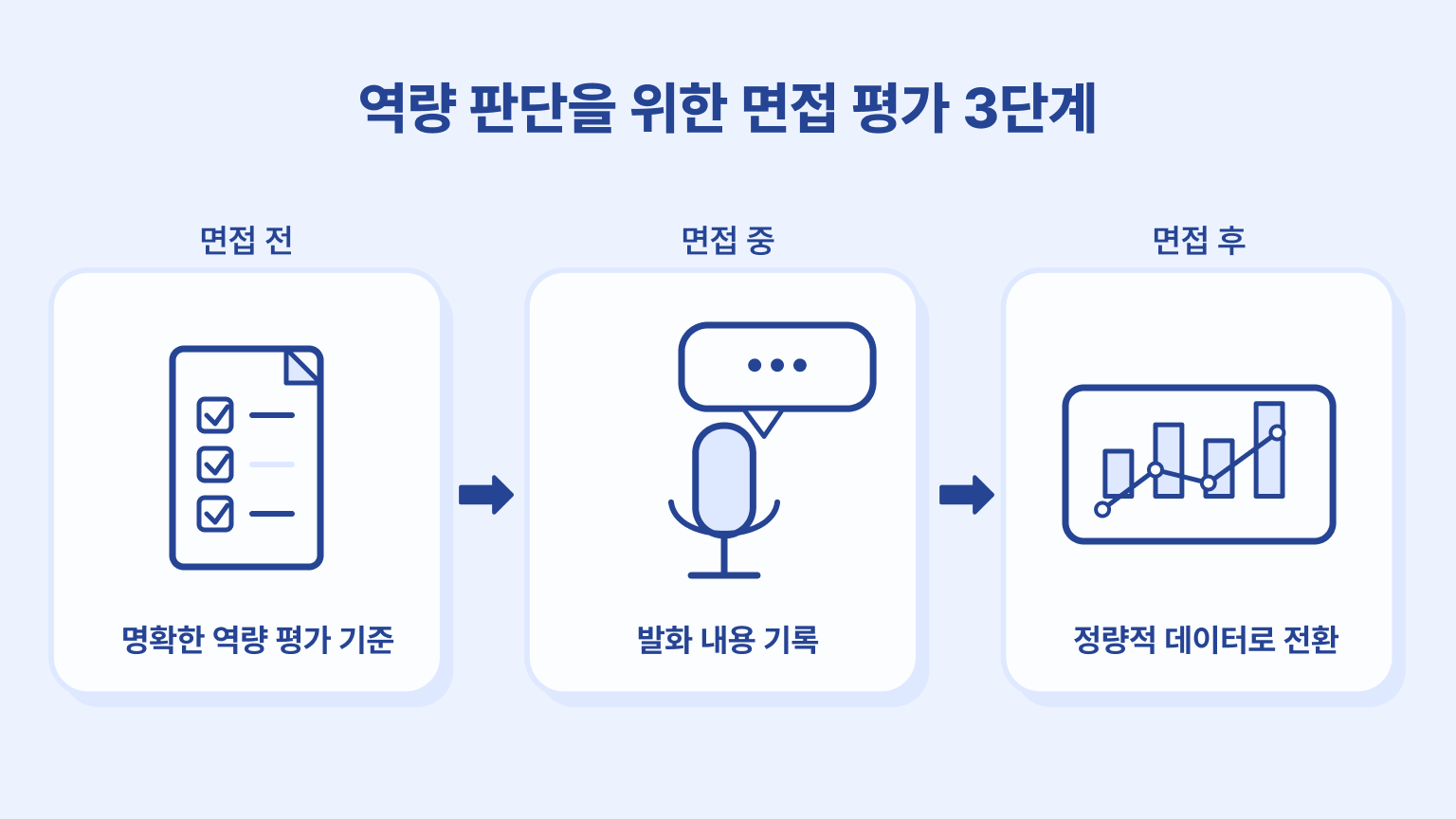
1. Before the Interview: Set Clear Competency Evaluation Criteria
Before the interview, use the job description (JD) to decide which competencies you’ll assess and against what criteria. Without criteria, ratings can swing with the interviewer’s subjective views or the candidate’s first impression.
For example, if you’ve defined the core competencies as problem solving, communication, and job expertise, we recommend deciding in advance which questions will test each competency and what level of answer you expect. That reduces the chance of each interviewer using a different standard and lets you judge candidates’ competencies consistently.
2. During the Interview: Capture What the Candidate Says as Evidence
During the interview, it’s important to record what the candidate actually says as objectively as possible, rather than relying on the interviewer’s memory or subjective summary. With a record of what was said, interviewers whose ratings differ can reconcile their views based on clear evidence.
3. After the Interview: Turn a Qualitative Conversation into Quantitative Data
After the interview, use the criteria you set in advance and the record of what the candidate actually said to organize the qualitative conversation into scores and specific evidence for each competency. For example, instead of stopping at an impression like “their communication seemed good,” convert the evaluation into quantitative data such as “Communication: 82” and “Initiative: 72.” Once a candidate’s competencies are captured as data, the final hiring decision can rest on evidence.
Related Reading
- What Is a Structured Interview? How to Reduce Rating Gaps Between Interviewers
- Why SK hynix Dropped Degree Requirements: 3 Competencies for the AI Era
Assess Candidates’ Competencies with Telta Interview Pro, an AI Interview Solution
We’ve walked through interview evaluation step by step, but applying all of it in real time within a short interview isn’t easy for interviewers. If you want to judge candidates more accurately in limited time, Telta Interview Pro can help. Telta Interview Pro is an AI interview solution that supports everything from recording the interview to suggesting follow-up questions and generating an evaluation report, so you can run interview evaluation more systematically.

Records Interview Answers and Suggests Follow-Up Questions
Telta Interview Pro records the candidate’s answers in real time during the interview and picks up signals related to role-specific competencies in what they say, supporting the interviewer’s judgment. It also recommends follow-up questions that fit the context of the conversation, so you can probe a candidate’s competencies more deeply even in a short interview.
Analyzes the Interview and Reports on It to Support Objective Evaluation
After the interview, it automatically generates an evaluation report with scores and detailed evidence for each role-specific and core competency, based on what the candidate actually said. That lets you assess a candidate’s key competencies more objectively within limited interview time.
If you want to judge candidates more accurately in limited time, start verifying their competencies systematically with Telta Interview Pro.
Related Articles
.webp)
.png)