.svg)
Why Telta’s AI Literacy Assessment Tracks How People Think


AI Transformation: The Persistent Gap Between Vision and Execution
In 2026, one theme ran through the New Year’s addresses of Korea’s major companies: AI transformation (AX). Leaders announced bold plans to embed AI in nearly every business process. Yet when HR has to turn that vision into action, the first step usually stops at AI training and prompt-writing workshops.
The real problem comes next. Training budgets keep growing, but it’s still unclear how far along the organization is on its AI roadmap, or whether the training is producing real results. Successful AI transformation requires knowing how much, and how, people are actually using AI today. Many organizations are running without knowing where they started.
AI Literacy Assessment: A Clear Starting Point for a Vague AX Agenda
That uncertainty is naturally pushing companies to check the return on their investment. Instead of charging ahead, they’ve started to take an honest look at where they actually stand.
But look at the market and the options are few. Most of the assessment tools that do exist are multiple-choice quizzes testing basic knowledge, such as “What is an LLM?”
So is a knowledge-based test really the best way to gauge your organization’s AI literacy? Before you assess anyone, it’s worth taking a hard look at the limits of the multiple-choice format, since it’s the first option most teams encounter.
Why Multiple-Choice Tests Can’t Find Your High Performers
Many AI competency assessments on the market focus on multiple-choice questions like “What is the definition of an LLM?” or “Which of the following is an appropriate ethical guideline for generative AI?” These questions can show how well someone understands AI, but they can’t tell you whether that person can apply it.
Will an employee who aces a right-answer test also be able to solve complex problems with AI on the job? There’s no way to know. Knowing what something is and getting work done with it are entirely different things.
When you work alongside AI, there is no single right answer. What determines real AI literacy is the ability to shape AI output to fit the context and map out the best path forward. Call it thinking muscle.
Two Conditions for Proving AI Literacy
To measure AI literacy properly, two conditions have to be met.
First, you need to be able to observe or record how a participant defines and works through a problem in an ambiguous situation with no predetermined answer.
Second, you need rigorous criteria that can turn that qualitative process into quantitative data.
(1) Telta’s AI Literacy Assessment Evaluates the Process, Not Just the Answer
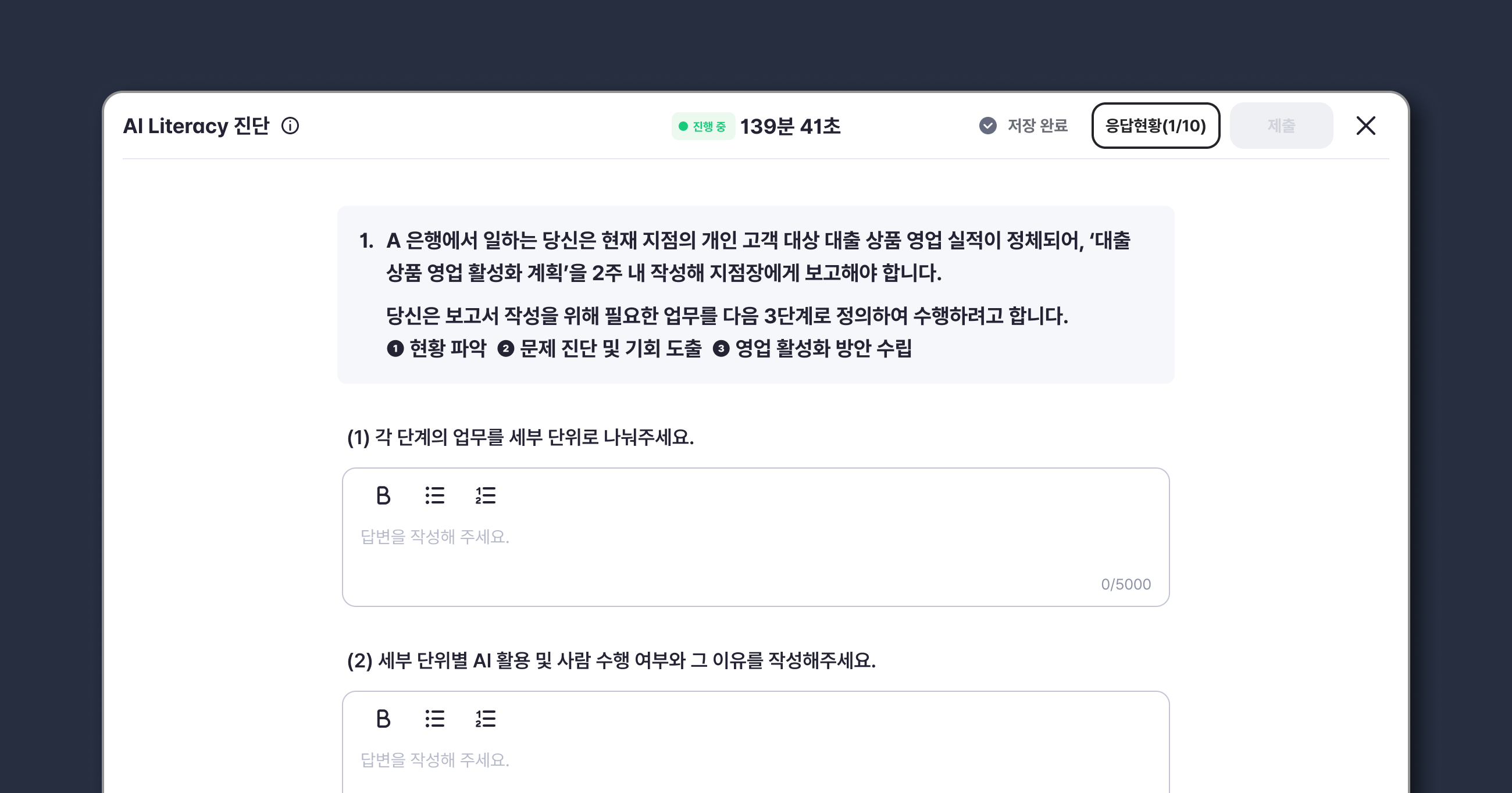
To meet the first condition, observing the process, Telta uses scenario-based, open-ended questions. Rather than simply asking what participants know, it directly examines and analyzes the thinking muscle they use when working with AI on real tasks: how they define the problem, the logic behind their prompts, and how critically they review the output.
Each participant’s recorded thinking process is then converted into objective metrics through Telta’s AI Skills Taxonomy. The assessment gives organizations an honest read on their AI literacy level and a solid starting point for turning vague transformation goals into concrete action.
(2) Rigorous Criteria Built on Leading Global Frameworks and Real-World Data
Objective evaluation criteria matter as much as assessing the process itself. They are the second condition for proving, with data, what AI literacy actually looks like.
Telta started by building the backbone of its evaluation on more than 10 leading global frameworks. In a field like AI literacy, where there are no right answers, we believed the standard had to be one anyone could trust.
Academic frameworks alone, however, can’t keep up with how quickly business is changing. To close that gap, Telta broke down real job postings from global AX leaders (based on Fortune AIQ) and added the core AI skills they call for.
By layering real market demand on top of widely accepted standards, Telta built an AI Skills Taxonomy that bridges theory and practice.
With criteria this solid behind it, an assessment can do more than hand out scores. It becomes the starting point for planning how the organization grows.
A Results Report That Becomes Your Organization’s Growth Roadmap
Telta’s AI Literacy Assessment doesn’t stop at labeling people high or low. Using the AI Skills Taxonomy, it analyzes each participant’s strengths and weaknesses in detail and delivers a 15-page report. With that data, HR can build individual development plans, define an AI tool strategy that fits the organization, and plan the company’s AI transformation in concrete terms.
Related Reading
- Knowing AI vs. Using It: How Telta Measures AI Competency
- Workplace AI Literacy: What Exactly Should You Assess?
Telta: The Most Precise Compass for AI Transformation
Successful AI transformation may not depend on flashy technology. It starts with looking closely at how your people actually think when they use AI, and how deep that thinking goes. Bad data can send an entire organization in the wrong direction.
Telta is here to be a reliable partner as companies and their people make that change the right way.
Related Articles
.webp)
.png)